 Between 1830 and 1840 Clinton County, NY, had a population of less than 30,000 and Plattsburgh had approximately 1,000 families. Andrew Jackson was President, the area was humming with new businesses, and local men and women were discussing the news of the day in lyceums, public forums which featured lectures and debates.
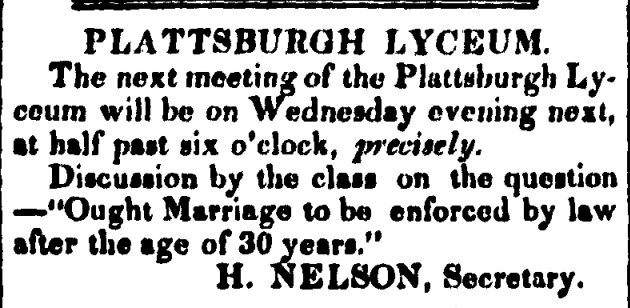
In Plattsburgh, the local Academy provided semi-monthly Wednesday evening discussions organized by the Plattsburgh Lyceum. Topics were current, most times relevant, sometimes historical, and sometimes just floating an opinion, like: “Is love a stronger passion than hate?” or “Should marriage be enforced after the age of 30?”
In August of 1833 the question was “would the immediate manumission of all slaves be a politic measure?”
Coincidentally, at the same time, there was a declaration in the Plattsburgh Republican on August 3rd by the Presbyterian Church concerning formerly enslaved people.
Led by Benjamin Mooers, members of the church resolved that since freed slaves had no rights, were fleeing the slave states, and were “unsound and may become a dangerous portion of our community,” the American Colonization Society should continue to return free Black Americans to Africa.
Involved in the lyceum’s “immediate manumission” discussion were Dr. Edward Kane, John Blanchard and George Beckwith, all on the Clinton County Common School Association, of which Mooers served as president.
Further to the manumission issue and several years later, the same Plattsburgh Lyceum debated whether or not the American Colonization Society actually injured those whom it hoped to serve.
Horace Boardman, a local abolitionist, argued it did not and in November of 1835, the local Methodist Episcopal Church went on record as strongly supporting the work of the Society.
September of 1833 would have marked 50 years since the end of the American Revolution, and a lyceum debate was reflecting on whether the revolutionaries were “justified in taking possession of this country in the manner they did?” Local attorney I.W.R. Bromley was on the affirmative side and C.C. Severance, a judge from Western New York, argued the negative.
In Plattsburgh this could have been an interesting question, depending on who the debaters identified as originally having possession – the French, the British, or Indigenous People.
The topic of Indigenous lands continued to be relevant to lyceum members. Ladies and gentlemen were invited to attend an October 1833 lyceum debate on whether “Georgia was justifiable in treating the Cherokee Indians in the manner she did?”
This debate would have been triggered by the 1832 Supreme Court case, Worcester v. Georgia, which denied the State of Georgia the right to expel the Cherokee from their lands.
Chief Justice John Marshall had argued that the Cherokee Nation was a distinct, sovereign community with its own territory, where Georgia’s laws had no force, affirming that only the federal government had authority over Indian affairs. The result was that Jackson refused to enforce the decision and allowed Georgia to remove Indigenous people from their homes.
(The widely-repeated quote “John Marshall has made his decision; now let him enforce it” is almost certainly apocryphal, having first appeared in print only in 1864, though it is widely considered a paraphrase of Jackson’s attitude.)
The lyceum debated the question as to whether Georgia was justified in trying to remove Indian people. The lyceum audience in 1833 could not have been aware that the issue was not settled by the Supreme Court’s decision.
In 1835 the Treaty of New Echota was ratified. A fraudulent agreement signed by a small, unauthorized minority of Cherokee (known as the “Treaty Party”) rather than the official Cherokee leadership, ceded all tribal lands east of the Mississippi River for $5 million and land in Oklahoma.
It was ratified by the U.S. Senate by a single vote, providing the legal basis for the forced removal of some 60,000 Cherokee, Muscogee, Seminole, Chickasaw, and Choctaw on the Trail of Tears, resulting in an estimated 13,200–16,700 deaths.
President Jackson himself was occasionally the direct subject of the local lyceum debates. In November of 1833, the debate question posed was whether in 1818 Jackson had justifiably insisted on the execution of Robert Ambristor, a British citizen charged with aiding the Seminole and Creek tribes during the First Seminole War in Spanish Florida.
Congress had condemned the incident at the time, but it’s unknown how the lyceum debate concluded 15 years later.
 Jackson’s name may have appeared again during an 1835 lyceum debate on whether dueling was justified. Those in attendance would have been aware of two widely-known and debated duels – Aaron Burr and Alexander Hamilton in 1804 and Jackson’s 1806 dual with Charles Dickinson.
The Burr-Hamilton duel, between then Vice-President Aaron Burr and former Treasury Secretary Alexander Hamilton was the culmination of long-standing political disputes. Hamilton had been in some dozen other “affairs of honor” before being killed by Burr’s pistol. His eldest son, whom he had with Elizabeth Schuyler Hamilton of Albany, was killed in a duel with George Eacker near the same spot in Weehawken, NJ, at the age of 19, just three years earlier.
The Jackson-Dickinson duel was over another long series of disputes, supposed to have begun with a gambling quarrel in 1805; Dickenson was killed and Jackson wounded. While it’s often claimed that Jackson was involved in as many as 100 duels, historians believe the number is closer to a dozen. However, Jackson was notorious for his quick temper and engaging in violent disputes, and was involved in many more affairs of honor that did not end in a formal duel.
Although New York State had outlawed dueling in 1801, and stiffened penalties in 1806, it remained a valid topic for a lyceum discussion. Prominent New Yorkers largely abandoned dueling but the practice continued in more informal way, such as the (relatively few) face-to-face “quick-draw” gunfights of the Old West.
(The 1859 Broderick–Terry duel in California, a dispute over slavery between United States Senator David C. Broderick and ex-Supreme Court of California Chief Justice David S. Terry, is considered the last prominent duel in the U.S.).
There were no recorded outcomes of these debates, but the topics remain a reflection on the era. For example, “Ought corporal punishment be inflicted for petit larcenies?” Corporal punishment was used in schools at the time, and also against enslaved people and criminals, yet the question dealt specifically with petty thefts.
Texas independence was a topic, as was the connection between the Roman Catholic Church and the Republican Party. Although the Party had formed in the mid-1850s over stopping the extension of slavery into newly organized territories and states, the new party included a large number of former nativist “Know-Nothings.”
Other topics offered the possibility for amusement and a discussion without the availability of actual facts. Do ghosts appear? Should all superstition be removed from the mind of mankind? Does the pulpit afford a better field for eloquence than the Bar? Are not tornadoes, earthquakes and other natural convulsions the result of celestial management?
The lyceums did not escape criticism through letters to the editor, but the format persisted, with twists and turns, providing what has been described as the “mental entertainment” of the times.
Sometimes lectures were given of an entirely local nature, such as Judge Williams’ 1833 lecture on the iron mines in Clintonville and Postmaster General St. John B.L. Skinner’s dissertation on the Battle of Plattsburgh.
Not published was Dr. Kane’s lecture on the pseudoscience of phrenology, a topic covered several times and a theory only beginning to be discredited.
John Warren contributed to this essay.
Illustrations, from above: A Lyceum article from the April 28, 1840 Plattsburgh Republican; and an illustration from “An account of some of the bloody deeds of General Andrew Jackson,” ca. 1828, Sir Emil Hurja Collection, Tennessee Historical Society.
Source link