 After World War II, the taste for rustic architecture that defined the interwar period of New York’s state park design began to wane. This also happened across the National Park Service system, which fully embraced modern architecture in the mid-1950s.
There were many reasons for rustic architecture’s declining popularity: loss of federal labor, which had been available through programs like the Civilian Conservation Corps; the emergence of more cost-effective construction materials, such as concrete and steel; and the need to rapidly and economically build out parks that had languished during World War II.
 Underlying these developments was a major paradigm shift in American architecture. The newly popular European Modernism and International Styles rejected traditional forms, styles, and ornamentation.
These styles favored geometric forms, structural clarity, and modern materials. The circumstances of the postwar period also aligned well with architectural modernism; rustic architecture was more costly, more labor-intensive, and required specialized work to maintain.
Nevertheless, strains of the rustic tradition carried into the postwar era, particularly in the state parks with an established rustic theme. A more streamlined and decidedly modern design program emerged in the 1950s before fully flowering in the Nelson Rockefeller period of the 1960s, when modernism found full expression in the state park system.
Subtle Shifts in Rustic Designs
At state parks such as Letchworth State Park and Hamlin Beach State Park, architectural rusticity already defined the built environment, and carried into the postwar era. Yet subtle differences distinguished the prewar rustic mode from postwar styles.
 At Letchworth, where the park landscape has remarkable rustic buildings, circulation paths, and wayside features, buildings like the 1951 restroom at Inspiration Point exhibit the scale, traditional gable-roofed form, and stone exterior typical of earlier work. However, the nature of the stonework sets it apart from prewar work.
Identical stonework, consisting of a matrix of coursed, rectangular-shaped stone interspersed with larger stones that rise multiple courses is also found on the 1959 contact station at the park’s Portageville entrance.
At Hamlin Beach, regionally quarried Medina sandstone from Orleans County was used extensively for the park’s rustic architecture. That tradition continued into the postwar period, as seen in the 1951 contact station.
 Despite its natural material palette of rough-hewn sandstone walls and slate-shingle roofing, it exhibits a streamlined profile and glass-enclosed contact booths indicative of contemporary trends.
Blended Styles
 John Boyd Thacher State Park witnessed considerable development during the 1950s due to increasing visitation.
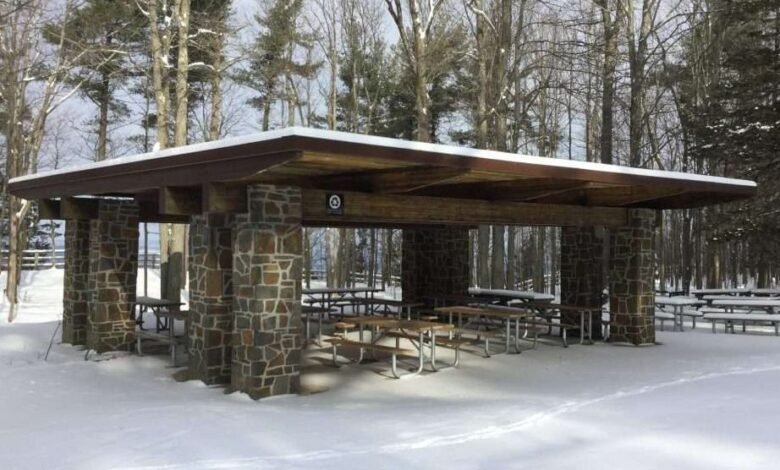
Buildings constructed during this era at Thacher represent a convergence of rustic and modern design impulses. They include the Glen Doone picnic shelter (ca. 1950), which features paired bluestone piers that sustain large horizontal beams of glue-laminate construction supporting the pavilion’s flat, overhanging roof. Wood “glulam” construction was a commonly used building technique for state park buildings in the postwar era.
The Horseshoe 1 pavilion (ca. 1955) features the same general design as the Glen Doone, but includes wood panels with a herringbone motif between the sets of masonry piers. Both shelters are expressive of park postwar design, in which existing rustic principles were informed by modern tendencies.
 Also notable is the Glen Doone concession building (c. 1950), built with a terraced patio of interlocking geometric forms. The building’s shape recalls a carousel, with a round central mass from which extends a broad 12-sided roof, providing shelter for the benches ringing the feature’s circular concrete base.
The deeply overhanging roof appears cantilevered, but bears on slender circular metal supports. Unlike the picnic shelters, restrooms, and other buildings erected during this era, the concession building shows little in the way of rustic sentiment or treatment.
Staff Design in Central Region
 In the late 1940s, the Central State Park Commission, which had operated out of offices in Binghamton, decided to build a new administrative building. The 1951 building at Clark Reservation State Park in Jamesville, Onondaga County, placed the offices on state park land and in a centralized regional location.
Designed by Parks staff, a view of the building was published in the Conservation Department’s 1950 annual report. The building’s strongly geometric form is evident, consisting of interlocking cubic and rectangular masses, the main sections being flat roofed. While the exterior is stone, ornamentation is absent, and windows are treated more as long ribbons than individual units.
The commission met for the first time in the building in August 1951, at which time it was noted “that the General Manager [Leonard L. Huttleston] and his design and construction staff should be congratulated for completing such an attractive and useful building for Commission headquarters.”
Bill Krattinger is Historic Preservation Project Director at the Office of Parks, Recreation and Historic Preservation (State Parks). A version of this essay first appeared on the New York State Parks & Historic Sites Blog.
Illustrations, from above, from State Parks: Example of rustic style, as shown in the park office at Tallman Mountain State Park; 1951 Restroom building, Inspiration Point, Letchworth State Park; 1959 contact station at the Portageville entrance of Letchworth State Park; 1951 contact station, Hamlin Beach State Park; ca. 1950 Glen Doone picnic shelter, John Boyd Thacher State Park; ca. 1950 Glen Doone concession building, John Boyd Thacher State Park; and the design of 1951 State Parks Central Region administration building from the Conservation Department Fortieth Annual Report, 1950.

Source link