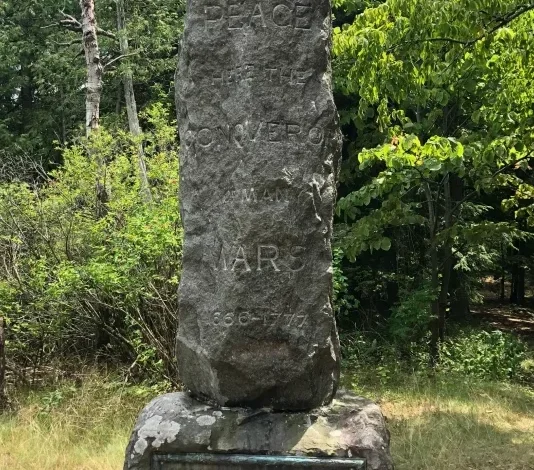
 In 1901, Saratoga Springs’ Katrina Trask (1853–1922) purchased Lake George’s Diamond Island for the reported sum of $750. Three years later in 1904, Ms. Trask, an ardent pacifist, funded the creation of a large granite peace obelisk that was installed at the north end of the island.
Standing 11 feet tall and 2 ½ feet at its base, the obelisk has the inscription: “PEACE. HERE THE CONQUEROR OF MANY WARS 1666–1777.” Metal plates with informative text, located on three sides of the four-sided base of the obelisk, provide details about the colonial military activities around the region from 1666–1777.
The oval-shaped isle lies about three miles north of the head of the lake and it is a picturesque landmark in the waterway’s southern basin. Diamond Island was named after the crystal prisms that lie in shallow water adjacent to the one-and-a-half acre property.
The peace stone, as the obelisk was called back in 1904, was fashioned from locally quarried granite. It was moved across ice-covered Lake George over the winter of 1904 and then erected on the north end of the island that was owned by Katrina Trask and her husband, Spencer Trask.
The Trasks created Yaddo, a Saratoga Springs, New York artist colony, and donated the property for Lake George’s Wiawaka Holiday House, a women’s retreat; today called Wiawaka Center for Women.
 In 1904, Katrina Trask correctly perceived that the world’s super powers were lining up for war, a military conflict that began 10 years later with the start of World War One (1914–1918).
Installing a peace stone on Diamond Island was somewhat ironic as the site was the scene of a fighting during the American Revolution (1775–1783). On September 24, 1777, British and German auxiliary (Hessian) troops on Diamond Island fought a cannon duel against a small American fleet commanded by Colonel John Brown.
The Battle of Diamond Island was the only naval battle of the 1777 John Burgoyne campaign, which culminated with a stunning patriot victory at the Battle of Saratoga, the so-called “turning point” of the revolution.
Later in Katrina Trask’s life, she became Mrs. Peabody after marrying philanthropist George Foster Peabody, several years after the death of her first husband in a tragic train accident. Mrs. Peabody died in 1922.
According to the January 16, 1922 issue of The Saratogian newspaper, she left Diamond Island to the American Scenic and Historical Preservation Society.
In 1951, Governor Thomas E. Dewey signed a bill turning over Diamond Island from the American Scenic and Historical Preservation Society to the State of New York.
Today, the Department of Environmental Conservation administers the island for day use. Over the decades, Diamond Island has attracted thousands of visitors for recreation and relaxation.
In a sense, Katrina Trask’s pursuit of peace and harmony, symbolized by the island’s stone obelisk, is actually realized each summer day when people visit the tranquil locale.
A version of this article first appeared on the Lake George Mirror, America’s oldest resort paper, covering Lake George and its surrounding environs. You can subscribe to the Mirror HERE.
Illustration: Peace Obelisk made from stone from Prospect Mountain on Diamond Island, Lake George; and a portrait of Katrina Trask.

Source link