 It was Saturday night, August 12, 1911, and 300 people attending the weekly dance at the Sagamore Hotel in the Town of Bolton on Lake George were startled to see a huge fire to the west. The C. E. Ingraham building on Stewart Avenue was ablaze.
As the town’s volunteer fire department confronted the inferno, some hotel guests went by automobile and on foot to lend a hand. Leading them from the Sagamore was retired U.S. Navy Rear Admiral Winfield Scott Schley, a co-founder of the National Geographic Society.
The 1911 hellfire could be seen from 10 miles away. Gas tanks inside the structure handicapped extinguishing the flames and the C. E. Ingraham structure, a soda bottling plant, was destroyed. The combustion was of unknown origin and the factory was a total loss.
Local and New York City newspapers covered the catastrophe, and they mentioned Rear Admiral Schley’s attempt to help douse the conflagration.
Winfield Scott Schley, a Maryland native, was born in 1839 and graduated from the U.S. Naval Academy in Annapolis in 1860. For a year he served aboard an American naval vessel in Asian waters before coming home to fight in the Civil War (1861–1865).
In 1863, Schley participated in the Union capture of Port Hudson, Louisiana, a Confederate stronghold on the Mississippi River.
 After years patrolling the world’s oceans for the U.S. Navy, in 1884, Schley led the naval operation that rescued Army Lieutenant Adolphus W. Greely’s Arctic expedition. Soon after those heroics, Schley was promoted to the rank of captain.
In 1891, the Marylander commanded the American warship that transported the body of John Ericsson to Sweden. Ericsson, a Swedish naval architect, designed both the USS Princeton (1843), the first screw propeller warship, and the USS Monitor ironclad (1862).
In 1898, Schley was promoted to commodore and served that year in the Spanish-American War. His career was somewhat stalled when he was accused of indecisive action in the Battle of Santiago de Cuba (July 3, 1898).
Though Schley’s warships destroyed the Spanish fleet, his superior officer criticized Schley’s role in the naval engagement. However, a court of inquiry recommended no discipline action against Schley.
In 1901, Winfield Scott Schley retired from the Navy with the rank of rear admiral. A decade later and only several weeks after the C. E. Ingraham building fire in 1911, Schley died at the age of 70 while in New York City. He was buried in Arlington National Cemetery in Washington, D.C.
Schley was one of the 33 visionaries — geographers, explorers, cartographers, teachers, military men, lawyers, and financiers — that founded the National Geographic Society in the nation’s capital in 1888. The institution was formed to reach out to the general public for “the increase and diffusion of geographical knowledge.”
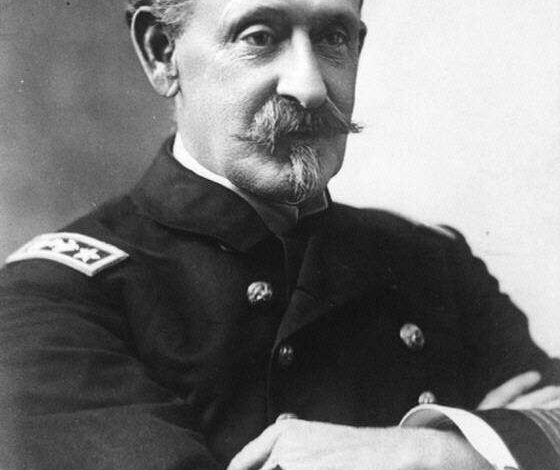
Illustrations, from above, Rear Admiral Winfield Scott Schley (US Navy photo); and Winfield Scott Schley (fourth from left), with some of his crew who in 1884 rescued the Greely Arctic expedition (US Navy).
Source link