 Lake trout have been restored to Lake Champlain according to an announcement by the U.S. Fish and Wildlife Service, Vermont Fish and Wildlife Department and New York State Department of Environmental Conservation. As a result, the wild population no longer needs to be augmented by hatchery-reared fish, and stocking will end after this spring.
The decision was announced by the Lake Champlain Fish and Wildlife Management Cooperative — a working group of fisheries professionals from the three agencies — at its annual meeting in April.
The cooperative has collaborated to increase the lake trout population since 1972, by stocking hatchery-raised juvenile trout and initiating a sea lamprey control program in 1990. Sea lamprey is an parasitic species that preys on the fish. The latest survey of lake trout suggests Lake Champlain’s population is self-sustaining because of these measures a Cooperative press announcement said.
The lake trout restoration program was created in the 1950s by the state agencies, who began stocking the lake annually with yearling lake trout. It quickly became apparent that invasive sea lamprey, which first entered the lake from the Hudson River through the Champlain Canal, were preying on the stocked trout.
In 1990, the Fish and Wildlife Service partnered with the state agencies on a sea lamprey control program, and the federal agency has led the program since 2011.
The cooperative will stock trout once more this spring, then is expected to continue to assess the health of the population and prepare a plan that includes benchmarks for reinstituting stocking if wild lake trout numbers appear to be declining.
While stocking was critical given losses to sea lamprey, successful re-establishment of a wild lake trout population would not have been possible without strong measures to control the invasive species. Native to the Atlantic Ocean, lamprey play an important role in ocean and coastal river ecosystems but cause havoc when they invade inland waters with no natural predators.
Lamprey latch onto fish like lake trout and feed off their bodily fluids, seriously harming or killing the hosts.
The Fish and Wildlife Service’s lamprey control program is multifaceted and includes adding physical barriers to rivers and streams entering Lake Champlain; applying lampricides to kill larval sea lamprey before they prey on fish; and trapping and removing adults before they can spawn.
After reaching a high of 99 sea lamprey woundings per 100 lake trout in 2006, the rate dropped to 23 per 100 in 2022. The wounding rate has hovered around the cooperative’s target of 25 for the last two years.
Read more about trout in New York State.
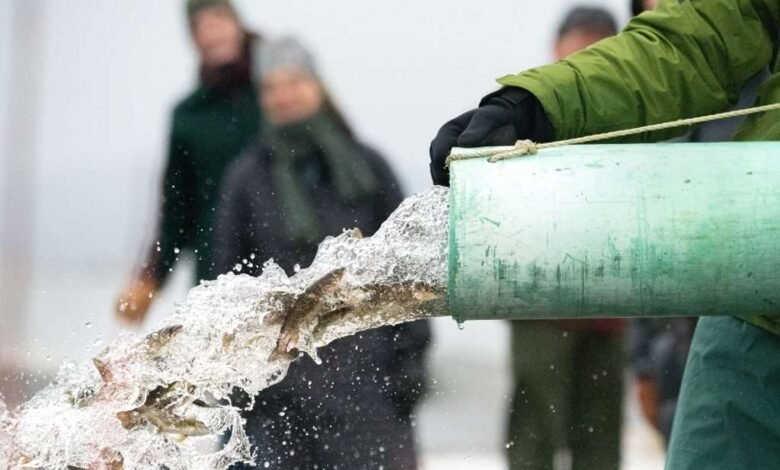
Illustration: Yearling lake trout from the final hatchery-raised cohort being released into Lake Champlain in mid-March, 2025 (provided by Vermont Fish and Wildlife Department).
Source link