
 Nearly 65% of the ticks biting Warren County residents and visitors are blacklegged ticks, also known as deer ticks. A species yet to be reported in the region may, however, be on its way: the Asian longhorned tick (Haemaphysalis longicornis).
The invasive tick was found in 2018 in Westchester County. Thus far, the population has not advanced beyond Saugerties in Ulster County, but according to Dr. Holly Ahern, a professor of microbiology at SUNY Adirondack and a nationally recognized expert on tick-borne diseases, there is nothing to prevent its migration farther up the Hudson River Valley.
The species has been found to carry a wide variety of pathogens known to attack human health, such as ehrlichiosis, but scientists have yet to establish, conclusively, if it also has the ability to spread diseases to people.
“The going hypothesis, at the moment, based on a limited amount of research, is that it doesn’t transmit diseases to us,” said Ahern. “But because of the paucity of research, I am uncertain in which direction to lean.”
The introduction of invasive ticks, when combined with climate change, the expansion of the ticks’ range and the spread of homes and neighborhoods into previously undeveloped areas, will contribute to an increased risk of infection from tick-borne diseases, according to the state’s Lyme and Tick-borne Diseases Working Group, of which Ahern was a member.
While the Asian longhorned tick may not yet have reached many upstate communities, plenty of other species have. According to a new Ticks in Warren County, NY website, crafted by the county’s public health and community development departments, scores of encounters with ticks have been reported every day this spring.
 Announcing the launch of the website, the county’s Director of Health Services, Ginelle Jones, said, “The website asks our residents and visitors to be citizen scientists, to allow us to collect data so we can easily let people know if certain areas of Warren County have larger populations of ticks this year.”
As encounters with ticks increase, so too, do reports of serious tick-borne illnesses, said Jones.
The rate per capita of Lyme Disease in Warren County is relatively high, with 151.8 cases per 100,000 residents in 2019-2021, compared to a statewide rate of 54.1 cases per 100,000 according to data from the New York State Department of Health.
Public health officials also receive, on average, reports of 35 to 50 cases of anaplasmosis every year, a fourfold increase over the nine cases diagnosed in 2020 and more than twice the number reported in both 2018 and 2019, the county department stated.
“Diseases spread through tick bites can be very serious,” said Jones, noting that Lyme Disease, anaplasmosis, Powassan virus, ehrlichiosis and babesiosis are among the tick-borne diseases spread locally which can cause life-threatening illness.
The weather this spring has been one in which ticks thrive and hence was favorable to tick bites.
“The conditions are perfect for a really bad tick season; it’s not surprising that people are saying it’s the worst tick season ever,” said Ahern. “The cool, wet weather and the tall grass are everything a tick loves.”
Testing Ticks for Pathogens
In the absence of point-of-care diagnostic tests that can provide timely, accurate and reliable results for multiple Tick-borne diseases, Holly Ahern recommends that people who have had an encounter save the tick and send it to the Upstate Tick Testing Laboratory for analysis.
“The results are returned quickly, within a day or two,” said Ahern. “If the tick was carrying a pathogen, you can then consult your medical provider for an informed decision about the best course of treatment.”
As of now, individuals are responsible for paying for the tests. Ahern argues that New York State ought to fund them.
“Pennsylvania, Rhode Island and Massachusetts are among the states that fund these tests, and it would cost New York State less than $600,000 per year to do the same,” said Ahern. “The New York State Department of Health would benefit. It would have better records of where ticks are being found in New York State and which pathogens they carry.”
Read more about ticks in New York State.
A version of this article first appeared on the Lake George Mirror, America’s oldest resort paper, covering Lake George and its surrounding environs. You can subscribe to the Mirror HERE.
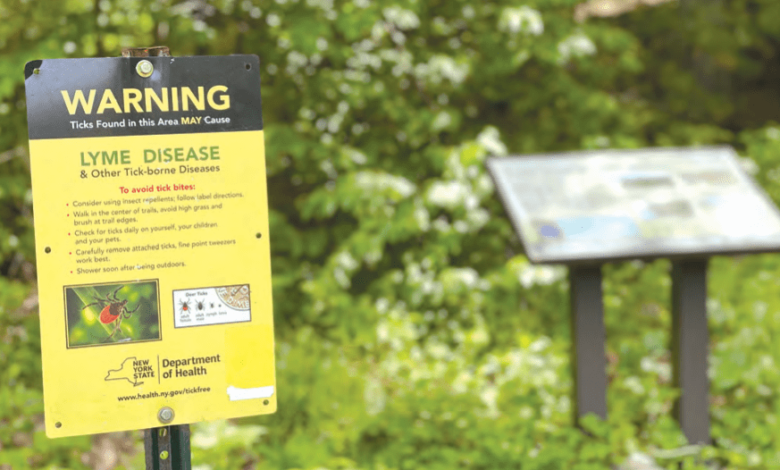
Illustrations, from above: Tick-borne disease warning sign at the trailheads to the Pinnacle and Bradley’s Lookout in Bolton, on Lake George in Warren County; Warren County Health Services education event (courtesy Warren County Health Services).
Source link