 A lot of things could be said about John Brotherson, but those who knew him well were unlikely to include “he would be late to his own funeral.” Yet in the middle of the day on October 17, 1887, a group of people waited patiently on a little knoll in Ballston Spa’s Village Cemetery, and he was nowhere to be found.
John had passed away two days earlier at the home of Dr. Charles Inslee Pardee, a relative with whom he spent the winter months in his later years. His death was an unfortunate accident by asphyxiation, caused by John inadvertently leaving a gas valve on when he retired for the night. At his passing at 87, John Brotherson was the senior member of the Saratoga County bar association and a practicing attorney for over fifty years. He was also a prominent Spiritualist.
Brotherson’s career in law began in Schenectady in 1821, where he practiced in partnership with John Cochran, served as a Justice of the Peace, participated in the community’s debating club, and served as the secretary of the Schenectady County Temperance Society.
It was during his time in Schenectady that he published a book of interest to other attorneys, the Executors’ and Administrators’ Instructor (1828), in which he compiled the law and necessary forms related to those topics.
In 1841 Brotherson relocated to Ballston Spa. When he found time, John enjoyed the sport of fox and raccoon hunting. Considered an expert at the pursuit of fox, after old age prevented him from following the sport, the residents of Ballston Center noted a dramatic increase in intrusions into their hen houses by these predators.
His knowledge of the sport even carried into his law cases, as in one where he represented a party whose hunting dog had been shot by a farmer when it entered a sheep yard while following a fox trail. Brotherson won the case with a judgment of fifty dollars for damages plus court costs against the defendant.
Known to be tenacious when pressing his cause in the courthouse, his summations could sometimes be so abusive as to elicit an attack from his opponents. In one instance during a Schenectady court case in 1841, Lewis Peck, said to have been “goaded into madness,” threw off his overcoat and landed two or three blows on Brotherson.
 This willingness to win at all costs resulted in his pursuing cases that stretched over decades, the most notable being a lawsuit against Emmanuel Consalus to recover costs from several litigations. This suit, continued even after the death of Consalus in 1872, was noted in some obituaries as having been the sole focus of Brotherson’s legal work for the last fifteen years of his life.
John Brotherson was born in Charlton in 1806. A lifelong bachelor, beyond his law career and fox hunting, one of his main interests was Spiritualism, which had found a considerable following in the village, with John as the leader of the local society.
Other prominent members of the village who were leaders in the society included mill owner Benjamin J. Barber and Samuel Hides of the Hides-Franklin Spring.
Only this humorous story about John Brotherson’s personal involvement in spiritualism was ever recorded, published by the Weekly Saratogian on June 23, 1881:
“Mr. B. is a firm believer in the Spiritualistic faith. While boarding with Mr. Brown on the hill, he was sitting one night at a basement window, which was even with the ground. Suddenly, he heard three or four thumps on the glass. John told the other inmates of the room to keep quiet, as he wished to converse with the spirits outside.
“He went into a trance and remained so for twenty minutes, and said he had a talk with a most beautiful creature. Upon going outside, Mr. Brown found two large sized toads flopping against the window in their efforts to catch flies that had been attracted there by the light inside.”
The most well-known account of Spiritualism connected to Ballston Spa is that of Samuel Hides and the discovery of his famous spring. It was during a séance that the spirit of Benjamin Franklin was said to have told Hides that he would find an abundant mineral spring if he would only dig down 715 feet at a certain spot on his property.
When the hole reached the predicted depth, a huge geyser shot high into the air and continued to provide a source of mineral water for years afterward as the Hides-Franklin Spring.
The spiritualist society in Ballston Spa, which boasted at one time as many as eighty members, gained a prominent presence in the village in 1876 when society member Benjamin J. Barber erected a 200-seat meeting place on Bath Street that was named “Centennial Hall.”
By Brotherson’s death in 1887, the building had fallen into disuse and became a storehouse for the American Hide and Leather Company.
 The remains of John Brotherson finally arrived in Ballston Spa on the 6 pm train and was met by his relatives and a large group of friends. His interment was held the same evening in the Ballston Spa Village Cemetery by the aid of lamps and lanterns, which presented a “weird and impressive scene,” according to the October 18th Albany Argus.
Members of the Saratoga County Bar were the pallbearers at the funeral. The services were conducted by Rev. Brooke Gwathmey White, a Protestant Episcopal minister from Jacksonville, Florida, who was in the area visiting friends.
Two weeks later, on the evening of October 30, 1887, Christian Science founder Mary Baker Eddy (1821-1901) held a “conversation” with John Brotherson open to the public at the Saratoga Springs Town Hall. The results of this conversation with John’s spirit were never revealed.
In 1903, John Brotherson’s stepsister, Mrs. Anna Attocha, erected a 25-foot-tall monument in the Ballston Spa Village Cemetery in memory of her brother.
Also buried in the Brotherson plot is John’s sister Eliza, his stepmother Alice Odell Brotherson, and his stepsisters Aleta and Sarah. Anna would be laid to rest in this plot the year after the monument was erected.
This essay is presented by the Saratoga County History Roundtable and the Saratoga County History Center. Follow them on Twitter and Facebook.
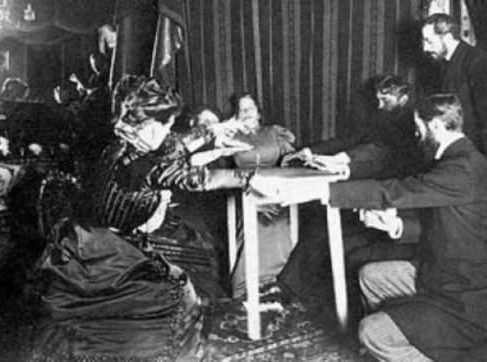
Illustrations, from above: A Victorian era seance; the building believed to be Centennial Hall on Bath Street, where the Spiritual Society met (see a larger version of this photo here); and John Brotherson’s monument in Ballston Spa Village Cemetery (courtesy Dave Waite).