 In December 1945, after the Second World War, the last refugee departed the Fort Ontario Emergency Refugee Shelter on February 5, 1946, and the Fort Ontario Military Reservation returned to the War Department at the end of the month.
The property then transferred to the State of New York on April 3, 1946. Approximately 60 wood-frame buildings constructed in 1941 were demolished.
For a short time, the New York State Housing Authority repurposed the 1903–1905 Fort Ontario Officers’ Row buildings into housing for veterans returning to Oswego or those using the GI Bill to attend Oswego State Teacher’s College (now the State University of New York at Oswego).
As early as 1947, the Oswego County Historical Society, the now-defunct New York State Historical Association, and local history advocates supported preservation of the core fortification and lobbied for the creation of a state historic site dedicated to Fort Ontario’s 18th- and 19th-century military history.
In January 1949, the New York State Lands Office officially transferred approximately 20 acres including the fortification and land surrounding it to the New York State Education Department for administration as a historic site.
The first site custodian began offering tours of the ramparts and casemates in the summer of 1949, but the buildings within the core fortification continued to house veterans and their families until 1953.
Once the last veterans departed in early 1953, the historic site was enlarged to 30 acres to include the core fortification, cemetery, administration building, and noncommissioned officer quarters.
The State Lands Office sold additional parcels of the former military reservation to the City of Oswego, the Oswego Port Authority, and private interests. During the 1950s, the State Education Department focused on returning Fort Ontario to its Civil War–era appearance and developing interpretation at the site.
 Changes included demolishing the larger 1903–1905 brick buildings and some of the roadways developed in the 1940s and constructing a visitor parking lot south of the fortification.
In the 1950s, about half of the military fort’s east and south sections adjacent to city streets and neighborhoods were conveyed by the state to the City of Oswego for public purposes. In 1956, the Oswego Little League was established and included baseball games on the former parade grounds at Fort Ontario.
In 1967, jurisdiction of the state-owned area (the western and northern portions of the former fort that are adjacent to today’s Port of Oswego and Lake Ontario) was transferred to the New York Division of Parks, which created a five-year plan for the site that focused on interpreting Fort Ontario as a representative Civil War–era fort.
By 1970, most of the recommendations in the plan had been implemented, and the property was listed in the National Register of Historic Places for its engineering and military importance on the state level during the 18th and 19th centuries. Management of the Fort Ontario historic site transferred to the New York State Office of Parks, Recreation and Historic Preservation (State Parks) in 1973.
During the 1980s, this state office appropriated funds for archeological surveys and improvements to the core fortification to allow the resources to better represent the 1868–1872 period of the fort’s history.
At the same time, the idea for memorialization and education about the Fort Ontario Emergency Refugee Shelter began circulating, starting with a New York State Museum Holocaust exhibit in Albany, created by the museum and the Greater Albany Jewish Federation.
An article by the project director Norma Bell in the summer of 1986 described the impetus for the exhibit, which also supported the later creation of a museum at Fort Ontario:
“Some of my most important students over the years have been teachers who have wanted to learn how to relate the story of the destruction of European Jewry to their students in such a way that this terrible event is seen not as an isolated ‘Jewish’ incident, but as a frightening possibility for all of us, revealing the potential for evil in all of us.
“These teachers have frequently expressed a need for a tangible resource center that they could use as a tool to help teach their students… We wanted to lead visitors through the story of the Holocaust without shocking them into numbness.
 “We wanted to explore the role of the U.S. government honestly. Most importantly, we wanted to reveal the extraordinary situation which developed once the Oswego refugees and the townspeople of Oswego and surrounding communities came together.
“We wanted to tell the human story—a story of love and concern, of fear and frustration, of determination and faith.”
In 1988, the City of Oswego created a new vision for their lands at Fort Ontario (the eastern and southern portions of the former fort adjacent to East Schuyler Street, East 9th Street, and largely residential neighborhoods).
That year the city made a successful grant application from the state to create a new “urban cultural campus” including restoration and adaptive reuse of six 1903–1905 buildings for arts/cultural programming, and recreation centers within a new “urban cultural park” on a City of Oswego–owned portion of the former Fort Ontario.
The new park would “serve as an incentive for creating a Local Historic Preservation committee to address the conservation of Oswego’s heritage.” This was part of a larger “Waterfront Revitalization Plan” creating and linking Fort Ontario venues to parks west of the Oswego River.
The grant envisioned retaining some uses and adding new ones for buildings on city property, including a gymnasium in Building 25, recreation offices, a youth sports center, a mixed-use studio and public restroom, a children’s science museum, a museum dedicated to Fort Ontario’s Holocaust refugees, a community theater and visual arts organizations, and parking.
Restoration activities funded by the grant included repairs to slate roofs and masonry, insulation installation, utilities upgrades, ADA-compliant access installation, window/door replacement, restroom construction, and more.
The grant-funded activities did not alter Little League or other field sports’ use of the former parade grounds, which are local activities that continue today.
In 1989, an important new partner for the city, the Friends of Fort Ontario, was chartered to help support educational efforts at Fort Ontario State Historic Site. Safe Haven Inc., a nonprofit dedicated to preserving the stories of the refugees brought to Fort Ontario in 1944, was also established that year.
The city largely fulfilled the 1988 urban cultural park plan, with some changes over time to the types and locations of uses. For example, in 1988 a
museum dedicated to Holocaust refugees and a children’s museum were planned for a former quartermaster building where the Head Start program is located today.
 Overall, the general arrangement of the campus on City of Oswego land today is generally consistent with the urban cultural campus intention from the late 1980s.
In October 2002, Building 22 (a former guardhouse) became home to the Safe Haven Holocaust Refugee Shelter Museum, which is dedicated to keeping alive the stories of the 982 refugees from World War II – most of them Jewish – who were allowed into the United States as “guests” of President Franklin D. Roosevelt.
In 2005, the Oswego U.S. Customs and Border Patrol Station purchased the southwest corner of the former military reservation to the west of the main entry road on 4th Street.
This approximately two-acre parcel is occupied by a private medical service building. Neither area appears to have been associated with improvements funded by the 1988 grant.
Today, the former Fort Ontario offers the public a variety of services and experiences, including visiting the Fort Ontario State Historic Site, learning at the Safe Haven Holocaust Refugee Shelter Museum in the former guardhouse, attending community theater and children’s early education programming in former quartermaster buildings, ice skating in a rink that incorporates former Fort Ontario stables, enjoying field sports on the parade grounds and the batting cage, and storing recreational equipment.
Additionally, the City of Oswego Department of Public Works sign shop and an active US Army Reserve Center are located in former fort structures.
This essay was drawn from the National Park Service’s 2024 Fort Ontario Special Resources Study, available in it’s entirety with footnotes here.
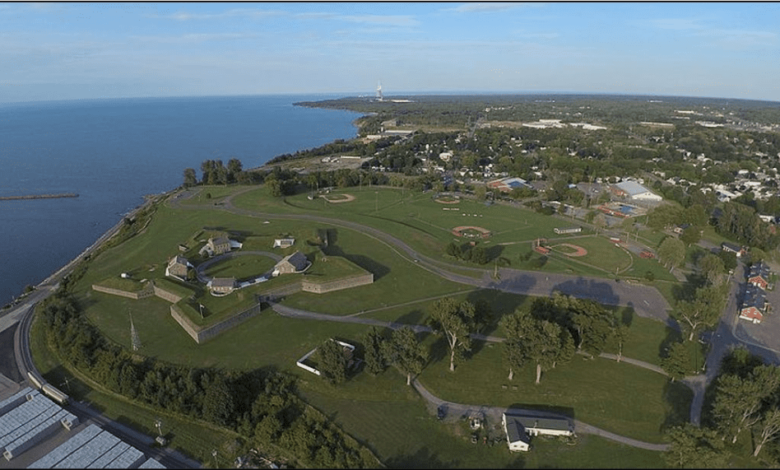
Illustrations, from above from the Special Resource Study: Aerial view of Fort Ontario, ca. 2024; Aerial view of the recreated Civil War era Fort Ontario State Historic Site, 2023; Fort Ontario Emergency Refugee Shelter Interpretive Sign; and Fort Ontario property boundaries, 2023.
Source link