 In the latest episode of the Crossroads of a Continent podcast Tim Dusablon discusses the events in the Champlain Valley leading up to the outbreak of the American Revolutionary War including the New Hampshire Grants and loyalists Philip Skene and William Gilliland‘s grand plans for a 14th British colony.
Before the War families from southern New England and eastern New York had settled in “the Grants,” as the New Hampshire-titled lands disputed by the Province of New York but now located in Vermont were known.
They believed that the royal governments of New Hampshire and New York, representing the king, wouldn’t deny the rights of citizens who settled the land, organized governments, paid taxes, and obeyed the laws.
Instead, in 1764 King George III ruled in favor of New York which then began to issue titles to the same lands occupied by the grantees, several thousand of whom had already settled on what they thought was New Hampshire grants.
When the Yorkers, as the New York landholders were called, started to stake their claims, tensions increased. In 1774 and 1775 they were intimidated, taunted, and humiliated.
 For example, Dr. Samuel Adams, a wealthy owner of New Hampshire Grants, was first warned not to speak sympathetically of the Yorkers’ cause or against the violence committed by Ethan Allen, the Green Mountain Boys, and their allies. Before they were known as the Green Mountain Boys, they were known simply as “the Bennington mob.”
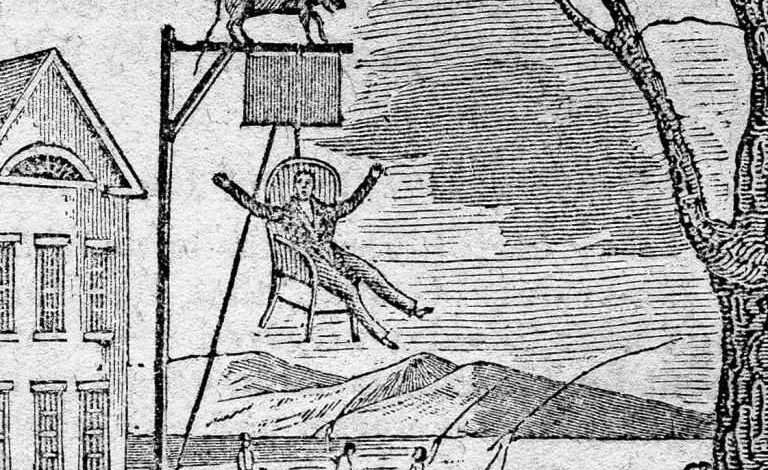
When he refused to be silent on the matter, he was dragged to the Catamount Tavern in Bennington and subjected to a “trial.” He was sentenced to be tied to a chair and hung from the tavern’s signpost, where he was ridiculed for several hours.
His treatment was mild compared to Benjamin Hough, a New Yorker who was jailed for a week, then tied to a tree and whipped 200 times before being banished from the Grants.
The Crossroads of a Continent podcast explores the New Hampshire Grants controversies and their “ejectment trials.”
It also addresses Philip Skene, Ethan Allen, and William Gilliland‘s short-lived plans to create a new, 14th British colony north of Massachusetts called “Skenesborough,” stretching from the Connecticut River to Lake Ontario that was very short-lived. Plans backed by British General Jeffery Amherst.
Gilliland, a Northern Irish French and Indian War (1754-1763) veteran, settled his family with a number of recruited tenant-settlers in what it now Willsboro, Essex County, NY in 1766. He soon secured an appointment as Justice of the Peace for “the whole of the Hampshire Grants.”
Instead of a new colony, Skene’s holdings, centered at present-day Whitehall, in Washington County, NY, became a significant British military outpost and supply base but were ultimately lost as the British campaign to take Albany faltered at the Battles of Saratoga.
Also discussed is Adam Beals Jr., of St. Albans, Vermont, who took part in the Boston Tea Party in 1773.
Listen to the Podcast
You can listen to this podcast here (40 minutes) and read more about these events at Tim Dusablon’s blog.
The Crossroads of a Continent podcast explores the history of Lake Champlain Valley, one of the most historically important bodies of fresh water in America. Listen to all the episodes here.
Read more about the New Hampshire Grants.
Illustration: Dr. Sam Adams ‘hanging’ in a chair outside Catamount Tavern, while another New Yorker is whipped while tied to a tree, from Zadock Thompson’s Civil History of Vermont (1842); and a map of the contested New Hampshire Grants from Wikimedia Creative Commons user Kmusser.
Source link