
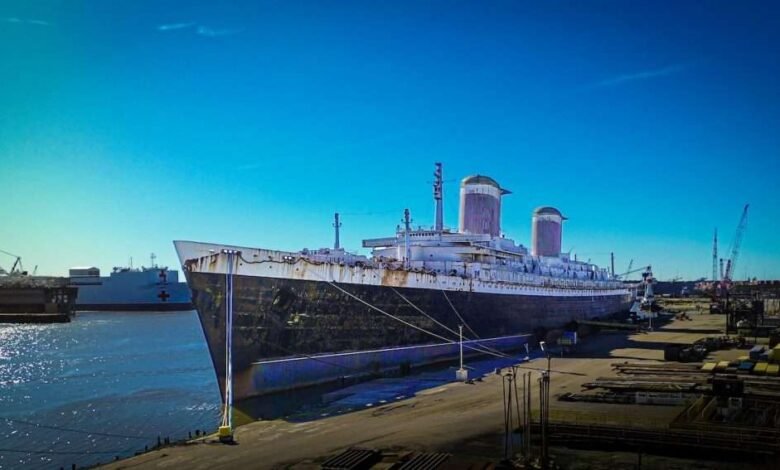
 A U.S. Magistrate Judge in the Federal Court for the Northern District of Florida has rejected a motion by attorneys for Okaloosa County Florida seeking to sanction James Maloney, Esq., counsel for the New York Coalition to Save the SS United States.
The County had attempted to penalize Maloney for filing the Coalition’s lawsuit aimed at preventing the destruction of the historic ocean liner. The Court’s decision makes clear that the case was not frivolous, but rather a legitimate legal effort to protect the historic ship from being sunk off the Florida Coast.
A federal judge in Florida dismissed the Coalition’s lawsuit on August 6, 2025 which had aimed to prevent the ship’s sinking. U.S. District Judge M. Casey Rodgers ruled the Coalition lacked constitutional standing to challenge the project. The court ruled the group’s interest was too abstract.
Of the latest ruling, James S. Kaplan, Director of the Coalition and Chair of its Legal Committee, said:
“This decision vindicates our view that the lawsuit brought by the Coalition to Save the SS United States was not frivolous, but rather a good faith effort to stop the destruction of one of America’s greatest historic maritime landmarks.
“The Magistrate’s decision is a victory for more than 20,000 people who have signed petitions protesting the destruction of the ship and the millions of New Yorkers whose New York City Council recently passed a resolution unanimously calling on the federal government to save the ship and fund its return to New York City. It is an embarrassment to the County whose lawyers brought it. The efforts of the New York Coalition to Save the SS United States to prevent the ship’s destruction will continue.”
A Historic Liner at Risk and Environmental Concerns
Okaloosa County purchased the SS United States with the stated intention of sinking the vessel to create an artificial reef off the Florida coast.
Supporters of preservation argue that this plan would permanently destroy a singular piece of American history and a masterwork of American industrial design for use primarily as a regional dive attraction, rather than preserving it for broad public, educational, and cultural benefit.
Beyond historic preservation concerns, advocates and environmental observers have raised ecological questions about the reefing proposal.
In statement to the press the Coalition that said that “large artificial structures can unintentionally provide safe harbor for invasive marine species, disrupting existing ecosystems and altering native habitats.” They pointed to a study which found that lionfish density at artificial reefs was 100 times higher than at natural reefs.
“There are serious concerns about the long-term interaction between saltwater and the vessel’s materials, including specialized primer coatings used throughout the ship and the unusually high proportion of aluminum in its superstructure,” they said.
“Preservation and environmental advocates caution that corrosion, material degradation, and the release of these substances into the marine environment could create lasting ecological harm affecting marine habitats, entering the food chain, and ultimately impacting the fish that people consume.”
National Significance
The SS United States “is not only the fastest ocean liner ever built, but a powerful symbol of American engineering, innovation, and Cold War–era national pride,” the Coalition said. “Designed with extraordinary attention to form, proportion, and design, the ship is widely regarded by preservation advocates as a true work of American industrial art – a floating masterpiece that merges function, beauty, and national identity.”
Preservationists argue that sinking the vessel would represent an irreversible loss of cultural heritage, eliminating not just a historic artifact, but a monumental artistic achievement that reflects a pinnacle of mid-century American ambition and creativity.
Supporters of the Coalition include preservationists, maritime historians, veterans, educators, architects, designers, and civic leaders who see the ship as a potential museum, educational center, and international tourism destination.
Growing Public Support
Public backing for saving the ship continues to grow. More than 20,000 individuals — and counting — have signed petitions opposing its destruction. In a rare show of unity, the New York City Council unanimously passed a resolution urging federal action to preserve the vessel and support its return to New York – the port city most closely associated with its historic and cultural legacy.
Coalition leaders said the court’s ruling strengthens their resolve and confirms their legal challenge was grounded in legitimate concerns about historic preservation, cultural stewardship, environmental responsibility, and federal oversight.
“The fight to save the SS United States is far from over,” Kaplan said. “This ruling shows that standing up for America’s history and its great works of art is not only justified, but also necessary. Our legal challenge was dismissed, and we are not seeking to revive our lawsuit. We are continuing to challenge the reefing in social media and before the Army Corps of Engineers, and with the Department of the Interior.”
Coalition representatives also point to what they called “a ready and fitting long-term home for the ship along the Brooklyn waterfront, where its scale, beauty, and historic stature could be fully realized.”
Preservation advocates envision the SS United States drawing visitors from around the world, supporting education and the arts, and contributing to the economic and cultural life of New York City.
The New York Coalition to Save the SS United States is a nonprofit advocacy group. James S. Kaplan has frequently contributed to New York Almanack.
Read more about historic preservation in New York State.
Source link