 In April 2025, the Sand Lake Historical Society was contacted by Will Lenihan, who is the Gardner and Curator for the Native Flora Garden at the Brooklyn Botanic Garden.
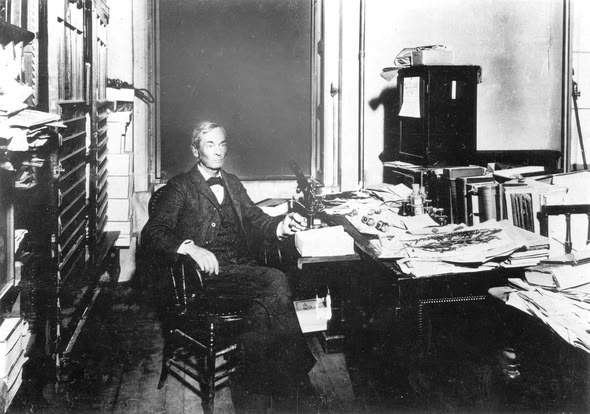
He was curious about a small perennial carnivorous plant that was documented by Charles Horton Peck (1833-1917) of Sand Lake, in eastern Rensselaer County, who was the New York State Botanist from 1867-1915.
The plant, known as Utricularia Ochroleuca, is a variety of bladderwort that was reported to grow in Big Bowman Pond in the mountainous hamlet of Taborton in the 19th and 20th centuries. In fact, this is the only known place this variety of bladderwort has been found to exist so far in New York State. (Peck’s most famous work had been in describing over 2,700 species of North American fungi).
Lenihan was interested in connecting with someone from Big Bowman Pond, who might allow him access to the pond to search for evidence of the existence of the Utricularia Ochroleuca in the pond. He was put in touch with Sharon Dawes, a resident on Big Bowman, who shared this information with Bowman Lake Association President John Losee.
Losee contacted Lenihan and invited him to Taborton so he could search for the plant and take some samples. In August, Lenihan did visit Taborton, and Losee took him for a tour of the pond in his rowboat.
After harvesting some samples of bladderwort samples from Big Bowman, Lenihan returned to Brooklyn, and, after putting dissected bladders from the samples under a microscope, he found that their glands do resemble the rarer form of Utricularia Ochroleuca, more than the common Utricularia Intermedia.
The arms of Utricularia Intermedia spread at a 30-degree angle or less, while Utricularia Ochroleuca’s can spread much wider, which the ones from Big Bowman do. Also, the more common Utricularia Intermedia has 9-20 tiny teeth on their leaves, while the rarer Utricularia Ochroleuca has nine or less.
The plants harvested from Big Bowman had only five to six, which also supports the presence of the rarer Utricularia Ochroleuca. They use their small, submerged bladder traps to capture and digest microorganisms and small aquatic creatures.
So, it appears Charles Horton Peck was correct in his report that this rare version of bladderwort does in fact grow in Big Bowman Pond. Whether it grows elsewhere in New York, though, remains unknown at this time. We only know that there have been no other reports of it in the State.
Read more about New York State’s carnivorous plants.
A version of the essay was first published in the Sand Lake Historical Society‘s newsletter Historical Highlights.
Photo: New York State Botanist Charles Horton Peck at his desk (courtesy NYS Museum).
Source link