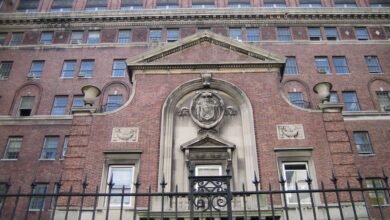

For whatever reason, the Mamdani administration chose Super Bowl Sunday — four hours before kickoff — to release an updated list of buildings in the dreaded Alternative Enforcement Program.
The mayor’s office didn’t bury the news in order to spare landlords bad publicity. Just two days later it made a big show of announcing its “rental ripoff” hearings, which have outraged and scared owners even before the first hearing.
In his press release about the updated AEP list, Mayor Zohran Mamdani vowed, “New York will no longer look the other way while bad landlords put tenants at risk.”
But AEP is in its 19th year. Clearly the city has not been looking the other way. The problem is, AEP has not been very effective, despite imposing penalties and charging landlords several times the normal cost of repairs. It tends to put out some fires in a building, then move on without fixing the fundamental problems.
If AEP worked well, the crisis of violations Mamdani keeps calling out would not exist. Yet his new list was accompanied only by bluster, not reforms.
When The Real Deal’s Quinn Waller looked into what happened to buildings owned by notorious landlord Aron Stark after they were thrown into AEP, she found few signs of progress.
Nor did it inspire changes in Stark’s stewardship of the buildings.
Waller reported last fall that the city put 1422 Greene Avenue into AEP in 2021 and has since made some repairs and billed them to Stark. But he hadn’t paid, and as of Oct. 1 the 12-unit building still had 79 open violations, 32 of them immediately hazardous.
Today it has 80 open HPD violations, 67 of which are class B or C. It also has six active building violations and eight open environmental violations. Stark hasn’t even filed a property registration form since 2020, and tenants have said he’s abandoned the building.
Yet somehow 1422 Greene Avenue was removed from the AEP list.
Instead Mamdani singled out 34-15 Parsons Boulevard in Queens, a 175-unit A&E building which the mayor said has more than 1,000 “of the most serious violations.” But half of the building’s 1,239 violations have been fixed — they just haven’t been cleared because HPD hasn’t reinspected them. Another 1,200 violations have been cleared.
“We’ve done a lot of work in that building to clear these violations,” said Douglas Eisenberg, A&E’s CEO. “We’ve invested $10 million into the building.”
It has apparently been years since Ari Stark — a landlord who was once jailed for neglecting his properties — has even put 10 cents into his Greene Avenue building. That the city took his building off the bad-boy list and put Douglas Eisenberg’s on it tells you there’s more than a little theater going on.
What we’re thinking about: Will Mark Levine, the new city comptroller, dial back the project-hampering 485x rules just proposed by his office? The draft rules were largely prepared under Levine’s predecessor, Brad Lander, who claimed to be pro-housing but sometimes wasn’t, and this proposal is another example. Levine is more enthusiastic about adding housing supply and now has a chance to prove it, though doing so will irk the construction unions. Send your thoughts to eengquist@therealdeal.com.
A thing we’ve learned: Only 13.7 percent of single-family homes are occupied by renters, the lowest share in more than 15 years, a Redfin analysis of census data found. Housing myth-buster Jay Parsons posted the stat.
Elsewhere…
The new law requiring landlords to install air-conditioning by June 2030 for tenants who request it has been deemed by some as another nail in the coffin of rent-stabilized housing.
But a closer reading of the bill suggests its impact will be modest, perhaps even minimal.
One line says, “The Department of Housing Preservation and Development would provide notice to tenants to characterize the potential impacts of opting into the program on their rent.”
The law says a rent-stabilized tenant would have to consent to a rent increase — via an individual apartment improvement — to get air conditioning. This key fact was missing from nearly all of the media coverage of the bill.
For units that are individually metered, as most are, tenants would also have to pay higher electricity bills to use the A/C. The prospect of higher rent and higher utility bills should dissuade many from demanding the upgrade.
The New York Apartment Association pushed for changes to the legislation by Council member Lincoln Restler, D-Brooklyn, which passed 40 to 7 on Dec. 18. It became law without Mayor Eric Adams’ signature.
Closing time
Residential: The top residential deal recorded Tuesday was $37.25 million for a 3,703-square-foot resale condominium at 220 Central Park South. Manju Jasty with The Corcoran Group had the listing.
Commercial: The top commercial deal recorded was $40 million for Metropolitan College of New York’s 100,000-square-foot property at 40 Rector Place in the Financial District. The Real Deal reported on the deal to the City University of New York in August.
New to the Market: The highest price for a residential property hitting the market was $20 million for a 3,851-square-foot condominium unit at 275 West 10th Street in the West Village. Jessica Chestler and Ben Jacobs of Douglas Elliman have the listing.
Breaking Ground: The largest new building permit filed was for a proposed 210,689-square-foot, four-story, 32-unit residential building at 2105 Tillotson Ave in Eastchester. Nikolai Katz filed the permit on behalf of Tucker Shane of 33 Equities Acquires.
— Matthew Elo