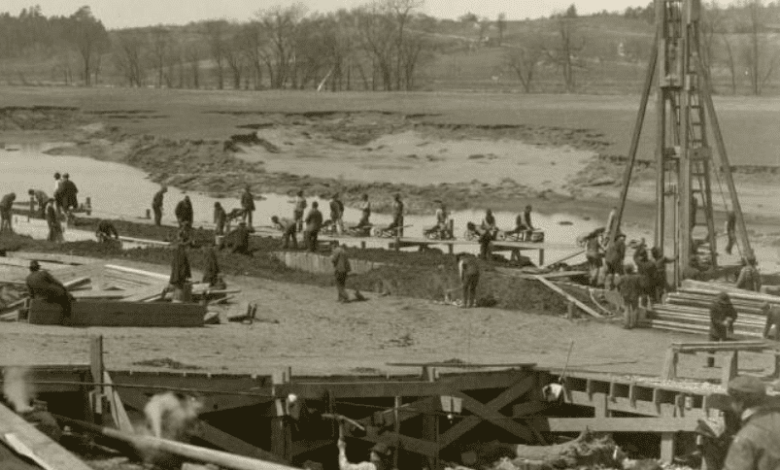
 The rampant industrialism of the Gilded Age and early Progressive Era eventually took root in Little Falls, NY. The city and the surrounding Mohawk Valley had served as a hub for immigrant and migrant labor for a significant time. The construction of the Little Falls Canal and the Erie Canal during the 18th and 19th centuries attracted a multitude of predominantly Irish laborers.
In the latter half of the 19th century, as industrialism took hold, the mass construction of railroads attracted even greater numbers of immigrant workers to Little Falls in search of jobs within the burgeoning factory apparatus.
Given the combination of the mass arrival of immigrants between 1890 and 1914 and the booming industrial apparatus of the Mohawk Valley overall, it was only natural that the city became a hub for immigrants to flock to in search of work.
Within that 24-year span, numerous Slovak, Italian, Polish, Slovenian, Jewish, and Ukrainian immigrants made their way to Little Falls, bringing a population spike of 4,000 people. The city would reach nearly 13,000 total residents, just shy of its 1920 peak of 13,029.
Slovaks, as noted in Richard Buckley’s book Unique Place, Diverse People, actually came to Little Falls by accident. A resident of Minnesota in the mid-1890s, Anna Mocko was encouraged to move to a city in New Jersey also named Little Falls. A reading mistake by a train ticket agent led Anna to New York instead.
 After finding work, she convinced her friends and relatives to join her, eventually resulting in a Slovak enclave in Little Falls. Many found work in knitting mills and other factories.
Italians had already settled in the area to some extent, having aided in building the railroads. Though some returned to Italy after earning enough money, a portion of Italian immigrants chose to stay, taking on various forms of manual work, including in knitting mills.
Polish immigrants, more often than not, were coming to the US to improve their economic lives and break free of the yoke of imperial domination under Tsarist Russia, the German Empire, and the Austrian Empire.
Each of these immigrant groups established a sense of community for themselves, countering the segregation they faced. Immigrants settled on the south side of the city, effectively separating the city based on immigrant status.
Slovaks, Poles, and Italians, among others, participated in their local clergy, often establishing their own churches. Community events like weddings, musical performances, and sports were commonplace, allowing these immigrant groups to build a true sense of community and cooperation against the nativist attitudes formulated within Little Falls and the country as a whole.
As the industrial boom created opportunities for immigrants, it likewise created conditions that allowed for the bolstered dominance of industrial capitalists. These robber barons were permitted to skirt regulations and more extremely exploit desperate immigrant workers to expand their profits. So-called “skilled” workers in Little Falls were typically not treated as horribly as immigrant factory and mill workers.
For some time, Little Falls served as a hub for bicycle production through the Homer P. Snyder Manufacturing Company. According to Buckley, the majority of workers in this factory were men who received a fair wage for the time and even received a yearly bonus that mimicked profit sharing. “Unskilled” immigrant workers were not in such a favorable situation.
 Conditions for immigrant workers in Little Falls thus created the potential for a strike even before 1912. Commonly employed in knitting mills, these workers were severely lacking in representation from labor organizations. Most local unions represented trades such as plumbers and cigar makers. Beyond this lackluster representation, many of these unions were conservative in character, and their leaders tended to side with factory owners to uphold the status quo.
This did not stop workers from engaging in militant struggle. In 1900, the city saw eighty knitting mill workers go on strike for improved wages. As has sadly been the case in many historical instances, numerous efforts were made to prevent the strikers from reaching their goal. Labor leaders condemned the strike, and local newspapers echoed their sentiments; even the local Spinners Union declined to become involved, leaving the eighty mill workers on their own.
The mill workers defied these detractors and continued their struggle, but their efforts were met with a continued nativist opposition. The owners of the knitting factories inevitably implemented scab labor, bringing in workers from other cities and hiring young women to undermine the strikers.
The media did not let up on its attacks, publishing two more weeks’ worth of defaming stories and even referring to the strike as a “vicious and wicked attempt to assault the city’s great industry.”
Nearly a decade later, the local Spinners Union wholly opposed the MacKinnon Mill’s decision to have “foreigners be permitted to learn all branches of the spinning operation.” This nativist campaign was once again supported by local print media.
Though these past struggles are significant, another source of outrage for organized labor—throughout not only the United States, but the world—served as the primary catalyst that would set off the events that created the conditions for the 1912-1913 Little Falls Textile Strike.
J.N. Cheney is an independent historian focusing on the labor movement, radical politics, and community action where he lives in the Mohawk Valley. This is an excerpt from his book Women, Immigrants, and the Working-Class Battle in Little Falls, New York: The Textile Strike of 1912-1913 (Algora Publishing, 2025).
Illustrations, from above: Detail of photo of construction on an Erie Canal enlargement in Scotia, New York (Schenectady County Historical Society); and a detail of an 1890s photograph of laborers working on an Erie Canal enlargement (New York State Museum).
Source link