 On Friday, August 30th in 1805, Matthew Prendergast set off on horseback from Sharon, Connecticut. Matthew was about 50 years old, a resident of Amenia in Dutchess County, NY, just across the state line from Sharon. He was comfortably well off, but definitely not super rich, and he suffered from rheumatism.
He had a few errands to do on the way, but he was planning on heading north and taking the waters at Ballston Springs, where he had visited in the past. He took his time, stopping several times, including at Kinderhook, Albany and Troy.
He also checked out the “Stupendous fall of Water” at Cohoes, back to Waterford, and finally the road to the Springs which was “principally very Sandy and hard Travelling for a Horse.”
Matthew finally arrived at the relatively new Aldridge Tavern in Ballston Springs on the evening of Tuesday, September 3. Aldridge still exists and is now the home of the Saratoga County History Center at Brookside Museum.
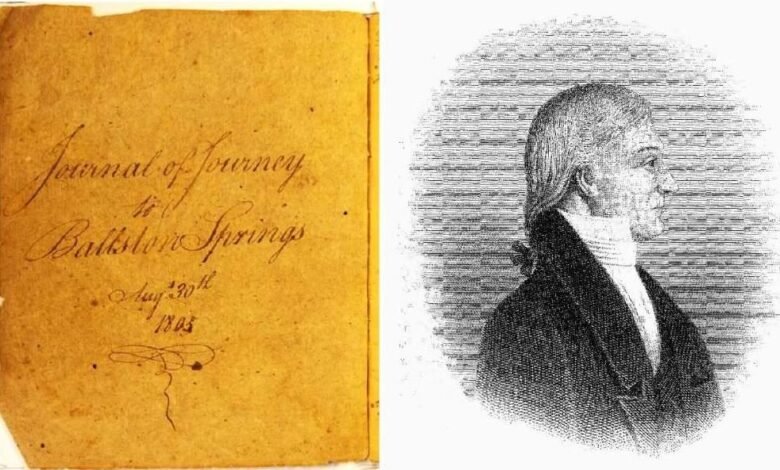
How do we know all this? In 2024, the museum was fortunate to be able to purchase his 1805 journal, describing his travels. It is a small book, only about 40 pages long, but provides wonderful, first person, information on what life was like for visitors to Ballston Springs, as Ballston Spa was first called.
Matthew was meticulous in recording his expenses, the cost of every cup of water, the cost of boarding for him and his horse, even the cost of writing paper and needles, and the tips he paid employees.
Although the US dollar was the official national currency by 1805 and Matthew refers to “dollars” and uses the $ symbol, prices were still expressed in pounds, shillings and pence, with twelve pennies to a shilling and twenty shillings to the pound. Matthew kept a very careful tally of his expenses, and his eight-week, 364½ mile trip, cost him £16.17.10.
 Matthew was not impressed with Aldridge’s Tavern. “[T]he boarders were principally Gentry being no Company for me and the Charges so enormously high”, so he opted to leave and move to David Cory’s, about half a mile away, where he had stayed before.
It certainly appears as though Aldridge’s was pricey. Matthew quotes $6 a week, as opposed to $4 at Corys. Aldridge’s charged 20/ a week “for a Horse to hay”, but Cory’s was only “6/ for pasturing.”
Quite a difference, and Matthew was much happier there. He found the people “Clean and decent” and considered the location of the house, on higher ground, to be “more healthy that any of the flat low and damp Situations near the Springs.”
At Corys, Matthew “drank freely of the Waters, buying a pint mug for 9 [cents], and paying 8 “for the use of what they call the pump Room, a long and commodious building over the Spring to drink the waters and to walk in.” They also had a “desent [sic] upper room to sit in” and supplied Boston, New York, Philadelphia and Albany newspapers for their guests to peruse.
Matthew seemed to enjoy the use of the newspapers, and devoted several entries to copying out stories. He seemed particularly interested in gruesome stories, at least if the entries of Tuesday, September 10th are anything to go by.
In the margin of the eight pages of his journal devoted to that day, where he retold tales from the papers or from other guests are titles “About Arnold Petitioners” (which was referring to a gruesome murder by Stephen Arnold in Otsego County of his six-year-old adopted daughter in January, 1805), “Extraordinary Murder of a Child” and “Horrid Murder of a British Officer.”
Other days give us “A Melancholy Accident,” “Yellow Fever in NY” and “Extraordinary Deaths.” To lighten the mood, he did include some articles on health, and a few delightful words on “The Character of Women written on the ceiling of the San Souci [Hotel] Springs Walking room with pencil.”
Matthew noted the weather each day, and also described how he spent his days. On Sunday, September 8th, he, along with David and Jemima Cory, he visited the Presbyterian Meeting “3 miles Northwesterly from Cory’s.” He was very impressed with the quality of the singing, as well as the sermon of the minister, Mr. Mcabe, who he had met a few days earlier at Cory’s.
He didn’t spend all of his time in Ballston Springs, and did venture out on some tourist excursions, including a few nights away to Schenectady (“an Insignificant City very few Elegant Buildings [but] they have a Magnificent Collidge”) and out to the Albany Glass Works.
That factory was one of the earliest glass works in the United States, operating from 1785 to 1815 in Dowesburgh (now Guilderland) in the pine barrens west of Albany. He shared a very detailed description of how they made squares of glass for windows and how the company had built a small town, including “4 or 5 houses of entertainment,” for its workers.
 On Tuesday, September 24th, he traveled to Saratoga Springs where he “drank pretty freely of the Rock Spring which is pretty much the same quality as the Ballston Springs.” However, he also drank “6 or 8 glasses” from the Congress Spring, which he noted were “much Stronger of Salts than any of the Springs I have yet tasted”, and, somewhat graphically, “it purge[d] like a large Portion of Glaubers Salts”!
On October 9th, Matthew Prendergast left Ballston Springs for a few more nights in Saratoga Springs, before setting off towards home a week later.
Two years later In 1807, he and his family moved to Western New York along with his brother James, who founded the village of Jamestown. Matthew became the first Town Supervisor of the town of Chautauqua, and eventually died there in 1838 at the age of 81.
Having this treasure at Brookside Museum, to have a first-person description of life as a tourist in 1805 is truly a gift. We have early reviews of local establishments, including our very own Aldridge’s Inn, and for this Brit at least, it’s interesting to see the older spellings of “labourer“, “favourite” and “neighbour” before the advent of Noah Webster’s first dictionary in 1806.
Read more New York State historical travelogues.
Isobel Connell, a retired engineer, originally from the United Kingdom, is a former President of the Board of Trustees of the Saratoga County History Center. She continues to volunteer as a researcher in the museum’s library. Grateful thanks to Dave Waite for photographing all the pages of Matthew’s journal, and to Pat Peck and Pat Sanders for their transcriptions.
This essay is presented by the Saratoga County History Center.
Illustrations, from above: Journal and portrait of Matthew Prendergast (1756-1838); Ballston Springs, 1817, engraving by J. Hill; Early Image of Saratoga Springs and Congress Hall.
Source link