
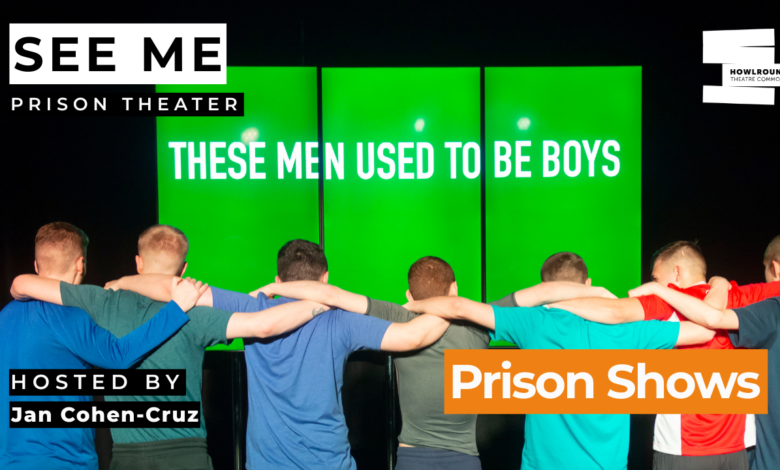
Jan Cohen-Cruz: Episode Five: Prison Shows
In this podcast, we intertwine first-person tales of prison theatre workshops across three continents, reflecting on the prison system, theatre, collectivity, and love. The frame is a love story from one of the workshops between Finn, who was incarcerated, and me, Jan, who cofacilitated.
So how was it for you? To me it just felt like it mattered. I just always—
Finn K.: The performances?
Jan: Both making it with the group, the making, and then performing it for those audiences. The audiences were so alive to it.
Finn: I know. That never had it. And they’re all in there forever.
Jan: Never had anything about themselves. That they’re seeing reflected. That’s what theatre’s supposed to do—
Finn: I never thought about that.
Jan: I mean not the only thing but that’s one big thing.
Finn: Yeah, they really loved it.
Jan: Other people say that, too, in the podcast. These stories were based on things they knew about in their lives.
Finn: Yeah. Right. I remember a skit I did because, you gotta remember, I was like shut down. Like when I went on stage and did that thing, nobody, I didn’t hear nothin’ from nobody. I was oblivious. Heard nothing, nothing, I was just 100 percent focused on that. That was just from terror. From absolute terror.
Jan: It’s so much like traditional theatre, like the Method, where you get really into it and everything is about just living in the moment. When I studied with Lee Strasberg one of the exercises he was really well known for was, we’d have to pretend to be taking a shower. So we each would have a little spot in the room, and you’d have to go through details of feeling what the water felt like, and the soap, and then he would say, “darling, look out at us”—the other students. And people would feel [gasp] like they were naked—they were fully dressed, but they got so into it. It was just wild. It was so much living a thing. And I felt like The Trial had that feeling to it.
When the audiences, the community, came in, I wanted it to be as if we were at a theatre down the road. Just at a show, not a show by young offenders.
Finn: To get to that place when there’s no separation.
Jan: I mean, and that that would happen in this prison, in this prison auditorium. We’re having that kind of theatre experience. Who would have thought it? I didn’t have any idea.
Jan: Here’s John:
John Bergman: When we went into institutions to make a show, we would say, “Look, this is the game. This is what’s going to go on in the next ten days.” And we’d lay it out. What really happened was, day one, they love us. Day two, they work hard. Day three, they hate us: “I don’t wanna do this shit. Why am I doing this shit?” Day four, they got it. Day five, they started telling us how to direct the show. And so on and so on.
Jan: Jess and George in Scotland—
Jess Thorpe: So we worked with a group of eight young men aged between sixteen and twenty-one for about ten months. We started with one three-hour-a-week session and built up gradually as we moved towards production.
George Ferguson: We kind of hand-picked staff that we knew would support the young people and promote them. I remember having a meeting with them and saying, “Your alarms can go silent, so let’s put them on silent, ok? We are trying to make this as professional as we can… the young people have been working on this for ten months. We need to ensure that they get the best chance at this.” That was the ethos because for the fifteen minutes that the show lasted, I wanted it to be an out-of-prison experience. I wanted the guys to think, “I’m not actually in prison at this point.” Physically they are of course, but I want it to be an escape for them and a bit of reality for them. If an alarm were to go off or a radio buzz, then that would bring everyone straight back to the prison context. When the audiences, the community, came in, I wanted it to be as if we were at a theatre down the road. Just at a show, not a show by young offenders.
Jan: This is Ausettua in Louisiana—
Ausetta Amor Amenkum: The LCIW Drama Club uses performances to increase self-fulfillment and self-esteem, instill hope, assist participants in learning more about themselves and others, and introduce them to the concept of ancestor veneration. The reverence for their ancestors directly magnifies the connection they have to themselves, their family, their community, and the world. We made many productions using African concepts, dances, songs, and costumes for women who had never traveled to Africa or even imagined that they were deeply connected to that ancestry and that culture.
Jan: John’s partner Saul—
Saul Hewish: That was a model. Research, discussion, and then creating characters that the audience identifies with, recognizes, and likes. You always said that the character has to do something that the audience would do. You get them on board and then the character does things that they wouldn’t do. And that’s when you investigate it.
Jan: Meanwhile, back in Trenton. Here’s Kathryn Erbe playing me and Terry Kinney playing Finn.
Younger Jan [Played by Kathryn Erbe]: After a few months, the workshop had generated quite a collection of poems and scenes. We decided to perform them for the prison population. Richard and I went to Trenton two extra times a week for rehearsals. It was deeply satisfying for Finn and me to be able to do this thing we loved together and not have our conjoined lives fully on hold.
The scenes reflected how the prison workshop had deepened. We explored both what was and what might-have-been. Nine did a scene about always wanting to fight. He had to support his mother and sister, so he joined the Marines. He was good at it all—hand-to-hand combat, artillery, explosives—and he was quiet. So he was surprised when his first assignment was as a server in the officers’ dining room. When time came for reassignment, they kept him there.
The scene began like so:
Nine: Excuse me, sir, but the class behind me just shipped out. Why was I not among them, uh, sir?
Training Sergeant: Oh, Harris, no slight intended. You’re as good a fighter as we have. But the officers like being served by Negroes and have gotten used to you.
Nine went AWOL and joined the Black Panthers. There, he found other angry brothers wanting to fight but not by picking on strangers overseas. They knew who their enemy was.
One of the guys asked me to do a scene with him beside a hospital bed, me giving birth, him imagining being there for his partner in a way that he suggested he had not. The room got very quiet. I had learned over the course of the workshop that having lots of kids was considered a proof of virility to some men, but actually helping raise them was a little wussy. That scene allowed us all to feel the miracle of bringing new life into the world and the tragic loss for all involved when fathers are discouraged from being involved with their kids.
Kuwasi set up a scene with me as a con-woman, part of a gang liberating money for “the cause,” by seeming to be a hostage they were taking in order to make an escape. There I got to imagine how far I would go and in what direction for what I believed in. Finn and I talked a lot about our multiple selves; I didn’t like when I or anyone else got pigeon-holed. I liked that, in Kuwasi’s scene, my white middle-class character was an outlaw. I loved seeing something I hadn’t expected in someone, slamming me face-to-face into my own preconceptions.
In another scene, based on an incident that happened at Rahway Prison, Richard and I were walking down a prison hallway accompanied by a guard. Other inmates were passing in the other direction, one of whom my character recognized:
Jan: Bobbie! So good to see you. You haven’t made it to workshop in a while. I miss your music!
Bobbie: Great to see you, too. And thanks about the music.
Jan: I hope you come back to workshop. We’re headed there now. Take care. (Unthinkingly stepping over the line between the two sides of the hall, she gives him a little hug.)
Jan (to audience): And suddenly there were whistles blowing and lights throbbing as two guards grabbed Bobbie from either side and hauled him away.
(Back in scene): Stop! He didn’t touch me! It was my fault!
(Back to audience): I sent a letter to an assistant warden, who wrote me back acknowledging my letter and telling me that Bobbie had all privileges suspended for ten days for his “infraction.” Then I wrote a letter apologizing to Bobbie for being so stupid and getting him in trouble. And he wrote back:
Bobbie: Don’t worry. It meant a lot that you like my music and missed me.
In another scene that Kuwasi cooked up, he and I were living in a cramped apartment and had gotten into a rut. I was just falling asleep when he started fantasizing about us starting over somewhere else. I got all excited and also started imagining how we might do that. The scene ended with me turning to him and seeing he had fallen asleep.
Kuwasi read one of his poems:
Tell her that the last time you saw
Me I was heading west
With a cloud of dust
And the biggest horse you ever seen
Tell her that I was putting spurs in his
Ass like tokens fallin in the subway
At going home time
Which I really hated to do ‘cause I know
It did hurt him
But it was either him or me.
Jan: Here’s John.
John: And as it got closer to performance, it began to strike some of them. This is real! This is real! So, then you had to really work fast to get them through all of that and us generally having to do set and props, costumes, all that other shit and trying not to do too much of that stuff. Then, there’d be that whole thing of stage fright, the amount of sheer terror that they had. Many of these guys were often very fearful, and suddenly they had to do something incredibly different, where all their prison experience didn’t count. Remember how they didn’t understand applause even, didn’t know what it meant, because nobody had ever applauded them. So we’d have to go teach them that as well.
Younger Finn [Played by Terry Kinney]: During our first showcase performance of skits and poetry, I had the confidence to be present on stage, but not to speak. Kuwasi had come up with a skit about a shooter randomly killing people walking down the sidewalk. I asked him if I could be one of the victims, to which he agreed. He understood I didn’t want to speak. I chose to stand at a bus stop holding an armful of books all the way up to my chin. When rifle shots were heard–created by Doc, Richard’s boyfriend, with an electric guitar–I stood rigid and let one book fall at a time until all the books hit the ground, and then I fell to the ground. We got a loud ovation for that scene.
My idea for this involved my new life after dying to the world, a world of literature and exploration into my endless tortured path that brought me to the worst prison in America. Like a dedicated reader of the National Enquirer, I simply wanted to know all of it, and who needs Satan to provide this knowledge when one has a lifetime of exploring anything one chooses to explore.
Jan: Here’s Saul.
Saul: One of my defining prison experiences was the first time that I worked with life sentence prisoners. Yeah, all lifers. I’d been asked to make a show with them. I remember being a bit terrified by the notion, not because I thought they were going to hurt me, but rather it was, “What do I do with them?” It was just before I came to work with you. I was still in my late twenties and was this skinny white kid with long hair. And I’m thinking, “What the fuck do I know about being a lifer? Nothing!” So that’s essentially what I used the show to do: to find out.
Younger Finn: After the success of the first show with skits and poetry readings, Richard announced, “We did great, and we are now ready to move on to a major production exploring the one thing all of us here share, a radical sense of justice, always sensitive to injustice when it rears its ugly head. I have learned about most of it through history and political theory, but all of you have learned it from experience. I chose a book we can adapt to the stage exploring the phenomenon of bureaucratic injustice better than anything else I’ve come across. It’s Franz Kafka’s The Trial.
“The novel is about a bank clerk, Joseph K., whom the Court has charged with a crime and is certain of it before Joseph K. is even charged, the Court not caring to engage in any reflection on the matter. No crime is ever officially named. That’s the nature of America’s criminal justice system: Everyone charged is guilty, that bogus refrain ‘innocent until proven guilty’ giving Kafka a good chuckle in his casket.”
Younger Jan: “Someone must have been telling lies about Josef K. He knew he had done nothing wrong, but, one morning, he was arrested.” And so, Joseph K. spends the rest of the book trying futilely to find what he is charged with and get out of the absurd predicament.
Younger Finn: “We know absurdity exists as ground throughout the criminal justice system in America. The entire system is based on a patriarchal hegemony dating back thousands of years. Leaders only saw the suffering masses as ignorant servants or slaves, convinced these lowly ones were genetically programmed to live in sloth with no appetite for intellectual advancement. They accuse all of you of being criminals as a means of locking you away in prisons to exploit your labor. They are responsible for generating the conditions in impoverished cities that force kids to find mentors in the criminal world that they grow up in, that forms their surface personalities, masks, and ambitions, having no option but to become criminals and end up working in prison factories.
“What we’re doing here is waking prisoners up to all of this, and once free from those mental chains, they can turn their justified anger in the right direction—no longer against themselves, their families, and their neighbors, but against the Man. Prisoners will see the time has come to redirect their energy into overthrowing the patriarchs and bring about justice for all. At that point, we’ll have no need for prisons.”
Richard pulled out copies of Kafka’s The Trial for everyone and continued:
“One can’t escape the feeling of being suffocated by a system that is one big prison with endless tiers and cells where one is forced to consult with bureaucrats in seeking a way out, only to discover these professionals could care less about you. It’s not about the surface but how we, absent power and a voice, respond internally to systems of oppression that have us on a treadmill going nowhere, at all kinds of speeds, to escape ourselves as the only way to escape a system of oppression, usually in criminal drug use—precisely how the oppressed end up in prison.
“What I want everyone to do is read the book, at a comfortable pace. It’s going to take time to build this production, and I don’t want you rush-reading the book like an assignment. Listen for any response that is paralleling an experience from your past. Then make a note of that experience, and when we get together, we can start improvising with those scenes, following familiar threads to construct a narrative reflecting the oppressions of prison life and how that connects to Kafka’s story, which is evidence of its universality.”
Kathy: The first performance with the drama club that you did, Ausettua, was Gifts of our Ancestors. It felt right in terms of what your company, Kumbuka—you and drummers Zohar Israel and Brotha T—had to offer the drama club, especially the Black women. As African American women in Louisiana, they all at some point were traumatically separated from their ancestors by the transatlantic slave trade. I didn’t fully understand the connection between slavery and mass incarceration until Michelle Alexander put words to it in her book, The New Jim Crow. But I felt like I was stepping back in time to the antebellum South every time I went to the prison. Even though there were a few white women, one or two Latina, Indigenous, and Asian women throughout my twenty-six years, the majority of the women serving time there have been Black. I couldn’t look at that and not see it, question it, and challenge it.
Gloria “Mama Glo” Williams: Sherral Kahey and I made all those yellow skirts. I ironed all the costumes y’all brought for the show. I remember that ‘cause you have to have your room in compliance, meaning everything had to be put away. But I was in a room that had an empty bunk. I had ironed all the skirts, and I had them on the empty bunk so the guards couldn’t see them when they passed by.
I remember the sound when we were hitting the floor with the sticks. It was a dance to call the ancestors; when you pounded the sticks on the floor, something happened: There was a guest there, who was not one of us! The person who came to visit us—her skirt was in a perfect circle, completely flared, so many panels in it, it covered the whole floor. And it wasn’t no one from our circle. To this day I believe it was one of the ancestors that came to celebrate with us. I hope Kathy or Ausettua finds that picture. The face was blurred. I thought it was Sandra Starr, but she said it wasn’t her.
Younger Finn: When we prisoners started to leave, Richard called to me:
“Finn—can I talk with you a minute?”
“Sure.”
“I was thinking about the best way to integrate personal experience with the scenes in the novel in the structuring of the play. I’ve read your writing. I think you could help with that.”
“If you mean taking notes during the improvisations and linking it to the Kafka narrative, I could do that.”
“That’s exactly what I mean, and thanks for offering!”
Younger Jan: Richard got a few things right—not only was this text a great vehicle for a story we in the workshop wanted to tell, but its power would rely on integrating our personal experience into Kafka’s vision. Richard had mostly done productions of plays written as dramatic lit or stories adapted into dramatic form but not with the actors adapting the narrative from their lives. He somehow must have known that we couldn’t do this play without the participants’ stories, a practice that took the alternative theatre world by storm a decade later.
Younger Finn: It was an epic event in my life, something that rarely arrives. I had been purchasing prison-related literature and blindly purchased a book of collected stories titled In the Penal Colony by Franz Kafka. I had inadvertently walked into a landscape of mind that went deep beyond my imagining, but I caught the drift and pushed forward. I was rewarded in reading another Kafka story, “The Hunger Artist,” experiencing a recognition that our tortured lives, whether chosen as exhibits on the world stage or something we loop around in, unconsciously, can have meaning in artistic expression, and acting is primary for everyone.
In other words, when all else fails, even when camping out in a death wish, the creative spirit can conquer. It harmonized perfectly with my situation in a prison cell, just like the Hunger Artist in his little cell. I realized when a guard or anyone walked past my cell, in the mess hall, in the yard, or when I was sent to a hearing, that sense that I was in a movie and playing the role of a hardened criminal was always there. Forty-three days in the hole and hunger strikes came easy, as long as I was in performance mode. It was all theatre. It was the same on the streets as a teen, selling prostitutes that didn’t exist and other adrenaline-soaked scams, petty thefts, and getting arrested to perform in another play. It was all theatre, from beginning to end.
I had entered Kafka-land never to leave. And here was Richard telling all of us that we would be entering Kafka-land for our major production. It could go on forever, continuing on the outside when Jan and I in a creative commune entered our Paradise. It was one of those cosmic intervention moments where the sense is that all is in order, what I would later understand as an affirmation of destiny.
Younger Jan: The next week, having read the book, Kuwasi said, “How about if in our version, Josef K. is a sociologist, and he comes to the prison to get a job? An assistant warden interviews him and then tells him, ‘Okay, the next part of the process is simulated treatment; we lock you up in a cell so you can feel what it’s like.’ Then the assistant warden goes on vacation. “Meanwhile Josef K. wonders why they are keeping him locked up so long. He calls a guard and says ‘Hey, I don’t belong here!’ The guard says, ‘That’s what they all say.’ Josef K. says, ‘No, I mean I really don’t belong here’—but the guard has already left. And like in the book, he spends the rest of the story trying to get out.”
Kuwasi is chuckling as he describes the scene, and the rest of us are right there with him. Finn adds: “But everyone he goes to is there to keep the system going. That’s their bread and butter. And they must have people to feed the beast.”
“Yeah,” says Kuwasi. “It’s a hellified thing.”
The room goes quiet.
“We gotta have a preacher, a jailhouse preacher,” says Winston. “Who always tries to get you to their meetings and shit.”
“And a psych,” says Finn.
“And arrogant, power-hungry guards,” added Kareem.
So we did. Finn outlined the scenes, and we all improvised, adding the character types we each wanted to play, wanted to expose. The part of our own story to which we wanted people to bear witness. Finn saw The Trial as an entrance into actually speaking on stage, the result of which he believed would determine if he could function as an actor in a theatre community.
Kuwasi played a guard—he would howl “Wolf-Gang, Wolf-Gang, Wolf Gang-Green!” when announcing himself; you could almost catch the scent of rot. Kareem played Captain Beefheart, representing a cadre of sadistic officers—White Hats, they were called—who loved to lord it over the inmates. Kareem got particular pleasure in giving his character an itchy butt.
We added a prologue, outside the story proper, to set up that the story was as relevant now as it was in 1914 when Kafka wrote it. In it, I played the sister of a guy who’d been unfairly imprisoned and had gotten nowhere in proving his innocence. Now she had come to the warden to plead his case again. For I wanted to play someone on the outside who loved someone who was locked up and would do anything to help free them. In another scene I played a sadistic nurse, which deepened my understanding of the abuses of power common among the professional class, of which I was a part.
The next scene was the job interview between Josef K. and the assistant warden, and from there, the whole play unfolded. After the play proper, we returned to the sister leaving the warden’s office, her clothes askew, making it clear that she had traded sex for what she hoped would be justice, but it didn’t look good.
It was uncanny to have found in Trenton, New Jersey this group of people motivated to make theatre for an audience that so-called political theatremakers yearned for–the spectators actually in the situation that their peers are enacting. Not in Manhattan, not with some famous director, nor a well-trained group of actors who’d all gone to some university program together, but somehow our ragtag collection of people whose paths crossed there, and who made a space where we all wanted to tell something that we suffered over, related to injustice, and found a way to tell it together through Kafka.
When time came to perform, the guys circulated a flyer that began:
“ATTENTION COMRADES IN THE STRUGGLE. ON THURSDAY 2 AUGUST, SOME OF THE KAPTIVES IN THIS PRISON WILL PRESENT A PLAY–THE TRIAL.” The flyer explained that false rumors had spread when we did our first show as to who it was for and stated clearly that all our shows were and would continue to be “for the kaptive audience.” It alluded to opposition we’d encountered in the workshop and asked for the population’s support. It ended, “OUR COLLECTIVE THANKS, THE DRAMA WORKSHOP.”
I knew nothing about the rumors the flyer referred to but had felt the guards’ ambivalence that the workshop was too much fun. Did other inmates see it as a reward? For what? I hoped the flyer would quell any doubts anyone had about us.
Jan: John and Saul.
Saul: What makes a brilliant actor in a way is that ability to do it as if it has never been told before. Which takes so much work. Which was what was so amazing about that man we worked with at County Jail #7 in San Francisco.
John: Yeah.
Saul: Remember, he was maybe sixty-five, African American, white hair. He’d been pretty quiet, and it was his turn to tell a story. So he told us about being on a bus, coming into Detroit very early on a winter’s day–I remember somehow he said 6:00 a.m. It was cold and he was alone. Then, he said, the wind picked up, and this piece of newspaper on the pavement flipped up and wrapped itself around his leg like it was his only friend in the world. And you got this incredible picture and feeling of loneliness, cold winter loneliness. And we were all floored!
John: Never forgot it.
Saul: Do you remember the problem though? Do you remember what happened when we asked him to perform it in the show? He could remember the story. The problem was that when he told the story, he kept turning around. So, we’d created a place on stage for memories, a circle where you come to remember and he would start the story. But as he would start to tell the story, he’d start to shuffle. He was telling the story, but the story kept taking him back to that moment.
John: Funny how slightly differently I remember the problem. I remember that he had been a big user of alcohol and was not long in recovery. And frankly his memory was shot. So he’d start to remember the story and then he’d get lost. But the story was so important—and we really honored any genuine story that the men created so we worked and worked and worked with him. And in performance he nailed it.
Jan: Jess and George in Scotland.
Jess: Together we made a piece of devised theatre called MOTION exploring what it means to be a young man in Scotland today. It played for five performances, each time for an audience of sixty members of the general public. It was part of the Futureproof Programme, a festival of new work for and by young people produced by the National Theatre of Scotland as part of the Scottish Government’s Year of the Young Person.
George: I went to all five shows. I thought they did really well with the first show, but there were wee bits here and there that didn’t go quite to plan and you could see them getting agitated. When they did the second show, it was tremendous and I could see that they cared about it enough to keep working on it and making it better. That was a massive light bulb moment for me.
No darkness—perhaps even some hope, if just for a moment. And the feeling of the translucency of all the arts and all our places in that light.
Younger Jan: We did two performances back-to-back, and both times got lively responses from the prison audience. The scenes were familiar, so it felt like our show was an affirmation that their lives were worth putting on a stage. It was certainly an affirmation that the workshop had value beyond us participants.
During the backstage preparations for our performance, Finn brushed my hair, an act almost too exquisite to bear.
John: I’m thinking about one of my favorite pieces, the AIDS play.
Saul: In the UK, it was called Are You Positive? It was a classic piece of TIE—Theatre in Education. Except that nobody was talking about AIDS in prison at that time.
John: There weren’t any practical AIDS pieces in prison back then—I think 1988. Of all the pieces we created, it worked the best because it was the simplest. We played a trick on the guys, which was, get them to love a character who’s a fuck-up, who’s amoral but lovable. Then at some point, we make him sick from unprotected sex and needle use. And then the audience fights the sickness with him. And he dies. And then we teach them how to prevent their own deaths. We did so much research for that piece—we all got tested, waited ten days for the results, we talked to everyone. In those days it was still called ARC—AIDS Related Complex. No one really knew anything at all about how to go and treat the disease.
Saul: There’s another show I still talk about. I think it was the most radical show we did together—the drug show, Hooked on Empty. It was so radical because it was so abstract. It was about dealing with craving.
The premise was brilliant. We’re going to go in, and we’re going to get you stoned without any chemicals. Get them stoned through their imaginations and then teach them strategies to bring themselves down, all in a sixty-minute show. Using everything from hypnosis and sound to word associations. We did the whole play set inside a body. With masks by Sally Brookes that represented what we called the demons of addiction: Suck, Wheedler, Buzz, and Crash. We knew that it worked from the first time it was performed, and there were prison officers with alcohol problems who were going, “That’s absolutely bang on.”
John: And always the intensely improvised, endlessly dangerous interactions with the audience; the decisions we shared with the guys about how the characters would deal with situations on stage. We never really knew how they would react.
Saul: The men were extremely generous in sharing their experiences, and the show had some great moments. I remember at the end, a participant came up to me and said, “That’s the best week I’ve had in prison, ever.” My initial response was feeling overwhelmed by the weight of the comment, followed by a concern that I didn’t really know how to respond. In the end I was just honest with him and said, “Well, this is one of the best weeks that I’ve ever had as well.” Those shared experiences, and their shared life experiences, inside this theatre process, is so compelling.
John: One more memory about the light, not darkness, that we found in some of those places was at a Texas prison. It was a long drive from the Northeast. Five hundred guys and an evening performance. The man who brought us in told us to ask the inmate gospel group to sing before the performance started. They were dressed in these fancy waistcoats, and they could really harmonize. So, they opened our set. And as we got to the end of the show, which is really dark, people are too tired for anger, drunk, people stoned, gone, I went over to the gospel group and said, “Would you sing out the end of the show? It’s just downbeat. I leave it up to you.” They watched and came in at the last moments in the show and sang this beautiful gospel song. Silence. 8:00 p.m. in a prison in Texas. Five hundred men and us holding onto the beauty that had just happened for as long anyone could. No darkness—perhaps even some hope, if just for a moment. And the feeling of the translucency of all the arts and all our places in that light. Stayed with me, stayed with me for always.
Mama Glo: We did so many performances. The most powerful one I remember was Behind the Walls. I had just lost my mother. I didn’t have time to make amends. We did a performance and I released some of the pain and guilt that I felt by apologizing to my mother for the pain that I caused her and the disobedience, ‘cause that was not the way she raised me.
Kathy: You were always devoted to drama, but the turning point came when you shared the death of your mother. It was terrifying. Your voice was so powerful. It was clear that you were reaching through the veil of this world to the next and really begging your mother’s forgiveness. Everyone in the room felt it. You touched an elemental part of human experience. We all came through a mother. And while not all mother/child relationships are healthy, we could all feel the truth of your spirit in that piece, and it freed everyone in the room. That’s the sacrifice we speak of. You were it that day.
Mama Glo: Sherral told the midwife story in St. Gabriel’s Nativity. We mixed our own personal birth stories with Mary’s story of Jesus’ birth; LCIW is in St. Gabriel, Louisiana. We did the performance at Christmastime, and we set the story at LCIW. In it, I worked for the warden, and Mary was pregnant. I didn’t want Mary to give birth to baby Jesus in prison. So I came up with this brilliant scheme: to mix Mary’s release papers in with other papers the warden had to sign.
That didn’t leave a good taste in the actual warden’s mouth. When he watched the performance, for a minute he would not approve for drama to do anything. After Lorraine Gibson, a social worker, left, Assistant Warden Jordan became the prison’s representative for the club and opened the doors again for us to do the performances we wanted to.
Remember the show, LIFE? Warden Jordan came to the performance. It was a parole hearing. I was going up for parole, and I had to convince the board to release me. I had to go through the line, just like Minnie McCallan, when her family came to get her on a white bus and they were all dressed in white. They made a line and she had to walk through it. We did that in our performance. All were dressed in white. When I was granted parole, Sandra Starr came through the line to get me because I was really crying. And Warden Jordan said: “Somebody’s going home!” Two months after that, Jackie Collier, the one they said would never walk out of prison, went home. And ten years later, so did I!
Younger Finn: The night we performed The Trial, I saw clearly how Richard would sacrifice Jan and anyone else. It was etched in his face when he confronted a guard who went to complain about us as we were setting up. Richard was excited about the possibility of a riot and purposely naïve.
I immediately told Jan the danger of a confrontation with some of the guards that could get violent. She looked at me with concerned, sympathetic unbelief in what I was saying. Then I had this thought that Kuwasi might use a riot to escape. I would, if escaping was my penchant, and it certainly was Kuwasi’s; a riot would be a gift for his intentions. It would be a perfect opportunity. So, saving Richard or anyone else from the outside in a riot would not be his first concern. I see my apprehension as valid then and now, no mistaking it. I remain an extreme empath, another reason I’m alone, and that’s not a lament. It’s my destiny.
Younger Jan: Our performance of The Trial did not set off a riot; on the contrary. Not only did we get no substantive pushback from guards, but I felt the tension of the prison audience release as we performed and was gratified to hear much laughter of recognition. Seeing experiences that the spectators knew to be true enacted on that stage did not make audience members angrier; it affirmed them. They did not need us, despite Richard’s rhetoric, to show them the truth of incarceration; they knew it very well. Our contribution was to reflect it back to them in a room where we witnessed it all together. We knew that each other knew, and that counted the guards as well as the inmates. What anyone does with what they know is a next step.
I recently asked Finn why he thought the show might lead to a riot. He said he didn’t mean the audience would rise up, but rather that by provoking the guard, Richard might be setting him up to make sure we were punished for being there in the first place. But that didn’t happen. The show was a true testament to the power of theatre that is by, of, for, and about its intended audience, and we all felt high for weeks.
Jan: Making theatre together, performing it for other people, being seen in our multiple dimensions, deepened our relationships and our sense of higher purpose, in short supply in prisons. Tune in to Episode Six about the joys and challenges of shifting perspectives.
The theme music you are hearing was composed by Sasha Paris-Carter. The musicians are Daniel Knapp on cello, Dionisio Cruz on percussion, Joanna Lu on viola, Mary Knapp on accordion, and Rene Ferrer on bass guitar. The percussion ensemble is Kumbuka African Drum and Dance Collective. Wade in the Water featured Kenny Butler on piano and vocalist Haja Worley.
This is Jan, signing off.