Foreword
New York City, 2021. Isolated, over-snacked, and starved for a creative community, I joined a virtual playwriting group. I was writing an existential dark comedy (as one does during a pandemic-induced lockdown) and thought, this play has clowns. Where do I find those?
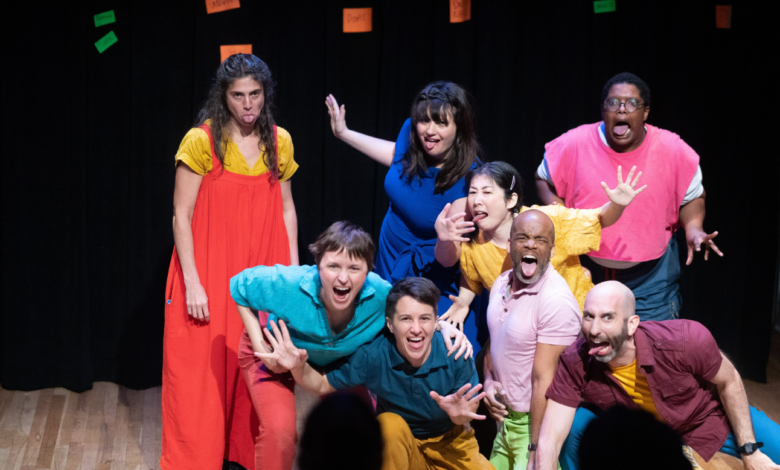
Once things opened up, an online search led me to something called “Clown Gym.” One Google Form and $15 later, I was tiptoeing into a studio, debating whether I should run back to Brooklyn, when I met a pair of kind and curious eyes peering over an N95 mask. “Welcome! I’m Julia. What’s your name?” She was dressed in brightly-colored overalls that matched her vibrant presence.
After sixteen months of isolation, those two hours of games and improvisations revived my spirit. The weekly ritual of play at Clown Gym was transformative and eventually propelled me to the Pig Iron School for Devised Performance.
Maybe clown is not only a form, but also a call to action.
Clown has existed since the first breaths of humanity, but in recent years, it has been revitalized as a movement in United States theatre. Clown Gym has served a vital role bringing people to the form, especially on the east coast (shoutout to the Los Angeles clown scene). But, more than a training ground, it was a special community nourished by Julia Proctor’s mission to make this work consistently available and financially accessible in a space that prioritizes people. Clown Gym modeled how to operate an organization based on the values it teaches by always adapting to meet the needs of the room.
Maybe clown is not only a form, but also a call to action. What can the ethos of clown offer when building other kinds of brave, inclusive, and joyful communities and organizations?
To be part of a movement, we need a vehicle. So…
How To Fill a Clown Car: An Instructional Guide
Step One: Figure Out What “Clown” Is so You Can Figure out How to Fill a Car with Them.
For most humans, the word “clown” conjures the following images:
- A smiling stranger with tumultuous makeup honking incessantly at Jimmy’s birthday party
- Hamburgers
- An unwelcome invitation to a sewer
Not to yuck anybody’s yum, but that’s not what we’re trying to fill a car with today. When we discuss clown in relation to theatre, there’s not a universal definition. However there are nuggets of insight, passed down through history and shared by contemporary clown teachers, that help us sense the territory:
Clown is:
- “Who you would be if you were never told ‘no’ and never betrayed your enthusiasm.” —Christopher Bayes
- “The dissolution of the fourth wall.”
- “The parts about you that your best friends laugh at behind your back.” —Aitor Basauri
- “A state of play.”
- “A poet who is also an orangutan.” —John Towsen
- “A discovery of how ‘personal weakness’ can be transformed into dramatic strength.” —Jacques Lecoq
- “To process with humor the tragedy of life.” —Giovanni Fusetti
For a concept rooted in stupidity, it becomes quite philosophical. The clown elders suggest that it’s not just fart jokes and hamburgers. But—
Clown is:
- Actually also fart jokes and hamburgers.
Step Two: Find a Whole Bunch of Clowns.
…Where?
Step Negative One: Find One Clown Who Organizes Clowns to Lead You to a Whole Bunch of Clowns Who You Can Fill a Clown Car With.
Enter Julia Proctor, the founder and director of Clown Gym—the bedrock of clown development in New York City. She also sometimes goes by “Icky Shirley Dangle.”
*****
Data crunch break: Over the past ten years, Clown Gym has produced four hundred drop-in workshops, twenty workshop intensive series, twenty virtual clown shows, seven Clown Flexes, seven open mics/clown parties, three devised shows, the Examining Clown Lab, a teaching cohort, and thousands of students.
*****
That’s a packed car mainly driven by Julia’s blood, sweat, tears, and joy. How did she find herself here? As she told me,
Many years ago, living in Washington, DC, I was a… super serious actor. I took myself very seriously. I had my heart set on New York University (NYU) for graduate school, and I didn’t get in. They told me, “Your technique is strong, but we want more mess.”
“I know that’s why I want to come here!”
And they said, “You should study clown with this guy Chris Bayes.”
The first time I had “success” in his class was so disorienting and confusing because I didn’t know why they were laughing at me, and I was getting more and more upset, and they kept laughing harder and harder. As this Type A person that likes being in control, that success came when I was out of control. And I got hooked.
After a couple of summers training with Bayes, Julia spent the next year apprenticing with him at Yale, Juilliard, and the Funny School of Good Acting, now known as The Pandemonium Studio. After one workshop, participants approached Julia wondering how they could keep this group training going. One student worked at Shetler Studios, and he used his staff credits to donate space, so the group began meeting regularly to trade leading games and exercises. Clown Gym was born in 2014 as a “collaborative member-sourced experiment in play.”