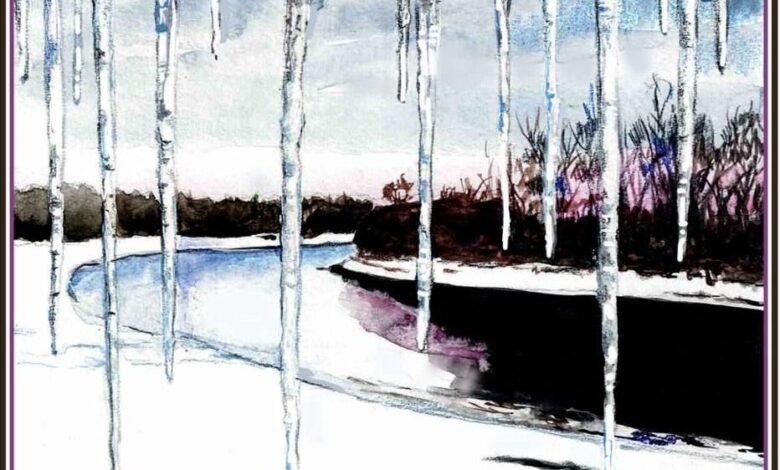
 Mile-long Trout Brook cuts downhill through heavily bouldered glacial moraine. Like any woodland brook, it features waterfalls, cascades, pools, and coves.
By mid-December it is usually frozen over, with audible water running under the ice and snow. Only a mile from my home, I often visit this brook from mid-November until late March to see the splash-enhanced bulbous icicles and frozen foam.
During some recent winters, however, climate change has brought unseasonably warm spells, incomplete ice covers, decreased water levels, and insignificant snowfall, all of which expose ice formations normally unseen.
These formations are known as frazil (often referred to as “frazil ice”), and they don’t begin in water, they begin in the air.
Ice first forms in air because water turbulence prevents freezing even when its “supercooled” temperature is below 32 degrees Fahrenheit, and brooks and many parts of rivers are highly turbulent.
Even on Trout Brook’s widest pools, where you might see a leaf moving only a mile per hour or less, the water below is swirling, churning, and mixing.
Experiments have shown that vapor in cold air, which will not spontaneously freeze until its temperature reaches about negative 42 degrees Fahrenheit, will nonetheless freeze against dust or organic matter to form microscopic “ice seeds” at far warmer temperatures.
In woodlands, airborne bacteria and fungal spores most commonly host ice seeds.
The ice seeds eventually fall into the super-cooled turbulent water. Just as ice particles tumbling through air amazingly form symmetrical snowflakes, ice seeds tumbling within turbulent water collide, break (forming more seeds), and grow into tiny symmetrical discs.
Most discs are elongated into forms known as spicules, typically one millimeter or less long. These forms are what scientists refer to as true frazil.
Discs tend to stick together upon collision to form what is known as flocs. Their diameter can exceed a few inches as more discs and water freeze to them. Dipping a fish net into a brook after a cold night will likely catch several.
Frazil freezes against cold shores and gets caught in coves, accumulating to make what river engineers call border ice. This ice first appears as a random mesh with space for frazil to grow.
Within hours, flat, inch-long, tree-like crystals with branches at different angles appear. If crystals within a fresh web are not obvious to your unaided eye, try a close-up cellphone picture to see their beauty.
Break off a chunk to find jumbles of inch-sized flocs, and crystals that have grown into vertical plates on the undersides. Within a day or two, borders will have grown into a solid white mass, far different than the fresh, transparent, bubble-rich ice we see on our lakes.
Frazil and flocs freeze and accumulate against submerged shores, mid-stream rocks, and river bottoms, all of which have been supercooled by the water. Engineers call this accumulation anchor ice.
A few years ago, when I was exploring Trout Brook in late February, I found myriads of flocs accumulated against shoreline rock walls, on mid-stream boulders, and piled on the beds, as I expected.
By early March the ice and snow were gone, Trout Brook was roaring, and moss and lichen on rocks and trees were fully visible. Though it felt like winter might be over, cold weather later that month brought me back to see plenty of fresh crystalline borders and anchor ice.
Visiting Trout Brook throughout the long winter has allowed me to see the many forms of ice and to understand how the story of ice forming might unfold again and again throughout future winters.
As you walk through winter woods, I hope you might stop at a brook or stream to notice ice. Look around at the lichen on the trees and any moss or fungi that may be exposed on the ground.
Some bacteria are still active in cold weather, and a gust of wind can launch bacteria and fungal spores from their places into the air. These will attract more vapor, creating ice seeds, which will eventually become ice crystals.
Steven Arcone is a semi-retired research geophysicist whose professional career included 43 years at the U. S. Army Cold Regions Research and Engineering Laboratory in Hanover, New Hampshire. Illustration by Adelaide Murphy Tyrol. The Outside Story is assigned and edited by Northern Woodlands magazine and sponsored by the Wellborn Ecology Fund of New Hampshire Charitable Foundation: nhcf.org.
Source link