We Have a Lot to Learn from Each Other. HowlRound’s Learning Circles Give Us a Place for It.

The Pilot
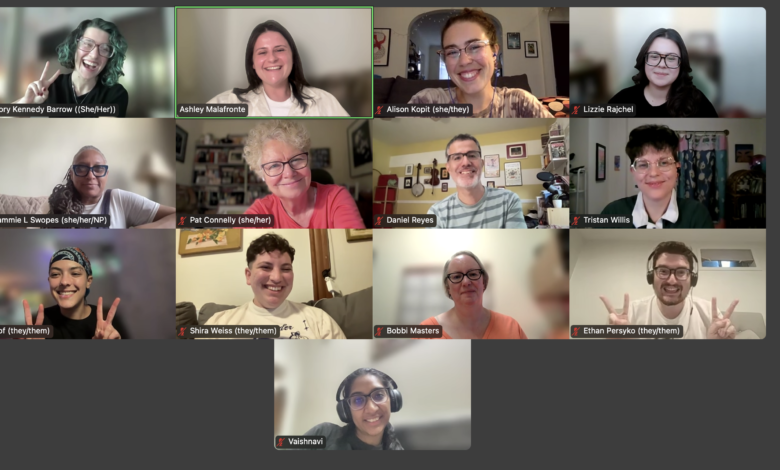
In June 2025, HowlRound put out a call for participants in a pilot Learning Circle called Justice in the Rehearsal Room. We invited theatremakers to join us for a “four-week co-learning journey for theatre practitioners to reflect and build knowledge about the way justice shows up in our rehearsal rooms.” This invitation resulted in the HowlRound team’s first big lesson: the hunger for these spaces was greater than anticipated. We had been hoping to fill a single cohort but were humbled to receive enough interest to fill many groups. We selected a cohort of fifteen at random, filtering only for those who could attend all sessions. The result was a group with wide-ranging backgrounds in terms of geography, identity, practice, and approach to both theatre and justice work. As I wrote in our welcome email, I knew immediately that we had a lot to learn from each other.
The first pilot group met for four weeks in ninety-minute sessions that teemed with energy and insight. But our conversations threatened to overflow their container; it was hard to go deep, to remain truly responsive. So we ran another pilot, extending to two-hour sessions across five weeks, and with more time came more space for nuance and reflection.
The added session in the second pilot served as a welcome week, giving everyone an opportunity to introduce their own theatrical background and discuss their investment in a more just field. The remaining sessions—which were the same in the first pilot—were organized around the following themes:
- Centering Trust and Care
- Gender, Sexuality, Intimacy, Autobiography
- Anti-Racism, White Supremacy Culture, Collaboration, Power
- Access, Disability, Size Inclusivity
I focused on HowlRound content by theatremakers who disrupt unhealthy and oppressive structures and offer alternatives rooted in equity, care, and justice.
All Learning Circle participants were taking time out of their busy lives to come together, and that is no small feat. With folks Zooming in from across North America, Europe, and Asia, we were always meeting each other during somebody’s dinnertime, work commitment, parental duties, typical sleep schedule, and so on—and that doesn’t account for the time it takes to engage with the assigned materials. I tried to mitigate potential friction by offering the full reading list in a syllabus at the beginning of each group and sending out discussion questions in advance for those who would like to review or prepare.
In selecting readings and other materials for Justice in the Rehearsal Room, I focused on HowlRound content by theatremakers who disrupt unhealthy and oppressive structures and offer alternatives rooted in equity, care, and justice. Each week put four of these pieces in conversation with one another and, because I cannot help myself, offered several other pieces as optional extensions. We have made the syllabus, including targeted discussion questions, freely available for others to pursue these ideas independently.
Choosing materials from HowlRound’s archive enabled a unique facilitation structure that became a real highlight of the Learning Circle experience. Each week, one of the HowlRound contributors who we were reading/listening to joined the group as a co-facilitator, working alongside me to develop discussion topics and activities rooted in their work. Co-faciltators Alison Kopit, Taylor Leigh Lamb, Dolissa Medina, Nicolas Shannon Savard, and Daphnie Sicre profoundly shaped the individual sessions they attended and, by extension, the groups as a whole. With this structure, participants got to read or listen to another artist’s work and then discuss it with them directly, a move that invites both expertise and knowledge-sharing.
We used a few other tools to seed community and exchange ideas. In a “Resource Potluck” document, participants and facilitators alike added readings, videos, podcasts, or other materials to expand upon our work. On the suggestion of a first pilot participant, we tried out a “Communal Notes Bank” document in the second pilot so that folks could add their notes. We also established community agreements in our first session and circulated a contact sheet at the end of the program so everyone could keep in touch. As we continue growing the Learning Circle community, HowlRound hopes to provide additional points of exchange to keep these connections going beyond the individual groups.
It modeled a path forward for the arts: one that resists gatekeeping and instead invests in communal care and shared humanity.
Our Learnings
Participant and co-facilitator feedback from both Learning Circle pilots consistently indicated that the readings/materials, facilitation style, and program structure were the program’s greatest strengths. Participants appreciated that the co-facilitators did not lecture, but instead joined in collaborative discussions and activities grounded in the week’s readings. One participant wrote that this facilitation style “created an environment where people could bring both vulnerability and rigor into the space.” The readings supplemented this by offering a wide variety of perspectives that sometimes contrasted, allowing the group to explore ideas they didn’t always agree with. For example, members of both groups initially found that Taylor Mac’s argument for non-auditioned casting in “A Culture of Trust” was a tough pill to swallow, but when they listened to a podcast episode in which Nicolas Shannon Savard discussed conversations as a casting tool, their feelings on the strategy often evolved. As one participant offered, “each session, while unique, seemed to be in conversation with previous or future weeks.”
Participant feedback also illuminated some ways that Learning Circles can continue to grow into their purpose, which I share here as a commitment to continued growth and—I hope—as takeaways that others can bring into similar work:
1. Learning as Conduit to Connection and Action.
Participants were hungry to bring their lived experiences and artistic practices to bear on our conversations. In this rare chance to connect with geographically dispersed but ideologically aligned theatremakers, they wanted to discuss shared challenges and hear how others were addressing them. They identified small group opportunities (i.e. Zoom breakout rooms) as key sites for deeper, more vulnerable engagement. Hearing this caused me to release an initial resistance to breakout rooms that was rooted in my own desire for control as a facilitator. The second pilot included more of these small group opportunities (and positive references to them in the feedback!) and the extra welcome session focused on participants’ practices. Future programs will dedicate additional time to professional connections by adding a closing session as well.
Similarly, a couple participants advocated for more time spent on actionable steps. One person shared that they had expected more space to work though problems participants are currently facing, though they ended that reflection by acknowledging that the group was “a ‘learning’ not a ‘doing’ circle.” I really love this nuance between learning and doing; while this program is firmly grounded in the former and, frankly, lacks the organizing capacity for sustained action, it feels important to honor participants’ desire for action steps in our session structure.
I’m also hopeful that these groups can seed action indirectly, as one participant implied when they shared that the Learning Circle “gave me tools and language I can take back into my own work as a storyteller and community practitioner.” Already, one participant wants to start a book club with local artists to continue learning in community. Another is interested in partnering with values-aligned theatremakers in their area to implement some of the ideas we discussed. HowlRound does not need to be the instigator of further action for that action to be valuable, though we are always interested in supporting and partnering where possible.
2. Intercultural Exchange Requires Intentionality and Care.
Inevitably, everyone comes to a Learning Circle with their own perspective shaped by their social position, experience, and prior learning. Folks coming from a place of power and privilege sometimes experience conversations about justice as novel or theoretical, while folks who have been disempowered or marginalized through systemic injustice might find that approach distancing and crave practical discussion grounded in action. Some participants shared that our pilot program was the first time they had been asked consistently to share access needs, the first time they saw people introduce their location with the names of Native lands and peoples, or the first time they unpacked the tenets of white supremacy culture. For others, these activities are standard practice.
Enabling cross-identity exchange begins with the participant selection. I particularly appreciated one first pilot participant’s reflection that “If we are, as a community, aiming for accessibility and inclusion, the group participating in discussions should reflect that. Perhaps being more intentional about the selection of participants could benefit the program and provide more unique perspectives on the topics discussed.” For the second pilot, and moving forward, the HowlRound team has discarded the randomized selections process in favor of one that prioritizes a wide range of perspectives. Our aim is to lean into the “intergenerational, multicultural, and multiregional perspectives” that another participant remarked upon as drivers of peer learning.
As we continue implementing strategies to meet participants where they’re at, it is with the hope that the Learning Circles live up to the experience of this second pilot participant:
Participating in this recent process was restorative. It offered a rare environment that genuinely supported practitioners like me: those who have been marginalized, silenced, or systematically pushed out of the very communities they work to uplift…. It welcomed a diversity of backgrounds, lineages, and ways of thinking—something I have rarely experienced in institutional settings. Although inequities persist, particularly those rooted in hierarchy, status, and the unexamined privilege that continues to shape academic discourse, the intentional design of this environment fostered greater equity, compassion, and self-awareness. It modeled a path forward for the arts: one that resists gatekeeping and instead invests in communal care and shared humanity.
3. Preparation in Service of Presence.
This learning comes from two strands of participant feedback that seem, at first, to be in tension with one another. In one, many participants indicated that structure and preparation are essential to their success and comfort in this session. In the other, participants desired opportunities for the program to develop “in an evolutionary way” from week to week.
The provocation to evolve is, admittedly, one that goes against my natural inclinations. As an eldest daughter with many Capricorn placements, I know that what feels like stabilizing structure to me can be too rigid to others. As the lead facilitator of this pilot program, I wanted sessions planned down to the minute, pre-determined discussion questions, and a tidy progression from week to week. And many participants listed these qualities among the program’s strengths, so they’ll stay.
However, preparation cannot come at the expense of presence. One participant shared that we sometimes had a tendency toward “talking in circles,” which perhaps comes from me, as facilitator, clinging too closely to a script. Another synthesized these two needs by offering an adrienne marie brown quote: “There is a conversation in the room that only these people at this moment can have. Find it.” brown implores us to be responsive, to pay attention. While structure and preparation will remain intact in future Learning Circles, I am grateful to these participants for the nudge to prioritize evolution and presence, too.
This program will keep evolving to remain responsive to the interests and needs of the community.
Learning Circle Futures
Today, Learning Circles officially launches, beginning with a Justice in the Rehearsal Room group this spring. We look forward to rolling out additional groups and new curricula as we build capacity throughout 2026. Pilot participants have been excited about topics like theatre training and pedagogy, commons-based approaches to theatremaking, leadership and organizational models, and accessibility and disability, and I’d love to see other topic ideas in the comments of this essay!
This program will keep evolving to remain responsive to the interests and needs of the community. To continue stewarding this work, my role at HowlRound has expanded to include both senior editor and learning programs manager. The Learning Circle program, however, is a collaborative effort, and its current form is indebted not only to various HowlRound team members—including Ramona Rose King, Julia Schachnik, and Alison Qu—but to the pilot participants and co-facilitators who shared their time and their generous feedback.
If you’re interested in joining a Learning Circle, you can find all the details on the Learning Circles page. Sign up for our mailing list to be the first to hear when new curricula and groups launch!