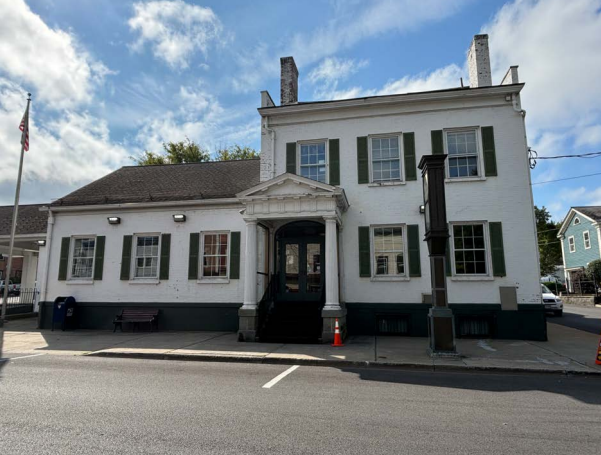
 Long before it became a bank, the building on Front Street in Ballston Spa, Saratoga County, NY, was simply a house, quietly resting on land once belonging to Johannah Hawkins, a woman whose story lingers only in the faded lines of an old newspaper notice. Her property, marked by creeks and stone heaps, was a patchwork of boundaries and memories.
When the land changed hands at auction in the winter of 1833, no one could have guessed it would soon anchor one of the village’s most enduring institutions, the First National Bank of Ballston Spa. Later named Ballston Spa National Bank, it is often referred to as BSNB.
Five years later, the bank’s founders purchased that modest house and set about transforming it into a place sturdy enough to hold the community’s trust.
The exterior stayed familiar, but the inside became something new: reinforced vault rooms, a front parlor turned teller counter, upper floors converted into bookkeeping and office space. Through it all, the fireplaces that remain are quiet reminders that this institution began as someone’s home.
In the 1800s, bank presidents and directors were not often bank professionals but rather business owners, lawyers, industrialists, and judges; men whose reputations served as the bank’s public guarantee. Their names lent credibility, their capital provided stability, and their influence shaped local politics and commerce.
By the late 1830s Ballston Spa was thriving, powered by mills along the Kayaderosseras Creek, and mineral springs tourism. It was the banks good fortune that its first president, James Merrill Cook, was an experienced businessman and local political leader who also understood the role of financial institution’s.
Cook, a young man from a respected Ballston Spa family was eager to discover the world beyond his hometown and ventured to the city of New York, immersing himself in the bustling world of business. When Cook returned, he didn’t simply settle back in; he poured his energy into shaping the village’s future.
He served multiple terms as village president and brought the same drive to the founding of Ballston Spa National Bank, while also owning and operating cotton mills in the village. He gave the growing community a financial anchor when it needed one most.
He became well regarded in the New York banking profession, and after serving as the National Banks president for 18 years, he became Superintendent of the State Banking Department in 1856.
In 1833, he married Anna Cady, a woman who would outlive him by more than thirty years and quietly preserve the family’s legacy. Together they raised four children: James, William, Catharine, and Anna.
Only Catharine would have children of her own, marrying diplomat George Sherman Batcheller (1837-1908) and carrying the family line to Saratoga Springs where they built the well-known Batcheller Manson. (Batcheller was born in Batchellerville, in Edinburg, NY, which was named for his grandfather.)
Following the presidency of Cook, the Thompson family left their own mark on the bank’s strength and growth. Judge John Tompson’s son, John Whalen Thompson, was himself the county surrogate judge from 1834 to 1847 and was one of its original incorporators and directors.
He became the banks longest serving leader until his death in 1892. His son and grandson, George Lee Thompson and George Lee Thompson Jr., each went on to serve as president, continuing a family tradition of conservancy.
Andrew S. Booth succeeded the Thompsons as president from 1896 to 1907. A skilled telegrapher who once worked for Western Union, Booth represented the blend of technical ability and community standing that defined turn‑of‑the‑century banking.
Over the years the bank’s hierarchy, presidents, vice presidents, directors, officers, clerks, and tellers, represented a wide range of respected local professionals. Their collective reputation helped build the institution’s credibility, while their work supported its daily operations and it’s value to the community.
As the 19th century gave way to the 20th, the bank’s leadership evolved. What had once been a role reserved for prominent local figures gradually shifted to trained financial professionals, reflecting broader changes in American banking.
In the modern era, presidents such as Christopher R. Dowd represent this new model; career bankers supported by directors with expertise in finance, law, and business.
 In an interesting side note, for 67 years, the First National Bank of Ballston Spa issued national currency, ending in 1931. Its $1, $2, $5, $10, and $20 notes, printed by the U.S. Treasury in uncut sheets, came in various forms: brown‑back, red‑seal, and blue‑seal designs. Today, these bills are prized by collectors, tangible reminders of the bank’s long federal charter.
The bank’s own story was later chronicled by Ruth W. Roerig, a Malta, NY historian and former vice president. Her 1988 book The History of Ballston Spa National Bank 1838-1988 preserved not only the institution’s history but also the stories of the people who shaped it.
Roerig herself broke barriers, becoming the first woman to serve as president of the American Institute of Banking (now the American Bankers Association) and remaining an active community leader through her work with the Malta Planning Board and the Daughters of the American Revolution. This article owes much to Ruth’s legacy.
In 2026, BSNB begins a new chapter in its history by joining forces with the National Bank of Coxsackie, NY. The merger is a partnership – two long‑standing community banks recognizing they could serve their neighbors better together.
Coxsackie kept its familiar name as a division of BSNB, while customers served by both institutions will gain a wider network and stronger resources. Much like Cook’s original vision, the merger created a larger, more resilient community bank that still holds tight to its local roots.
From its humble beginnings in a converted house on Front Street, Ballston Spa National Bank grew alongside the village, quietly anchoring generations of families and welcoming newcomers.
Its story is woven into the very fabric of Ballston Spa; a testament to resilience, adaptation, and the enduring spirit of a community built by those who believed in the power of local institutions.
And as you walk past its doors or see its name on a street sign, you’re not just passing a bank, you’re stepping into a living piece of history, one that continues to touch lives, including yours and mine, with every passing day.
Read more about Ballston Spa history.
Amy Shannon runs the popular book review site Amy’s Bookshelf Reviews and a writer’s blog. She is the author of Balls-Town: A Community of History, Friends, Neighbors, and Lingering Spirits and Reminiscences of Balls-Town: Echoes and Whispers of Forgotten Legacies, planned for release in April 2026.
This essay is presented by the Saratoga County History Center.
Illustrations, from above: Ballston Spa National Bank at 87 Front Street in Ballston Spa (courtesy NY State Parks); and a 1929 Ballston Spa National Bank ten dollar bank note.
Source link