
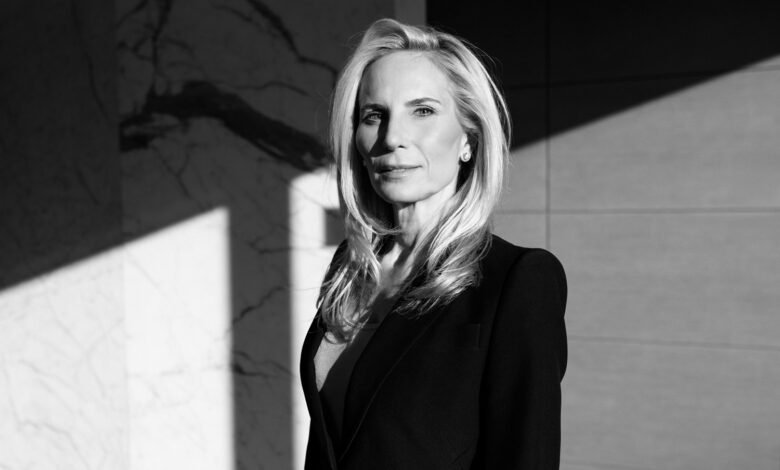
Lauren Hochfelder climbed the ranks at Morgan Stanley to take the helm of one of the firm’s main investment platforms.
As head of global real assets, Hochfelder oversees roughly $78 billion in investor capital across four core strategies: private real estate equity, private infrastructure and two real assets credit businesses. Since joining the firm in 2000, Hochfelder has held a series of leadership roles before she expanded her mandate to the entire real assets division, which includes 300 people across 20 offices in 13 countries.
Over more than two decades, she has helped steer the business through boom times and bruising downturns, rebuilding the platform after the financial crisis and sharpening its focus on long-term, data-driven trends like net lease properties and senior housing. Hochfelder is also a familiar face on financial news shows, where she speaks fluently about the areas of the market Morgan Stanley is leaning into.
Hochfelder grew up on the Upper East Side, the daughter of a father who ran a clothing manufacturing business and a mother who was a part-time real estate investor — an early introduction to the business. (Both are now real estate brokers.) She attended such elite schools as Dalton and Yale before making her mark in commercial real estate.
Today, she’s raising her two children just four blocks from her childhood home, where she grew up alongside her brother, David, chief investment officer at Naftali Group.
The interview has been condensed and edited for clarity.
Born: February 23, 1978
Hometown: Upper East Side
Lives: Upper West Side
Family: Two children, ages 12 and 13
What were you like as a child?
I had a lot of interests as a child. I loved school. I had amazing friends and teachers at a young age. I was very serious about ballet and subsequently various types of performance art. I was always just really curious, energetic and always loved participating in a wide range of things.
What was your first job?
My first paycheck came from the New York City Ballet, when I performed in “The Nutcracker” in Lincoln Center. I was maybe 10 and I was a soldier.
So you were pretty serious about dance.
Yes. Beyond the beauty of the discipline itself, it’s such an amazing way to engage with rigor, discipline and practice, and working as a group.
I imagine that a lot of those skills still apply to your career today.
Yes. Just not in a tutu.
“We can speculate about interest rates, but we can calculate that the 80-plus population is growing by over 50 percent over the next decade.”
How did you get into real estate?
I joined Morgan Stanley straight out of college as an investment banking analyst in the real estate group. At that time, our real estate private equity business was part of investment banking, and so I joined straight out of Yale, and the rest is history.
Did you have a mentor?
I’ve been really incredibly blessed to have several really incredible mentors over time. John Klopp, who is now the chairman of real assets here at Morgan Stanley, has been the most amazing mentor you could ask for. He’s been empowering, encouraging, and pushed me to take on new challenges, sometimes even before I knew I was ready. Our business went through a transitional period after the [Great Financial Crisis], and John came in at the time all of a sudden as the new guy. But it turned out to be so great — not just for our business, but for me personally.
What asset classes are you investing in right now?
We’ve been very active in a few spaces. Net lease — real estate that is long term leased to credit tenants in a structure on which the tenant pays the rent and all the expenses — is a very high-conviction strategy for us. It’s where you have the most predictability of cash flows and the least exposure to macro uncertainty. Another … is senior housing, driven by aging demographics. We can speculate about interest rates, but we can calculate that the 80-plus population is growing by over 50 percent over the next decade.
On the infrastructure side, we’ve been most active in digital, energy transition, utilities and transportation.
You’ve weathered a few downturns. What are your strategies?
I think one of the important lessons we’ve learned is to see reality clearly and early, and to stay reality-based, data-driven, make hard decisions, challenge each other, be willing to admit when things didn’t go as expected, and really to dig deep on what we got wrong.
The finance industry has long had gender imbalances at senior levels. Have you had to take a different approach than your male peers to advance?
I feel so fortunate that there were generations of women in our industry who did have to overcome pretty substantial hurdles. I feel like I’m really the beneficiary of so much of the work they did. Across our broader team, and across our senior team, we have various types of diversity, including gender diversity. And I think it enabled us to make much better decisions. An example of that might be we developed high-conviction early around e-commerce and took the view that it would be a major driver of industrial real estate demand. We invested heavily around that trend and it was wildly successful for us. If you think about gender diversity, women are disproportionately responsible for household-buying decisions.
If you could give your younger self advice about climbing to a leadership role in finance, what would it be?
Work for and surround yourself with the smartest people you can find.
What is your biggest career gaffe?

Coming out of the Great Financial Crisis, we invested in some secondary market office, and actually that was more than a gaffe. That was an investing mistake. We ultimately monetized those assets at a profit, but they meaningfully underperformed our expectations. I think the experience really brought us together as a team to understand what went wrong.
How would your colleagues describe you in three adjectives?
Collaborative, results-oriented, hands-on.
I read in one article that you grind your teeth. Do you have any other vices?
I have a bad sweet tooth.
Which sweets?
Häagen-Dazs vanilla bean ice cream — no other dessert comes close. Also black & white cookies from William Greenberg on the Upper East Side and anything chocolate.
When you’re at cocktail parties and you tell people what you do, what’s the most common question you get?
“Is the market going up or down?”
What advice have you given to your children?
Take in as much as you can every day. We’re so fortunate to live in an amazing city in an amazing country. They’re so fortunate to go to a great school with great friends, and I just encourage them to take it all in and to ask questions and stay curious.
What do you like to do on the weekends?
I love any activity with my kids. We love to go for long walks, to do anything outside — hike, bike, jog.
Do you do anything with them that you used to do growing up on the Upper East Side?
We have a lot of the same family traditions, whether it’s shows that we go to, or Sunday night dinners, we do a lot in the neighborhood that’s not all that different from the things I used to do with my parents and brother. My kids and I eat at so many of my childhood haunts: Saturday lunch at Three Guys on Madison Avenue, meatballs at Elio’s Restaurant, gelato at Saint Ambroeus, Chinese food takeout from Shun Lee.
Growing up, I spent a lot of time at Lincoln Center, including for ballet and at the opera with my grandfather. I certainly take my kids there (including for the Nutcracker every year — just like I went with my parents). But more often I take my kids to Broadway and off-Broadway shows and concerts. We see and love a lot. But Hamilton still reigns in our house. We keep going back.
We do have some differences. I grew up a Mets fan, and my kids are somehow partial to the Yankees! We all love Central Park — but for me growing up it was all about Sheep Meadow whereas they prefer the Great Lawn, where they can actually play sports.
We also love to explore. We love to travel.
What is your favorite restaurant?
Mezzaluna. It’s our local spot a couple blocks from our house. My kids have befriended the pizza maker.
Where was your most recent vacation?
I took the kids to the Winter Olympics, which was an unbelievable, pinch-yourself, incredible experience. It was so cool to be with them and see all of these incredibly talented and driven athletes who had done so much to make it to the Olympics.
“Is the market going up or down?”
What events?
We saw the ski jump, figure skating — so we saw when the American figure skating team won gold — and ice hockey.
How did growing up on the Upper East Side and attending Dalton shape your career? Dalton alumni seem to have a notable presence in commercial real estate. Have you found that network to be helpful professionally?
Most significantly, I feel like I had incredible teachers who, from an early age, focused on teaching us how to learn, how to think and how to really develop our own views, and I think that helps sort of train your mind to think like an investor, so that was certainly an amazing privilege. It’s definitely really fun to live in New York and have so many childhood friends that I still get to see, either regularly, or occasionally run into.
Do you think it’s a coincidence that you and your brother both ended up working in commercial real estate?
I think we grew up pretty passionate about New York City and seeing how different neighborhoods could transform over time, seeing how private and public sector investment completely transformed neighborhoods, so I think we both grew up really interested in it. So both coincidental and not. I guess it’s a shared passion.
What career advice did your parents give you?
My parents prioritized family and balanced that with really hard work and focus. I hope I can do the same for my kids.
How do you balance being a mother and having such a high-powered career? Do you have any advice?
If you know the secret, please tell me. I would say this is the eternal question.