 For nearly two centuries, the Old Croton Aqueduct has stood as a testament to New York’s innovation, engineering, and community spirit. Built in the 1840s to deliver Manhattan’s first clean water, the Aqueduct today serves a new purpose — as a 26-mile historic trail and state park where people walk, bike, learn, and connect.
Yet, as has happened with many public spaces, many of the Aqueduct’s historic ventilators, weirs, and stone structures have long suffered from graffiti and grime – marks that distract from the beauty and dignity of this National Historic Landmark.
The cleaning of graffiti along the Aqueduct has long been a goal of both the State Parks’ Taconic Region and of the Friends of the Old Croton Aqueduct.
The Friends, in partnership with the State Parks and supported by a grant from Parks & Trails New York, have made the cleaning part of their mission.
From Pilot Project to Preservation Success
The Friends have worked with architectural conservators and preservation experts at Parks’ Peebles Island Resource Center to research and test minimally invasive yet effective cleaning methods that respect and preserve the Aqueduct’s historic stonework.
 Two ventilators were selected as subjects for dry-ice blasting. These ventilators were built to bring air into the tunnel to keep the water fresh.
They were chosen for both their location — places where neighborhood watchers could generally look after them — and for their composition.
In the original construction of the Aqueduct in the 1840s, contractors were given some leeway with materials and design, and the contractor in Irvington (in the town of Greenburgh, Westchester County) chose igneous rock for ventilators, while the nearby Hastings-on-Hudson builder used a local marble, of a variety quarried adjacent to the Aqueduct.
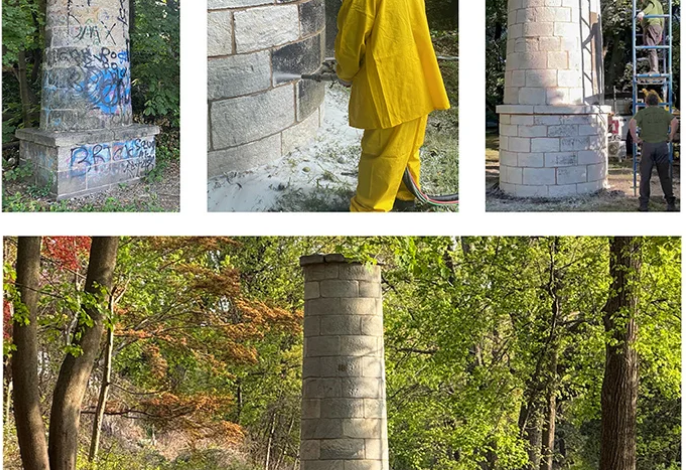
The first attempt at removing graffiti involved the Irvington ventilator in April 2022 and used the dry-ice process. Paint removal should have been most effective on its less-porous material, but the results were disappointing, and the method abandoned.
In September of 2022 an attempt was made using a different method that was receiving good reviews in the preservation field: Rotec Vortex.
It uses a fine, soft media and a low-pressure vortex to remove paint, and was being used successfully on preservation projects in Europe and the US, including those involving limestone and marble.
New York City has used the process to clean the High Bridge, a significant structure of the original Croton Aqueduct between Manhattan and the Bronx.
The September trial showed that Rotek Vortex method did a spectacular job of removing graffiti and the organic grunge that had built up over nearly two centuries of exposure.
The cleaning process caused no damage to even the soft marble or the lime putty mortar. The next goal was to expand to a full graffiti-removal program.
Expanding the Effort
With the pilot program complete, The Friends of the Old Croton Aqueduct sought and received a grant from Parks and Trails New York to fund a cleaning of four additional ventilators and one weir along the trail.
 These sites were chosen for both their visibility and community support — several local volunteers and neighbors have committed to keeping an eye on them and to quickly report to State Parks staff any graffiti that re-appears so that it can be removed in a timely and effective manner.
Immediately after the cleaning, the State Parks staff, in coordination with the contractor and with the Friends, applied a sacrificial coating that will make future graffiti removal quick and harmless to the stone.
This innovative approach, recommended by Architectural Conservator at State Parks, Erin Moroney, ensures that the Aqueduct’s unique structures can remain beautiful for generations to come.
The next phase began in August 2025 when volunteers and conservators gathered in North Yonkers — just south of Odell Avenue — to kick off the “Scrub Graffiti Series.” Two Yonkers ventilators were the first of four cleaned that summer.
The next ventilator to be cleaned was just south of the Croton Dam, at the start of the trail.
Ossining Weir
One of the most significant structures slated for cleaning was the 1842 Weir, the only original weir still standing. Weirs contain metal gates that could be lowered to stop the flow of water in the aqueduct tunnel to permit inspection and make repairs.
 The others were demolished and rebuilt in the 1880s when the system was modernized. This surviving weir, saved by circumstance and community stewardship, is an essential piece of Aqueduct history — and a perfect symbol of preservation in action.
Work needed to be done to prepare this site for graffiti removal; it was covered in vines although fortunately it turned out that none were actually growing on the structure itself.
Board member Diane Alden, who arranges for a local arborist to cut vines on various sections of the trail each winter, came up with a solution involving community participation.
Since the arborist, Pete Ström, is skilled in working with volunteers to enhance his efforts, Diane called on Ossining Youth Bureau members, with whom she had previously worked, to work on the vines.
During one chilly morning in March 2025, Lesley Walter, President of the Friends, Diane Alden and Adrianna Waitkins, Board Members, arborist Peter Ström, community volunteers and many OYB participants gathered to tackle the vines.
They also went on a treasure hunt and jubilantly gathered up lots of trash along the trail. When the summer arrived, the weir was ready for cleaning.
Lessons & Future Plans
This initiative celebrates not only cleaner stonework but also renewed connection to the landscape and history around us. It is the beginning of a new era of respect, restoration, and pride. Erasing graffiti attracts heritage tourism, lifts local economies, and fosters a sense of shared ownership.
 The cleaned ventilators and weirs have already transformed parts of the trail, enhancing the visitor experience and renewing community pride. As one trail user remarked, “It feels like we’re seeing history come alive again.”
More recently, neighborhood watchers discovered two ventilators which had been re-graffitied. The one close to the Croton Dam was identified in the fall of 2025 with a small graffiti and the State Parks crew quickly sprang into action.
They were able to remove the graffiti and reapply the coating, which can only be done when the temperature is above 41 degrees.
Although the weather was cold, the State Parks crew members were motivated to attempt to remove the new graffiti and quickly sprang into action, improvising a variation on the standard method.
They did their best to remove the graffiti and reapplied the coating. Even though the graffiti disappeared for a while, it re-appeared.
So, this was a good learning experience: it is necessary to wait until the weather is warmer to do the cleaning. The crew will return as soon as they can.
The second incident, in Yonkers, was more dramatic and discouraging. Because it occurred after the temperature had fallen considerably, so the State Parks crew postponed the cleaning until the weather warms-up.
But this will be cleaned and the sacrificial coating reapplied as soon as this can be done. This is clearly going to be on ongoing saga, but one which the State Parks’ Taconic Region and of the Friends of the Old Croton Aqueduct are continuing to manage.
The Friends have now restored seven historic structures – but fifteen more still need attention. They have initiated a fundraising campaign to keep up the momentum. You can contribute to the effort here.
A version of this essay first appeared on the Friends of the Old Croton Aqueduct blog, you can see many more photos of the graffiti cleaning project here. Friends of the Old Croton Aqueduct is a private, non-profit volunteer organization formed to protect and preserve the Old Croton Aqueduct in both Westchester County and New York City.
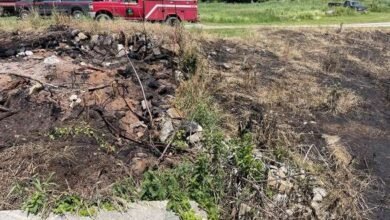
Illustrations, from above, courtesy Friends of Old Croton Aqueduct: Cleaning grime and graffiti from ventilators during the Old Croton Aqueduct Graffiti Campaign; the Hastings-On-Hudson ventilator before graffiti removal; the Irvington ventilator being cleaned using the Rotec Vortex method; the Ossining Weir being cleaned using the Rotec Vortex process; and the Croton Dam ventilator after being cleaned using the Rotec Vortex (photo by James Falk).
Source link