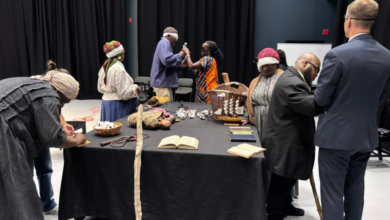
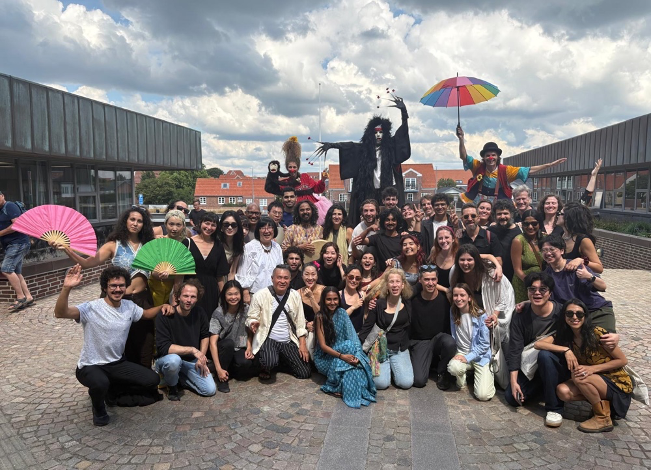
Ten Days, 7:00 a.m. to 10:00 p.m.
Odin Home is a summer intensive. Ten days. It runs on a simple, regular cadence: breakfast, physical training blocks, voice, sessions with teachers, afternoon masterclasses, evening performances. The day begins early and ends late. In between those edges, the body does the thinking or does not think at all.
I came from New York with city speed in my spine. The first morning put that speed in question.
We began bare feet on the floor, testing balance at its edge: weight forward and back, side to side. We worked first with eyes open, then with what so-called “eyes gathered”—a soft focus that narrows distractions without closing eyes, as if your gaze settles inside the skull while still taking in the whole room. There was little talk. The point was to notice how quickly the body adjusts to space when attention is steady.
At Odin, they call this sats—a borrowed, Scandinavian term for the charged instant before an action, when breath and weight commit and the body’s readiness becomes visible. In practice, it looked like this: our breathing and weight shifts began to sync, and we could sense each other’s timing without anyone leading. Once that readiness was in the room, we didn’t need to “sell” intention; the room could see it.
Training blocks were exact: falling and recovering, pressing the floor, opening the ribcage from the inside, waking the spine. The markers were simple and unforgiving: weight through the feet, knees warm rather than locked, pelvis buoyant, spine longer than habit, back of the neck easy, eyes gathered. If I chased someone else’s speed, my attention leaked and the work dimmed. When my internal count returned—breath and weight shifting in a steady rhythm—my attention returned with it.
In the afternoon we talked about where the attention comes from. Theatre Anthropology gives language to what the body already knows: Change the balance point and a different presence appears; shift breath and timing changes meaning. None of this replaces craft. It organizes it.
Once that physical score is stable, text can land on top of something real, instead of manufacturing momentum.
Stick Work: Learning to Block by Listening
Before stick work, we often dropped into Cat, a Grotowski exercise—quiet, low, spine first. The task was simple: move as if the spine were initiating and the feet were catching up, not the other way around. Shift weight without noise. Let the pelvis lead the ripple. Land through the outside edge of the foot, then the whole sole. When I rushed, my shoulders grabbed; when I softened, balance returned. Cat made sats legible: the readiness wasn’t a pose but a chain of adjustments you could feel from neck to heel.
The stick work sessions taught me the most. Two people. Three contact points—lower abdomen and both hands. A light stick linked those points as we moved. We kept silence, kept exploring.
Three points of contact made honesty unavoidable. I wasn’t inventing a dance; I was answering pressure. If I retreated too fast, the lower-abdomen contact pulled me back to center. If I pressed without listening, a tremor in my partner’s palm told me to change the angle. The stick turned momentum into a readable line.
That line taught me a different way to shape a scene. In New York, I had been blocking with ideas—what the scene “means,” what it “should” look like. At Odin, I learned to locate pressure first: where weight gives, resists, and transfers between bodies. I attended to points where performers touch, nearly touch, or share a clear line of force (hand to wrist, shoulder to back, a shared object, or even two bodies moving on the same diagonal). If those points of contact—or, simply, contacts—are truthful, timing emerges on its own. As a director, this changes my first questions in rehearsal from “What’s your intention?” to “Where is the weight?” “Who initiates?” “What do you resist?” “What has to stay connected?” Once that physical score is stable, text can land on top of something real, instead of manufacturing momentum.
Steps and Breath: From Private Focus to Room Rhythm
We trained many basic steps—rococo, sailing, and others—each with its own balance point and tempo. Then, we stripped them down to our own score: walk, stop, turn, breathe, eventually all react to the room. Those rhythms didn’t stay inside training. Some afternoons we kept walking through town for an hour or two, long enough that we forgot we were “walking,” and our bodies simply carried the tempo. That mild boredom during the long walk was useful: It revealed what I usually skip—a left heel landing late, a corner widening breath, someone else’s exhale lengthening mine.
After a while, the room could set stillness down like placing a bowl on a table. The group had synced up enough that we could reach that stillness together.When we brought text in after that, our lines sat inside a pulse we already shared. Nobody had to push. That’s where the pre-expressive became practical: the group kept a meter before the scene, and the meter did half the dramaturgy.
Greentime: Practice as Exchange
During daily Greentime sessions, people volunteered to share a skill or a tiny piece of performance. Joseph, from India, led us through Kathakali eye training. Katie, from the United States, showed a shadow walk. Soyoung, from Korea, broke down floor-dance basics. None of it was long; all of it was precise. For me, much of it was hard. That was the point.
Watching these fragments clicked something into place: Odin’s strength comes from decades of learning outward—touring across Europe, inviting teachers from China and India and elsewhere, folding in sources as different as karate, Étienne Decroux, Jacques Lecoq, Japanese budō, Kathakali, and Grotowski’s Cat exercise. That mix doesn’t sit on top of the work; it charges the performers’ energy.
I left Greentime with a simple commitment: Keep studying beyond my borders. Instruments, performances, and cultures from any place, any people. The ones I’d heard of and the ones I hadn’t. If I learn without sorting by habit or taste, my own shows are less likely to fall into dogma. Curiosity becomes part of the method.
Watching Hamlet’s Clouds
By night, I watched performances. The black box felt like a second training hall. I saw Odin Teatret perform Hamlet’s Clouds twice. The rig was spare—warm light, LED strips, two projectors—yet the fabric held light like memory. The piece is not a straightforward retelling of Hamlet. It moves through fragments: bodies, images, and repeated motifs (especially the “clouds”) that return in text, movement, and projection.
Hamlet and Ophelia aren’t built through scenes so much as through repeated encounters: a reach that hesitates, a breath that arrives late, a hand that can’t quite let go. That’s where, for the first time, I believed Hamlet loved her—not because he said it, but because his restraint read as care even when the moment turned cruel. The “red cloud” that kept appearing in Hamlet’s gaze became, for me, a recurring sign of Ophelia: girl, grief, ghost.
Shakespeare stood inside the story literally: a performer embodied Shakespeare as part of the staging, visible in the space with the others. Shakespeare works as a figure inside the event, moving among the action as if trying to steer what he wrote and being overtaken by it.
Let breath organize the body, then choose. The work stays honest, and the body stays safe.
The production’s “war” isn’t an abstract idea. It arrives as image. In the projections, black-and-white photographs of war keep flashing through the space—interrupting, returning, refusing to stay in the past. Against those images, vengeance doesn’t read heroic. It reads like inheritance: harm passed down, a story the body can’t outrun. At the same time, the Ghost did not feel like a clean apparition; it felt like pain and shame finally given a body—crying, relentless. In the final scene, the ensemble danced around the Ghost’s screaming, creating a ritual of reckoning with what we carry and what we bury.
Underneath the images, I recognized the training as a structure. Breath set the meter the way sats sets a room before words. Transitions landed where pressure changed—when bodies released, resisted, or redirected force, as in stick work. Presence did the dramaturgical lifting.Hamlet’s Clouds didn’t show off technique. It lived inside it.
This mattered to me because my own rooms in New York had drifted toward speed—explanations before breath, cleverness before contact. Hamlet’s Clouds helped me name why the work had thinned. I was starting from idea rather than conditions for performance. The performance argued for the reverse: keep the conditions and the meaning will arrive.
Other Nights, Other Lessons
I also watched pieces that held time differently. In My Stage Children, Else Marie Laukvik opened a box and time opened with it. She took out puppets she has carried for decades—worn fabric, seams repaired, fingerprints in the paint. The puppets carried wrinkles from her fingers—the visible traces of long handling, the way care marks an object over time. She called them children. I believed her. It felt like a living archive, not a display, the kind of care that turns craft into lineage.