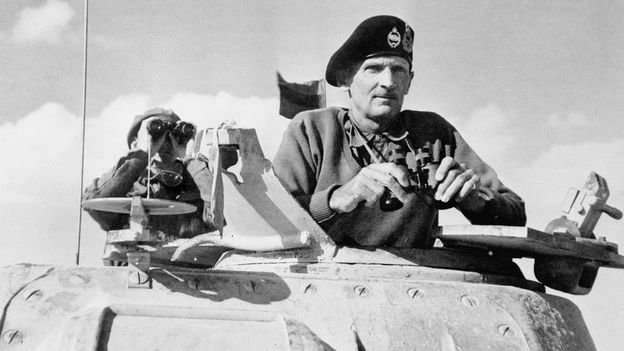
By 23 October he was ready to attack. It began with the largest British bombardment since World War One. Sickened by the carnage of that war in which he had himself been badly injured, he was determined to avoid unnecessary loss of life. According to historian Richard Holmes, the bombardment reflected Montgomery’s “desire to let metal, not flesh, do his business wherever possible”.
Engineers cleared channels through the deep German minefields, allowing the Allied tanks to pass through. While the weight of tanks would have exploded the mines laid by the Germans, soldiers were able to cross the territory. Montgomery gave this part of his plan the apt name of Operation Lightfoot. Losses mounted rapidly on both sides, but the Germans and Italians were outnumbered two to one. Rommel’s tanks, far from their supply depots, were running short of fuel.
On the night of 1 to 2 November, the second phase of the offensive, Operation Supercharge, began: British armoured divisions pushed through the final layer of Axis defences. The advance was still far from straightforward. On 3 November, the Ninth Armoured Brigade lost 102 of its 128 tanks. After the battle, Montgomery led his victorious Eighth Army across 2,000 miles of North Africa. Rommel had begun with 500 tanks: by the end of the first phase, he was down to just 100, and after a massive tank battle on the last day he was left with only 30 serviceable tanks. Elements of Rommel’s mobile forces managed to slip away because Montgomery, true to form, refused to gamble during the pursuit. Even so, most of their infantry was taken prisoner. By May 1943, the remaining Axis forces in North Africa had surrendered.
More like this:
• The true story of World War Two’s Dambusters raid
• How fascist Lord Haw-Haw was tried for treason
• The tiny island seized by Britain to foil the USSR
While Rommel did not live to see the end of the war, he was not killed in battle. When he was implicated in the 1944 plot to kill Hitler, the Nazis offered him the chance to take his own life to avoid the spectacle of putting their celebrated general on trial in public. Historians remain divided over Rommel. While some see him as an ambitious but essentially apolitical commander who fought a clean war, others argue that his career and prestige were bound up with the Nazis’ brutal and murderous regime.
Source link