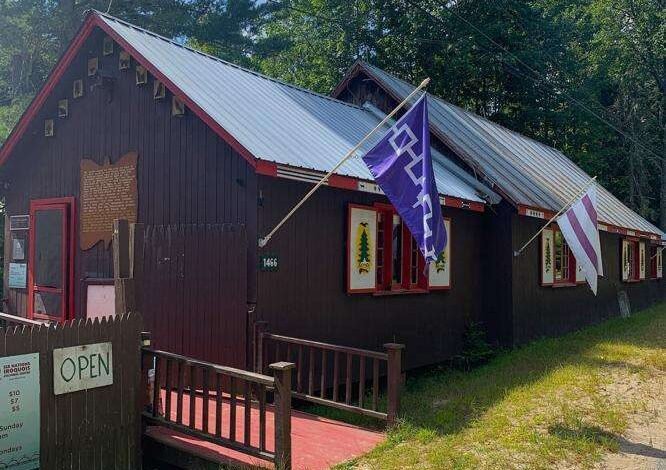
 In one of the largest private land return initiatives in what is now New York State, a forested 600-acre property is returning to Indigenous care.
With assistance and funding from The Nature Conservancy, the Six Nations Iroquois Cultural Center (6NICC) purchased the land from Paul Smith’s College for $1.1 million.
The 6NICC, a nonprofit organization, will combine management of this land with 330 adjacent acres already under their care.
The combined 900 acres will be managed according to Indigenous traditions and scientific ecological principles and will be home to an extension of the 6NICC, a Haudenosaunee gathering space, and an Indigenous youth camp.
Indigenous Nations have regularly identified relationships with ancestral lands and waters as central to maintaining their distinct cultural identity.
This return of 600 acres of land in Kanien’keháka (Mohawk) territory, the eastern door of the Haudenosaunee Confederacy, “recognizes and supports the centuries-long efforts of the Haudenosaunee to reconnect with their traditional territories,” a press announcement sent by The Nature Conservancy said.
“Since time immemorial, the Haudenosaunee have lived in reciprocal relationship with these lands and waters,” said Bill Ulfelder, executive director of TNC in New York. “This marks TNC in New York’s first land return and demonstrates our commitment to expanding Indigenous access, care and ownership of land. We are grateful to so many who made this wonderful opportunity possible.”
 This project builds on the legacy of and efforts of Ray Fadden, a schoolteacher at the Tuscarora Indian School and the Mohawk School in Akwesasne, who founded the 6NICC in 1954.
Fadden’s life’s work to educate Indigenous communities and the public about Haudenosaunee history, culture, and contemporary realities is reflected in how the Cultural Center is directed today by his grandson, David Kanietakeron Fadden.
“The land ethic of care and preservation has been a central part of the 6NICC’s mission since its founding by Ray and Christine Fadden in 1954,” said David Fadden.
“This acquisition of over 600 acres will serve as a classroom to share and learn Indigenous ecological knowledge for Native and non-Native students alike for generations into the future,” he said.
“The Haudenosaunee look to the seventh generation yet to come while we live our lives and make thoughtful decisions that ensure those who come after us will have clean air, water and land to live healthy lives. This philosophy is shared by the organizations that enabled this land transfer to take place and we are most grateful.”
The return of this land is a result of partnerships working to advance Indigenous-led conservation and cultural restoration and offers a model for how conservation organizations and private institutions can participate in that movement.
This includes partnerships among the 6NICC, TNC, the Haudenosaunee Environmental Task Force (HETF), SUNY College of Environmental Science and Forestry ‘s Center for Native Peoples and the Environment (CNPE), Paul Smith’s College, the Akwesasne Seed Hub, the Adirondack Land Trust (ALT) and the New York State Department of Environmental Conservation (NYS DEC).
Located in Onchiota, NY, in Franklin County, adjacent to the 6NICC, the property has been used as a seasonal camp/retreat center and as a site for teaching forest management practices.
The 600 acres is 94% forested, mainly by northern hardwood forests comprised of red maple, yellow birch, and black cherry.
John Thomas Brook, which supports native brook trout, flows through the wetlands and the land is book-ended by Big Haystack Mountain and Buck Pond Hill.
In addition to serving as an extension of the 6NICC, the camp will be a home for the Native Earth Program, which has been hosted by the CNPE and the HETF for 17 years.
The program brings Indigenous high school students from across Turtle Island to the Adirondack region for community building, reconnecting with the Earth and deepening skills for environmental leadership.
While there are thousands of camps and other learning spaces dedicated to environmental education and outdoor recreation, there are few places in the United States dedicated to protecting Indigenous cultural practices and engaging traditional care-taking in support of ecological conservation and restoration.
“I met Ray Tehanatorens Fadden, or ‘He Splits the Pitch,’ when I was six years old at his home in Onchiota. He was my grandfather’s elementary school teacher and an ally to our people at a time when there were few. Through new alliances, we now have a permanent home for Native Earth—and a path back to the care of our ancestral lands. The Center is looking forward to bringing young folks back to Onchiota to ‘split the pitch’ of the pines on the old tracks of Tehanetorens,” said Neil Patterson Jr., executive director, Center for Native Peoples and the Environment, SUNY ESF.
In 2022 the 6NICC secured 330 acres of forestland west of the Cultural Center in partnership with the Adirondack Land Trust, providing room for a planned expansion to include land-based cultural and Traditional Ecological Knowledge programs and a visitor center designed by architect Ray Kinoshita Mann.
Since then, the 6NICC and the Adirondack Land Trust have been working on a first-of-its-kind-agreement that incorporates Haudenosaunee perspectives and Mohawk language into a conservation easement. The partners plan to extend this agreement to include these 600 acres.
“We are grateful to be part of work that strengthens relationships between people, and between people and the land. We look forward to building on our shared values of caring for the lands and waters around us, and to learning, sharing and trust-building in the years to come,” said Chris Jage, Adirondack Land Trust conservation program director.
The partnerships between these Indigenous and ally organizations are modeled on the living treaty of the Haudenosaunee Two Row Wampum Belt (Gaswéñdah).
The belt contains two rows that represent a canoe for the Haudenosaunee way of life, laws, and people and a ship, which in 1613 represented the Dutch government, but in time has come to represent settler nations.
The canoe and the ship travel down a river in parallel, bound together in their journey but also autonomous. It serves as a reminder to center sovereignty and uphold Indigenous Peoples’ right to self-determination.
Read more about Indigenous history.
Illustrations, from above: Six Nations Iroquois Cultural Center; and a map of the 600 acres.
Source link