When the Future Becomes a Provocation
The immediate response to the first exercise was silence. Then one artist burst out, “You want me to imagine the future? When I can’t even sleep without the sound of bombs in my head? The only thing I can imagine is surviving tomorrow’s morning.”
Another added, “I can’t perform hope on demand. Every time I try, I feel like I’m betraying what’s happening now.”
Their refusal to imagine was not paralysis—it was lucidity. As one participant later wrote, “The obsession with the future is becoming a colonial trend. They want Palestinians in futuristic plays, futuristic settings, futuristic fantasies—because if we live in the future, we stop seeing the present, and we stop remembering the past.”
The rejection of “futurity” became the lab’s pulse. For these artists, imagining forward felt like denial. The present demanded testimony, not escape.
Museums of False Freedom
Other participants responded through satire. Several artists, without coordination, imagined dystopian “museums of Palestinian history,” where liberation had become a souvenir.
One performer announced, “Welcome to the Museum of False Freedoms! Please don’t touch the exhibits—they’re fragile, just like our peace agreements.”
Their satire had teeth—it exposed the grotesque, global tendency to archive Palestinian pain rather than end it. Humor became both a defense mechanism and an act of critique.
Another improvised a guided tour: “Here’s the final wall, preserved like a dragon’s skin. Here’s the Freedom Bar—beer for five shekels, revolution on the house. And here—look closely—are the theatre artists who once believed in change. They’re now historical figures, beautifully lit.”
The room erupted in uneasy laughter. Their satire had teeth—it exposed the grotesque, global tendency to archive Palestinian pain rather than end it. Humor became both a defense mechanism and an act of critique. “If I don’t laugh, I’ll break,” one participant later said. “The museum is my way of surviving what I can’t describe.”
Letters from the Edge of Endurance
In a later exercise, participants wrote letters to their imagined future selves. The results ranged from biting irony to quiet faith.
One letter declared, “I’m proud of the artist I’ve become—famous, free, adored. Funders beg for my projects. I tour the world. The safest place on Earth is my homeland.”
The laughter that followed was knowing, almost tender. The “safest homeland” was under siege. When the noise faded, the writer added, “Maybe that’s my way of saying I’m still alive. To write an impossible life, even if it’s a joke.”
Another letter was written in a single breath: “They might erase my name, but not my blood. I perform so I can endure. I write so memory won’t be erased.”
Between irony and conviction, the letters mapped the contours of a generation’s psychology—where despair and insistence coexist.
Critical Refusal: Decolonizing Time
At one point, an artist turned to me and said, “You academics love the future. But for us, it’s another checkpoint. You think it’s liberating, but it’s just another place we’re not allowed to reach.”
That sentence captured what the lab made palpable: Futurity, as framed by Western discourse, can be a colonial form of violence. It demands optimism from the oppressed while excusing global indifference.
Several participants noted that “Palestinian futurism” had become a new curatorial trend: “Every festival wants futuristic Palestine now—robots, artificial intelligence, Mars. It’s their way of saying, ‘Enough of your suffering, show us your imagination.’ But imagination is also being bombed.”
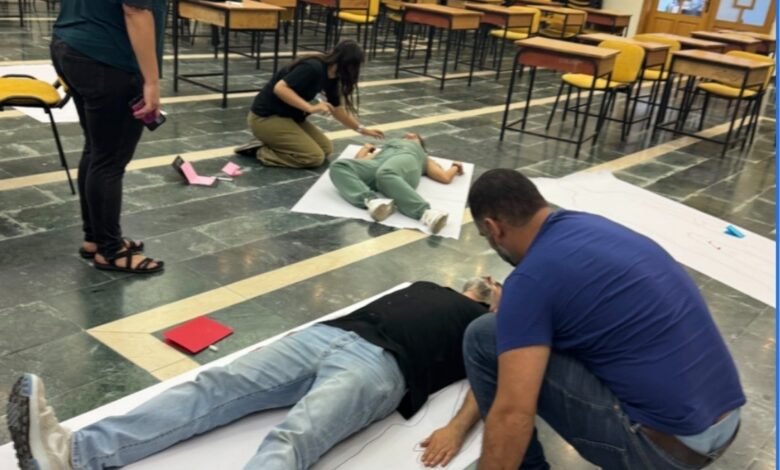
The lab thus transformed into something larger: a decolonial inquiry into time itself. This decolonial approach to temporality was not merely discussed by participants—it was embedded in the very design of the lab. Rather than treating the future as a linear horizon of progress—a premise often assumed in Western dramaturgical and development frameworks—I structured exercises to disrupt this temporal logic. Participants were not tasked with producing coherent visions of what might come next. Instead, they were invited to confront, resist, and reimagine futurity on their own terms. What emerged was a refusal of linear inevitability: The present did not serve as a bridge to resolution, but as a densely overdetermined space, shaped by repetition, rupture, and the immediacy imposed under occupation. In this way, the lab became a site where time itself was contested. By embracing fragmentation, contradiction, and refusal, the process re-centered temporality as a lived experience, allowing participants to reclaim the ways in which past, present, and future are narrated, inhibited, and performed. Refusing the future became an act of reclaiming presence.