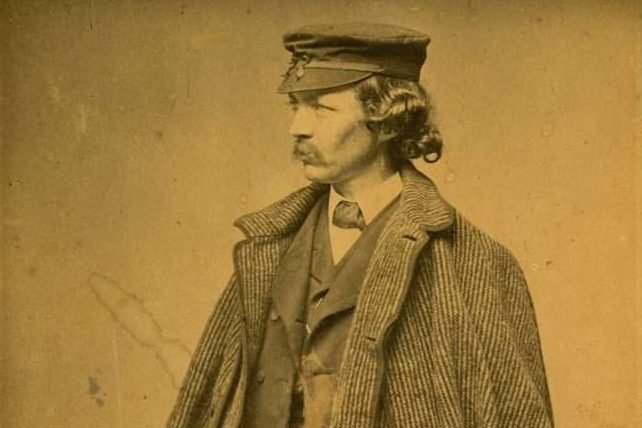
 From December 1852 until August 1854, Frederick Law Olmsted, who later gained renown as a landscape architect for designing New York City’s Central Park and Brooklyn’s Prospect Park, traveled through the American South as a special correspondent for the New-York Daily Times, the predecessor of The New York Times.
His reports published by the Times under the name Yeoman, were included in a 1856 book as A Journey in the Seaboard Slave States; With Remarks on Their Economy.
At the outbreak of the Civil War in 1861, the book was republished as The Cotton Kingdom: A Traveller’s Observations on Cotton and Slavery in the American Slave States with an “Introductory. — The Present Crisis.”
In his reports to the Times, Olmsted was critical of the institution of slavery, not primarily out of concern for enslaved people, but because he believed it contributed to economic and social backwardness in the South, including among Southern whites.
Olmsted was not identified with militant abolitionism and believed the institution of slavery had to be resolved in the South rather than through northern agitation, however he also opposed the extension of slavery into new Western territories.
In the letters to the New-York Daily Times and in the books, Olmsted defended the humanity of enslaved Africans. He argued they were degraded by enslavement and refuted Southern claims that they were actually better off as slaves.
Descriptions of enslaved people reported as interviews with both Southern whites and Blacks included the casual racism of the day. To my knowledge, The New York Times has never issued a public apology for past racist depictions of Black Americans.
At the start of his travels in March 1853, Olmsted wrote to the Times that although he had not initially planned on writing about slavery, as he traveled in the South, the more he recognized “the character of the whole agriculture of the country depends upon it.”
“In every department of industry I see its influence, vitally affecting the question of profit, and I must add that everywhere, and constantly, the conviction is forced upon me, to a degree entirely unanticipated, that its effect is universally ruinous,” he wrote.
In February 1854, in his final letter to the Times, Olmsted wrote “I do not consider slaveholding — the simple exercise of the authority of a master over the negroes who have so wickedly been enslaved — in itself, necessarily wrong, any more than all forcible constraint of a child or lunatic is wrong.”
His opposition to slavery was essentially because of its unprofitability. He witnessed on plantations that “where labor is not voluntarily and cheerfully applied to the indeed purpose, it is not possible to combine and direct it without either great cruelty to the laborer, or very great (and probably compensating) economical disadvantages.”
In a more extended discussion in his book, described ways that enslaved Black Americans resisted work where possible by claiming illness or injury and were even willing to “make himself sick or lame – that he need not work.”
 In that final letter to the New-York Daily Times, Olmsted was especially critical of what he witnessed because he believed “there would be an immediate profit in abolishing Slavery in those States, even to the owners, if it were not for the profit of breeding slaves.”
While he did not consider enslavement inherently wrong, Olmsted argued for the humanity of the enslaved Africans who are “endowed with a faculty, which distinguishes them from brutes, of perceiving the mortal distinction of good and evil; of loving the good and regretting the evil which is in themselves.”
He reported that “They are, beyond a question, I think, also possessed of independent reasoning faculties” and he felt that “the soul and mind suffer in Slavery.”
Because of the way it dehumanized the enslaved, “Slavery as it is, in the vast majority of cases, is shamefully cruel, selfish and wicked. … In my judgement of its ultimate influence, there is no institution in the world, no form of tyranny or custom of society that is so great an injury, so great a curse upon the whole family of man,” he wrote.
In A Journey in the Seaboard Slave States, Olmsted added “I do not think, after all I have heard to favor it, that there is any good reason to consider the negro, naturally and essentially, the moral inferior of the white; or, that if he is so, it is in those elements of character which should forever prevent us from trusting him with equal social munities with ourselves. So far as I have observed, slaves show themselves worthy of trust most, where their masters are most considerate and liberal towards them.”
In one letter to the Times, published June 21, 1853, Olmsted took on the question whether enslavement benefited the African by introducing them to Christianity.
Olmstead believed “Christianity can only be practically defined… as a principle of the heart which manifests itself in the constantly progressive, moral elevation of the individual. In my judgment, the general degradation of manhood, the training to cowardice and imbecility, or duplicity of mind, the constraint upon the free development of individuality of character, and the destruction of the sense of high individual responsibility, which is demanded by an established system of perpetual slavery, is most strongly opposed to the reception in the hearts of its subjects of anything that can be reverently dignified with the holy name of Christianity.”
Olmsted had a more derogatory and stereotypical attitude towards Jews and poorer whites than the free and enslaved people that he encountered in Virginia.
“Among the people you see in the streets, full half, I should think, are more or less of negro blood, and a very decent, civil people these seem, in general, to be more so than the laboring class of whites, among which there are many very ruffianly looking fellows. There is a considerable population of foreign origin, generally of the least valuable class; very dirty German Jews, especially, abound, and their characteristic shops (with their characteristic smells, quite as bad as in Cologne), are thickly set-in the narrowest and meanest streets, which seem to be otherwise inhabited mainly by negroes,” he wrote.
At another point in the book, Olmsted wrote that “A swarm of Jews, within, the last ten years, has settled in nearly every Southern town, many of them men of no character, opening cheap clothing and trinket shops; ruining, or driving out of business, many of the old retailers, and engaging in an unlawful trade with the simple negroes, which is found very profitable.”
Olmsted was not innocent of benefiting from racism when it was to his advantage. In 1853, the New York State Legislature approved the construction of Central Park in Manhattan. Proposed plans for the park meant destruction of Seneca Village, a largely Black American community.
Residents were evicted using eminent domain laws, many without compensation. Olmsted was appointed superintendent of the park in 1857 and the Greensward Plan submitted by Olmsted and his partner Calvert Vaux was approved in 1858.
After interruption caused by the Civil War, Central Park was completed in 1876.
Read more about slavery and New York State.
Illustrations, from above: Frederick Law Olmsted in the mid-nineteenth century (cropped, courtesy National Park Service); and “A view of the Federal supply depot at Aquia Creek Landing, Va.,” established by Olmsted in December 1862 after the battle of Fredericksburg as a relief depot to which wounded soldiers could be evacuated (Library of Congress).
Source link