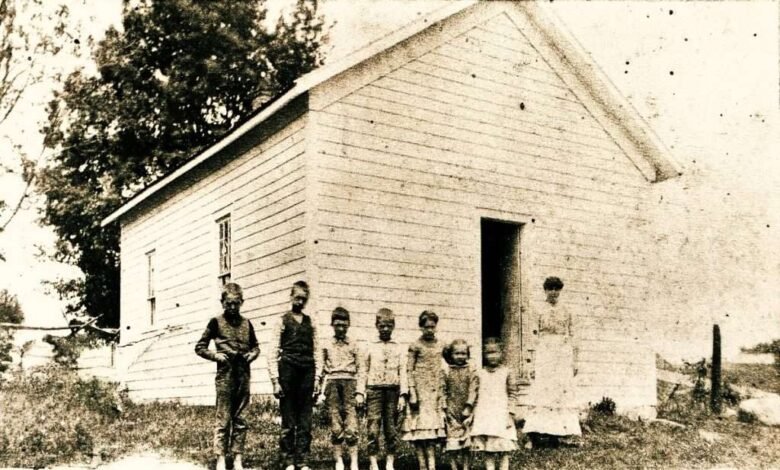
 I started first grade in our local one-room school in Daketown, in Greenfield, Saratoga County, sitting in the row of the smallest desks beside the blackboards in September 1942. I finished in the last seat of the last row of bigger seats on the window side of the room eight grades later in June 1950.
I had just turned five the previous year, but my mother refused to send me because the last mile of the walk was not plowed in winter.
Morning walks were straight to school except for leaning on the railing of the old bridge and watching the Kayderosseras Creek flow by with it’s banks of mayflowers, bloodroot, and trilliums in spring.
Our lunch pails went on the shelf first thing and if we were early, we walked in the other direction to meet the Palm kids. All of us were in our seats at 9 am. In the first-grade class the first of every day began with the alphabet.
Rote learning along with blackboard exercises were a large part of early grades. The alphabet in small letters was always across the top of the board. As the teacher was working, she was also making the letters. Everyone had to learn the sounds of every letter and go down the board perfectly.
Homework would be practicing the 3 or 4 new letters just learned while next grades each had their 15 minute class.
Then came arithmetic. First graders learned numbers same as their letters. The other grade had their 15 min turn using the blackboard as addition, subtraction was added.
I can’t remember which grade what was introduced but there was always a vague idea of what was coming because you had already heard it, most just needed the textbook and a little personal attention to really understand it.
The grades in the middle of the room would be learning cursive, sentences, paragraphs, grammar diagramming. Filling a whole board with a diagram was one of my favorites.
We also learned basic history, geography, and of course spelling with its test every Friday right up to the last week of eight grade.
Moving over to the window side of the room where not looking out the windows and daydreaming too long was learning self-control and not even knowing it.
The window seat row was usually 7th and 8th grades, when we really began to think about preparing for the New York State Regents exam given at the two-room school in nearby Porter Corners.
English expanded to reading more books, book reports, writing essays, poetry. Learning two poems was required. Algebra and geometry with lots of very long division took up Arithmetic time.
Geography and Social Studies used the roll maps behind the teacher’s desk, especially the United States and World maps. Learning the structure of local, state and Federal governments was a necessity as was basics of the American Revolution, a bit of the Civil War, and Parliamentary Procedure (Robert’s Rules of Order).
We were blessed with our teacher, Miss Mary Chatfield, then she became Mrs. Herbert Coombs and after my time the widow Coombs became Mrs. Carl Stiles.
Every year she helped us pick out a Christmas Play and everyone had a poem to memorize and recite for our Christmas Parents Program. She managed to set aside time to help us learn and practice our parts until we were really good.
I do not know who felt most proud as that long black curtain in the front of the room opened – students, parents, or teacher – but I know it was always a special evening.
During the Second World War the teacher encouraged and supported our collecting metal cans to be melted down for war use and collecting milkweed pods.
The man who came to the school explained the pods were to make life jackets “to save soldiers’ lives.” Each grain bag full was worth fifty cents. I was so proud of my first earned fifty cent piece and dollar bill.
Then my dad reminded me the important thing was helping to save the soldiers’ lives not how much we earned, something I have never forgotten.
At our school there was no nurse or supplies to do any nursing, nor were there any phones to call your parents. One morning on the way to school I was running, fell, and skinned my knee filling the area with sand and gravel. I was nearer home than school, but it never occurred to me to turn back.
When I got to school the teacher sent me next door to Nina Jones, whose youngest was my age. She sat me on a counter, poured water and something that really hurt on the knee [probably hydrogen peroxide], added a bandage and sent me back to school. The scar is still on my knee.
Recess was fifteen minutes outside at ten am and two pm unless it was raining. It was everyone’s favorite time except for four pm when we started walking home.
Being an only child, I probably enjoyed the social times the most. Recess was usually games of Hide and Seek or Andy Over. There was a team on each side of the school throwing a ball over the building and being caught by the other team in the air or on one bounce. Each team kept their own score.
At noontime some of us ate at our desks, those who could walked home. This hour was the teachers’ only free time all day so as soon as our lunch was finished, out the door we went.
In summer we could walk to meet the kids who had gone home for lunch, passing or playing at Arthur Jones farm and creek, Fred Carps grape arbor, or the Old Dake cow barn and pasture.
During winter we brought our sleds almost every day. Occasionally Harold Jones would bring his father’s old hand made bobsled out of the carriage house. We could all pile on at once and ride down the hill. What a treat.
When the snow depth and crust was just right, we went down the hill in front of the school, ducking our heads to go under the fence on to Mr. Vanna’s part of the creek. There was rarely time for more than one of these rides.
Sledding across the road was not that dangerous. It could be a few days before the road was plowed.
I really liked the walk home, often finding myself in trouble for being late to do my evening chores. I was always listening for Babe’s bell to tinkle. Babe was Mrs. Vanna’s cow who came running whenever her name was called.
Sometimes I stopped to see Mr. and Mrs. Vanna. She baked the best pastries filling her kitchen with wonderful smells, and I never wanted to let go of my early belief that Mr. Vanna was really Santa Claus.
At the four corners of North Creek and Sand Hill as I was checking our mailbox, I was always looking up the hill for Art Perry’s dog who thought he was guardian of the four or five mailboxes.
Walking the rest of the way home we went past the Potters, Wilseys, Rhodes, Gram and Gramp. Great memories to this day!
Read more about the history of education in New York State.
Mary Carlson is a descendant of several early families of Greenfield that settled in the vicinity of the Kayaderosseras Creek near Middle Grove. A 1954 graduate of Saratoga Springs High School, she has compiled a memory book of stories about her experiences growing up. Mary is featured in “The Town of Greenfield: A Forgotten Crossroads Film” produced by the Saratoga County History Center to be released in May.
This essay is presented by the Saratoga County History Center.
Photo: Daketown School, ca. 1880.
Source link