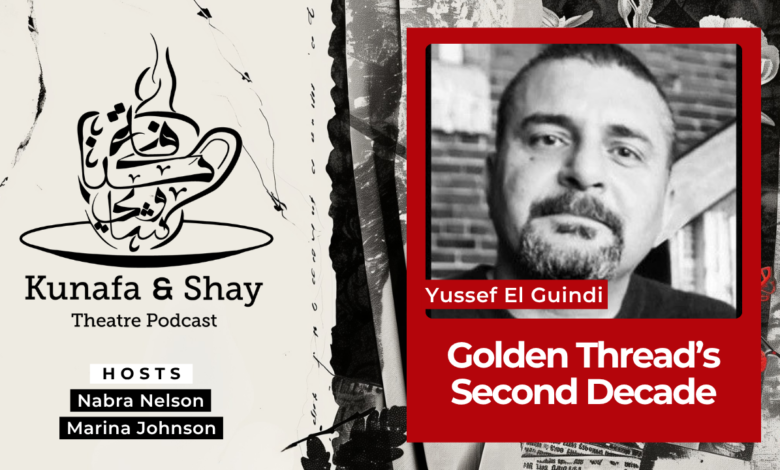
Nabra Nelson: Salam Alaikum! Welcome to Kunafa and Shay, a podcast produced for HowlRound Theatre Commons, a free and open platform for theatremakers worldwide. Kunafa and Shay discusses and analyzes contemporary and historical Middle Eastern and North African, or MENA, and Southwest Asian and North African, or SWANA, theatre from across the region.
Marina Johnson: I’m Marina.
Nabra: And I’m Nabra. And we’re your hosts. Our name, Kunafa and Shay, invites you into the discussion in the best way we know how, with complex and delicious sweets like kunafa and perfectly warm tea, or in Arabic, shay.
Marina: In each country in the Arab world, you’ll find kunafa made differently. In that way, we also lean into the diversity, complexity, and robust flavors of MENA and SWANA theatre.
Nabra: Season six of this podcast marks a double milestone, the thirtieth anniversary of Golden Thread Productions, the oldest MENA theatre company in the US, and my first year as the theatre’s new artistic director. Across ten episodes, we use Golden Thread as a case study to revisit landmark productions from 1996 to 2026, and trace shifting tropes, political urgencies, and aesthetic strategies that shaped the company’s early decades.
Marina: This season also expands to reflect on the past three decades for MENA theatres across the US, not as a closed chapter, but as a living archive, one that illuminates where we’ve been and where we’re headed.
Nabra: In this episode, we turn to the years 2006 to 2015, in conversation with Yussef El Guindi, who helped shape Golden Thread Productions during a pivotal period of growth and transition.
Together, we reflect on how the company navigated the post-9/11 landscape, expanded its artistic reach while deepening its commitment to the new play development and community engagement.
And through Yussef’s insights, we trace how this decade strengthened Golden Thread’s national presence and clarified its role within an evolving ecosystem of MENA and SWANA performance.
Marina: Yussef El Guindi was born in Egypt, raised in London, and is now based in Seattle. His work frequently examines the collision of ethnicities, cultures, and the politics that face immigrants. El Guindi holds an MFA in playwriting from Carnegie Mellon University. He is the recipient of many honors, including the Lawrence Hatcher Foundation Citation of Excellence Award, the Steinberg ATCA New Play Award, American Blues Theatre’s Blue Ink Playwriting Award, Seattle’s Stranger’s Genius Award, and the 2010 Middle East America Distinguished Playwright Award. El Guindi’s past productions include Hotter Than Egypt at Marin Theatre Company and ACT in Seattle and the Denver Center for the Performing Arts, People of the Book at Urban Stages and ACT, Language Rooms at the Wilma Theatre, Pony World Theatre in Seattle, and Broken Nose Theatre in Chicago, Hostages at Radial Theatre Project in Seattle, The Talented Ones at UCSV’s Launchpad and Artist Repertory Theatre in Portland, Threesome at Portland Center Stage, ACT and 59 East 59th, Pilgrims, Musa and Sherry in the New World at ACT, Center Repertory Company and Mosaic Theatre Company, Our Enemies, Lively Scenes of Love and Combat at Silk Road Rising. His plays Back of the Throat, Pilgrims Musa and Sheri in the New World, Jihad Jones and the Kalashnikov Babes, Such a Beautiful Voice is Sayida, and Karima’s City have been published by Dramatist’s Play Service. Hotter Than Egypt, People of the Book, Ten Acrobats in an Amazing Leap of Faith, Collaborator, Threesome, The Talented Ones, Hostages, Language Rooms, and In a Clear Concise Arabic Tongue have been published by Broadway Play Publishing, Inc. Bloomsbury Metheun Drama published The Selected Works of Yussef El Guindi. In 2023, he was selected by the Royal Society of Literature as an international writer. He is Golden Thread’s most produced playwright.
Excellent. So we’re so excited, Yussef, to have you back on Kunafa and Shay with us.
Thank you for joining us to talk about the second decade of Golden Thread.
Yussef El Guindi: My pleasure. Thank you for inviting me.
Marina: When you first began working with Golden Thread, what did the company feel like to you in that moment? So we’re talking, starting today in 2006. It had sort of survived the scrappy beginning years. But yeah, curious about your initial sort of time with Golden Thread.
Yussef: The initial relationship with Golden Thread began, I always say 2000, and Torange corrects me and says, no, it was in 1999. So when I first got on the internet, I typed in Arab American Theatre, and I got two hits. One was a theatre in Dearborn, Michigan, and the other was Golden Thread Productions. Both responded, and I did have a piece done at the theatre in Dearborn, but it was really Torange who sort of opened the door wide open and said, send me your stuff.
This was a revelation, amazing. You know, I’d been writing these stories with Middle Eastern themes. No theatres were interested. I mean, there was, when I say an indifference, it was just, you know, crickets when it came to interest in the stories I was telling. So to find Golden Thread was, you know, it was finding water in a desert.
When Torange, through her encouragement, I started sending stuff. It started being done, which just lit a fire under me. You know, as a playwright, knowing there’s a theatre out there that’s interested in your work, it stimulates me to want to write more. One of the problems with COVID and the contraction of theatres around the country and my continuing to write plays with no outlet for those plays. For the first time in thirty, forty years, I began to ask myself, why am I writing the next play?
Which was deadly, extraordinarily debilitating to have that thought. There is so much working against you as a playwright, you know, rejection, rejection, rejection. And there’s that thing inside you that makes you keep going with the encouragement of theatre, one or two theatres.
It only needs one. But when those theatres start shutting down or no longer show interest, the impulse to write, you know, I’m not a novelist. I’m a playwright who can only function in collaboration with others.
So when Torange and Golden Thread came into my life, it really changed my career. You know, through the early phase, they’re doing, you know, I was part of the ReOrient, little plays that went up. And they did actually a play before Back of the Throat called Scenic Roots.
It wasn’t a very good play, but Torange said, let’s do it. And it was in this little theatre, I think in downtown San Francisco off Market Street. And we put it up and it had a life. And again, it just kind of motivated me to want to write more. And then I think the next big play they did was Back of the Throat. I believe that was 2005. Was it 2006?
You know, it was in collaboration with the Thick House. And again, to have something I wrote realized on stage for them to put all their resources, to making it happen, gathering an audience, getting a response, reviews, generating conversations. That was just huge, to be in conversation. You know, what Golden Threat did was enable artists of Middle Eastern background to be in conversation with the wider culture.
And we had not been in conversation with the wider culture. We were not, we were ignored. There was an indifference to our stories. And what Golden Threat did was create a platform for us to be in conversation with other theatres, with the culture, with news outlets, with theatres around the country.
We were not silent anymore.
Marina: It’s so important. And I think, I mean, let’s look at Back of the Throat. So it was 2005. I just double checked because I was like, oh, this, you know, we’re talking, you know, it’s getting into the second decade of Golden Thread. But it remains one of the productions that we keep hearing talked about at Golden Thread. And I’m curious, like, what it meant to stage that play in the Bay Area at the height of the so-called war on terror. It sort of traps the audience. I mean, this is our interpretation, traps the audience inside paranoia and fear.
But it doesn’t explain, like, Islam, which I think I imagine and I see this still in a lot of plays is that people feel like they have to explain things and sort of these didactic ways to audiences. And this play really resists those urges.
Can you tell us more about the production and can you tell us more about sort of were you consciously pushing back against this sort of, I don’t think I would call any of your plays didactic, but were you consciously sort of pushing back against these things?
Yussef: You know, not necessarily consciously. I mean, to a degree, but I am too, I’m an old fashioned term, neurotic. I’m too neurotic a playwright to be didactic, obviously didactic. I am too sort of, my nerve ends are too raw to have any sort of didactic agenda overwhelm the rawness of my nerves. So that’s always what is front and center.
You know, it took a long time. You know, I’m a late bloomer. And for me to plug into my voice really took a long time. Once I did, then I trust that. I trust that all my concerns as a citizen, all my concerns as somebody politically conscious will find its way into the play.
And if it doesn’t, it doesn’t because that’s not what the play demands. Whenever I write a play, whenever I see it through production, my concern is with my characters, the trajectory of my characters, the reality that they find themselves in.
I don’t concern myself with the politics, if anything, because I come to the table with the presumption that we are political animals.
The domestic is political.
You know, in my family, we might be at a dinner table talking about, gossiping about family members, which leads to somebody’s political activity, somebody being arrested, to what do you think about this political move, this particular headline, back to gossiping.
It’s all one.
You know, I think if you, when you come from a certain, a certain population, politics, domestic and the political are fused.
I think it’s a great privilege to have that separated.
I think that’s why what’s happening now with Trump and everything is a shock to people because they’re suddenly being shoved into the political in a way that they go, what the hell is happening?
As opposed to, can we just go back to our domestic, you know, comforts, our domestic concerns?
But for a lot of other people, the political and domestic are fused. The transition between the two is one synapse, one thought away from each other.
You don’t have to make a great leap. So this is why when I write a play like Back of the Throat, there is no agenda to say this and that about Islam, to say this and that about the political situation at the time. I’m simply reporting what I, as a citizen in this country, was feeling at that time.
And that’s what Back of the Throat was. It was a thought experiment about, well, a couple of agents came into my apartment and there were reports of things like that happening. Would the books I have, with the possessions I have, the material, could they make a case against me? And I looked at my books, I looked at what I have, and I thought, yes, they could make a case against me.
I mean, we forget the time, but people were, you know, there were art galleries. Agents were going to art galleries that showed a bias towards Arabs or had Arabic writing. And then that became cause for investigation and suspicion. You know, the paranoia was real. I mean, there was a good cause to be paranoid.
It wasn’t just about going to the airport and dealing with that. You know, it was coming. This was a time when, you know, the post office was being brought into the Homeland Security and saying, if you see something, then, you know, there were many cases of paramedics being called in for one thing, looking around the apartment, becoming suspicious, and calling in, you know, the authorities. There were reports of people, you know, calling in about former exes, you know, grudges.
It was just a very fraught situation. So, and Back of the Throat was just kind of, was reflective of all that paranoia.
Nabra: It’s such an interesting insight also into what you were writing and how it reflected the moment and how Golden Thread and MENA Theatres specifically could support this kind of writing as opposed to mainstream theaters. And looking into that second decade, I mean, Golden Thread had already established itself by 2006. And yet the political situation for Arab Americans was even more heightened than at its very founding.
I’m wondering, you know, how you saw Golden Thread as a producing company, and maybe you can also talk about other, if there were any other MENA Theatres kind of in the 2010s that you were working with, um, across the nation, how did they resist those pressures to box Middle Eastern artists into certain narratives that you’re talking about?
Yussef: It’s the fact that Golden Thread and Silk Road Theatre Company, as it was called at the time, they were doing those plays that other theatres would not touch. Started with Golden Thread, and then Silk Road Theatre Company came along. And I had a relationship mostly with those two theatres.
There was Nibras, I think they were called Nibras at the time. In New York, I didn’t have so much of a relationship with them.
So it was those two theatres that really boosted my career, and because they were performing plays that put Middle Eastern people front and center, you know, other theatres would put Middle Eastern voices front and center if they reflected the biases of the mainstream culture.
That’s the plays that were…gained traction in the wider public.
Nabra: Do you remember any of the specific plays that kind of you were seeing being produced in, in mainstream theatres?
Yussef: Well, I’m not going to name names. I’m not going to, I don’t want to. And here’s the thing I want, I want to say. Those plays that I might call out, a) were very good plays. 2) I totally understood why they were being, why they were being written. My issue was with the larger LORT theatres around the country programming with those plays.
Why did they program those plays and not the plays of other Middle Eastern American writers?
The plays I have issues with, it’s because they reflected the biases, in fact, the bigotry, of, uh, the wider public.
I remember seeing one play, you know, and this is a non-Middle Eastern play that was being done everywhere. And I was going, well, why, why is this play? It’s okay. I remember thinking, this would be a very good, this was like a MFA thesis play.
I go, this shows a lot of promise. This is a good play. But I’m going, why is this play being… won awards.
And I realized it comforts the audience. It reflects the audience back on itself and says, uh, your values are good and okay. Doesn’t challenge them. It has just enough bite to make it seem like it’s engaging in important social issues, but essentially it’s a play that comforts the audience. And I think a lot of the Middle Eastern American plays that were being done around the country were plays that comfort the mindset that audiences come in with about the Middle East. It says, your mindset is correct.
We’re going to show you just enough to think you’re being shown something new and different, but really at bottom, we are confirming your bigotry.
And to this day, there are certain plays being done that gain traction. Again, good plays, good craftsmanship. This is not a, uh, this is not a critique of the quality of these plays. These are well-written plays.
But again, there are headlining plays that somewhat sensational, that kind of, um, cater to the mainstream mindset of those audiences.
Marina: Nabra and I could name a few playwrights that we often wonder in the current atmosphere, why these particular playwrights are being done besides the fact that the plays are well-crafted, but they do reinforce, uh, and reify particular stereotypes.
And I love what you said about making the audience feel comfortable. They do make the audience feel comfortable with their assumptions. And I think that that’s something that audiences continue to look for, especially as we see sort of the world around us changing in different ways.
Yussef: The thing about Golden Thread and Silk Road is that they would put the plays in that did challenge the audience, that did allow for ambiguity, that wasn’t, that weren’t binary, that both critiqued aspects of our community, but also allowed complexity, nuance, ambiguity, all the things that make a good drama good.
The other plays, you know, the plays I would see in the mainstream, I remember seeing one play and thinking, oh, that’s why we have to invade Iraq. You know, I remember seeing this play and I was thinking, oh, the audience is going to walk out thinking, walk, walk, walk out thinking, oh, this is, this is the rationale for, you know, we’re, we’re doing good. You know, the audience comes out thinking, yes, we’re doing good by invading.
It’s, you know, talk about manufacturing consent on every level from the news to the films to theatre. You know, when I, at the time reading so-called progressive local paper, which kind of endorsed the invasions, and I was thinking, what? And I would just think it’s kind of a, it’s a kind of manufactured consent. And a lot of theatres around the country participated.
Golden Thread did not.
Nabra: How do you feel audiences reacted differently in these MENA theatre companies? Maybe you saw this, you know, the contrast between your plays, especially, you know, you were also being produced across the country at non-MENA theatres by this point, by the 2010s and things like that. Did you see an audience difference, you know, audience reactions? Was it welcoming? Was it, was it reactionary?
Yussef: A couple of things. The very distinct difference was when I had a play done at Golden Thread or Silk Road Rising, there was more laughter. My plays are usually a mix of comedy and drama. The audiences at Golden Thread, they felt more permission to laugh because they, because a lot of them were audience members from MENA backgrounds, were able to understand some of the ambiguity and nuance.
The audiences in non-MENA theatres, I think they weren’t sure if they had permission to laugh or not. They approached it with much more seriousness, as going, well, this is a serious subject, you know, we can’t laugh. I just wanted to say, it’s okay, you can laugh.
If you find something funny, go ahead and laugh. So that was one distinct difference.
Can I get some reactionary?
Yes.
We had a talkback after the play.
Almost every single talkback I had, there would be at least one person, probably speaking for a number of audience members, who would ask me some really atrocious question. Had as its basis, well, Muslims and Arabs are violent, therefore, how do you respond to such and such?
You know, where the premise was, well, given that you are a violent population, or given that you have this or that trait, and then the question would follow. And I wouldn’t go off on them. I would just kind of assume, well, how would they know any different? They’re not being given an alternative point of view. Any alternative point of view that might have filtered through would be dismissed as radical or fringe, or, well, it’s coming from that group, so you can’t trust.
And that’s the other thing, is that if it comes from the MENA group, the SWANA population, well, then how can you trust that voice? You know, which was, so often reporters will go to a community and try, and, or they’ll get reporters from that community to talk about their community. But when it came to the Middle East, so often reporters were outsiders who would come into the, it’s like our voices couldn’t be trusted. And I think that was, in part, also reflected in theatre for the longest time. You know, we had, and I’m not averse to that, by the way.
I’m not averse to non-MENA playwrights writing about aspects about the Middle East. And, you know, I think art and artistry is about empathy and trying to make a leap into somebody else’s mindset. So, in theory, I’m not opposed to that.
In practice, a lot of those plays were sensational, did tap into a lot of the bigotry, did not really add much to the conversation in terms of broadening people’s perspective.
I would get pretty awful questions in talkbacks after the plays, as well as good questions, but invariably there’d be that one or two questions.
Until recently, actually, I mean, it’s controversial. MENA theatre continues to be controversial, unless it plays into the prejudices of the audiences. A play challenges those perspectives. Then, you know, usually, like in a review, if I, a lot of my reviews, I would be accused of being didactic because I dared to humanize a population that had not been humanized previously. And the very act of creating three-dimensional characters felt controversial because before they were very much two-dimensional and fit an agenda.
And I was going, let’s un-agendify, un-agendify these characters and make them real, have them speak. The very act of having them speak, you know, not in the way the critics who came were used to felt controversial and agenda-driven. And so people were going, well, you know, I don’t have an agenda. I’m writing a domestic drama or I’m writing about this individual’s journey, which happens to be, to intersect with political occurrences because that’s what’s happening to actual people in the real world.
You know, it’s a bigger discussion, but American theatre’s reluctance to engage with politics on their stages, other places, you know, around the world, to agree, at least in London, I think it’s a phenomena.
I keep asking myself, why, what is it about this country that’s so averse to political theatre? And again, I don’t regard my theatre as political theatre. I just regard it as a play about people with political aspects because that’s what makes up a human being. The particulars of their private lives intersecting with the public political aspects and one informing the other.
In American drama, we just want, hang out in the private lives of these people. Don’t widen the context. Don’t widen the lens. It’s a question. It’s an ongoing question for me of why that is. It’s a shame because, you know, some of the most vital drama are so-called political dramas. Well, oh, we want to write about universal themes, about, you know, our humanity. Your humanity is a political concern. Your humanity is made up of the politics that surround you.
The so-called universal elements you talk about are part and parcel of the politics that inform you who you are in this moment. And insofar as worrying, well, I want to, I don’t want to write something so particular because I don’t want to date it. So it becomes that everything’s become, every play becomes dated at a certain point.
What happens is a play may be relevant in the moment. A few years might pass, a decade might pass. It becomes very much part of its time. Things move on. And then in another generation, they read this play and this play that’s very particular of its time holds resonance for that audience.
And they go, now it is firmly embedded in the time it was written and it is regarded as a piece of its time. It’s not pretending to be written thirty, forty, fifty years later. It is of its time and that future audience will look back, see the resonance and perform that play and say, look at the echoes.
Nabra: I was actually about to ask if there are any plays that you would want to see revived from that decade of 2006 to 2015, the early 2000s. Maybe you were about to go into that with what you’re reading now.
Yussef: I should have looked up all the plays that were done during that time to be able to pick out certain plays. I didn’t. So, but…
Nabra: But you know all of yours. So maybe it’s something of your pieces that you’re thinking about.
Yussef: I mean, there was a play that was done, was it 2011, called Language Rooms. And that was recently revived in 2019. Then that was, which was written very, very for a very specific moment in time during the so-called, where prisoners were taken to black sites, American installations in foreign countries where they were interrogated. People suspected of being involved in terrorist activities were taken to be interrogated. And so it was written around that subject.
So, and I remember thinking about this play in 2007. It was finally performed in 2011 by Golden Thread. First at the Wilma Theatre in Philadelphia, then Golden Thread, then it went to LA, and then it was revived in 2019.
And then just last year, the theatre that they did it in 2019 in Seattle, they did a fundraiser using that play to fundraise for immigrants. Because the play deals with immigration. And so that was a play that has been revived and then it was recently published last year as well.
But I was going to talk about talking about plays that were way done in the, you know, revived. You know, I’m just reading now Trojan Women, you know, and Euripides. And, you know, yeah,
I mean, the Greeks are frequently done. But, you know, if you, you know, to think about, go back to the earliest days of drama, and that we’re still doing plays from that era. I’m reading this translation. Speeches, oh my God, they’re so pertinent to today. It’s quite shocking. So yeah, I mean, you write for this moment. You dare to write about the politics of this moment. You don’t worry about whether or not it will, how soon it will be dated. I mean, I have written plays, like I wrote a play, I wrote several plays about the Egyptian revolution.
One of them, within a couple of years became dated because that play, a comedy, was very optimistic about the future, about democracy for Egypt. And when the military came back in and the dictatorship was reinstated, that I couldn’t write around that. You know, that sometimes you can adjust, but when the heart of the play was so optimistic, but, you know, I wasn’t, in that play, it wasn’t just about the present, it was also imagining the future. The future, I imagined, was very, I was quickly disabused of, you know, this notion that Egypt had entered a new chapter. I don’t regret writing that play. I think as writers, you need to, you need to focus in on the moment.
And again, Golden Thread, go back to Golden Thread, the good thing about Golden Thread was that it was up for that challenge. It was like, this is the moment we’re living through, these are the plays that we think are reflecting the times. And they were not afraid to put on plays that challenged, you know, the political mainstream.
That’s what was, you know, so great about Golden Thread and also Silk Road Rising.
Again, my relationship with Nibras and I did not really, so I can’t really speak to Nibras to the same degree.
Nabra: Thinking about that kind of greater Middle Eastern theatre community that was building at this time, there were a few theatre companies popping up in New York. You know, Noor also started during this time. What were the conversations looking like behind the scenes? Did it feel like there was this building community from your perspective? Were you, you know, connecting with other MENA directors, writers, designers, things like that? What were some of those conversations that were happening behind the scenes among our own community of theatre artists?
Yussef: I think the main thing is that there were now conversations. There were not, we didn’t have these conversations ten years ago, and now there are an accumulation of voices.
More and more voices were coming in to be a part of this conversation. You know, Golden Thread and Silk Road Rising and Noor Theater, I forget when Nibras came or Noor came, but these were creating platforms for more and more MENA theatre voices to come in. I mean, there was a time when, I mean, a friend of mine in the early 2000s once said to me, this Arab-American friend, she said, the problem is you are writing plays for actors who don’t yet exist.
Casting, which is why we did a lot of casting outside of the MENA community, because we just but there weren’t a lot of actors, you know, like good immigrant children, they were becoming lawyers and doctors or engineers.
The proliferation of these theatres coming on board, Golden Thread, Silk Road Rising, Noor Theater, sort of nascent artists, artists who were thinking, Arab-American artists, Middle Eastern-American artists who were thinking of this now saw opportunities for them to enter into this field, you know, as Middle Eastern American artists. That didn’t exist before Golden Thread, Silk Road Rising, Noor, Nibras, you know, that’s the importance.
Now, we do have many more actors, we do have many more directors, many more writers, costume designers, set designers, sound designers. We now have a real community of theatre artists and the legacy of Golden Thread and Silk Road Rising and these other theatres is that they brought all these people in from the cold. You know, they gave them a home. You know, the notion of a home is so vital. You know, you cannot live or create in isolation. You just can’t. You know, you have to be in community and what these two theatres helped create is community. You know, it helped generate conversations among ourselves first and then with the wider theatre community and with the wider culture, we still have a long way to go.
We’re still struggling to have our voices heard. COVID really did a number on us. You know, my own feeling is I’m a little bit concerned that after, what, twenty five, thirty years, we don’t have more theatres, more MENA theatres around the country in the same way that there is, there’s been a growth in Asian American theatres or African American theatres or Latinx theatres.
You know, we should, I wish there was an explosion of theatres, you know, theatres around the country and there hasn’t been and doesn’t mean there won’t be in the future but that is a concern, that is an ongoing concern.
Marina: Well, and I love what you’re talking about with community building because it’s so true and I mean, the first time I worked with Silk Road was in 2018 I think and Malik (Gillani) literally I was saying like, oh, I’m so happy to be here. I’ve, you know, Silk Road has been so much part of my formative experiences and so to be in the space was amazing. And he said, “this is your home now” and I just, it like took my breath away. Because I felt, oh, yeah, this is a home for these conversations that I was not getting to have in any other rehearsal room in any other setting so it’s really beautiful. And these, I mean, I think you’re right, like we have to have more homes for MENA artists in the States too but I would love to jump ahead. So we were looking at this time period, What are you working on now? Like, this is a moment that is again fraught and I mean, getting to see you reading Trojan Women I think is really interesting. I’m curious, like what are you working on? Are there, is there anything that you’re writing that you either want to share or want to share what it means or feels like to be writing now?
Yussef: I mean, during the horror of Gaza I did write three plays, a couple of shorts or one short that was done at the “24 Hours for Palestine” and was performed there. I wrote another one, a play called This is Didactic, but So is a Gun and while I was writing it I knew it was never going to be done.
Marina: That’s an amazing title.
Nabra: I know I’m laughing back here. It’s just an amazing title.
Yussef: And you know, this play was didactic and the reason I, this is one of the few plays where I go, right, I’m going to be as didactic as all hell, all as fuck. And, can I swear?
Nabra: Yeah.
Yussef: Okay, good. It’s a play that keeps breaking down its walls where two sets of dancers are rehearsing a set piece in two different studios and the walls between those studios break down and they’re, well, they start off a competition and then they start interacting with each other and then it opens up and, you know, Leila Khaled, the Palestinian resistance fighter enters into the conversation and then I start a play that began about dancing suddenly now becomes about what’s happening right now and goes, I knew this play was not going to be done. I wrote it and it was so weird going, thinking this play will never be done. It’s a weird experience. That’s a weird experience. And then I wrote another play called Slay, which Noor Theatre did a stage reading of. You know, since then, no interest again about, this is more about the protests about what is sort of the response to what was happening in Gaza.
Now the plays that are being done are plays I wrote before Gaza. There’s one play called Full-on Cleopatra which is getting a workshop production at Silk Road Cultural Center and Northeastern Illinois University and they’re collaborating to put on this workshop production and it’s a Seattle Rep commission and so I’m working on that. I’ve always been fascinated with ancient Egypt and Cleopatra and I finally found a way in to writing about that period and I think it’s also about invasion and war and dealing with that so it’s you know somewhat reflective and in a sense I am, even with the Trojan Women, I’m sort of going back. I’m trying to find answers going back back back…
And then I’m also working on a play called Refugee Rhapsody which is going to be done at the Contemporary American Theatre Festival rolling world premiere with three other theatres and then yeah I mean that was written 2020. So I had a bunch of plays written before COVID, thank god, that are finally finding a home, thank god. And a play here in Seattle at the Annex Theatre called Wife of Headless Man Investigates Her Own Disappearance again written in 2020, just for 2020. So in terms of you know what’s ahead, you know these crazy crazy times, who knows? I just, I did finish a play just now, I’m just just, before I came on I was going over some of it called Two Mad Egyptians which again is about immigrants. My plays are all essentially about immigrants, a lot of the time, and so we’ll see what happens with that. So that’s, as a playwright, specifically a MENA playwright, who’s having to digest all the these awful headlines all the time that’s coming at you, and I’m very much a writer who responds to the times he lives he lives in. I don’t wall myself off from what’s happening so to write in this storm of events is tricky to say the least.
Nabra: And it seems like it’s never stopped being tricky. I mean it’s interesting to hear about the similarities and differences in how your writing has evolved over the years and especially honestly the one thing that hasn’t changed is your titles are amazing. They’re just, the shows, I don’t know, you just say the title and I immediately have a reaction. So, and that’s true I think of all of your work since the very beginning. So we’re really excited to see what comes next and to see what’s revived as you’re saying from that earlier decade coming right out the early 2000s into that big moment of creation of MENA theatre in the 2010s. It is interesting to think what will come back to the surface and your work is a really great kind of temperature on that since you’ve been so prolific over all of these years. You know, what are folks revisiting from your canon.
Thank you for joining us today to talk about that second decade of MENA Theatre.
Marina: Yes, Yussef, this is always amazing. Thank you.
Yussef: Thank you for inviting me, and I am very excited for the future of Golden Thread and your leadership, and I’m so glad that Golden Thread exists, continues to exist, and that’s the source of much comfort and creative joy for me. So thank you. Thank you to both.
Nabra: This podcast is produced as a contribution to HowlRound Theatre Commons. You can find more episodes of this show—and other HowlRound shows—wherever you find podcasts, including on noncommercial open source apps like Anytime Podcast Player for iPhone and AntennaPod for Android. If you loved this podcast, please share it with your friends. You can find a transcript for this episode, along with lots of other progressive and disruptive content, on howlround.com.
Marina: Have an idea for a meaningful podcast, essay, or TV event that the theatre community needs to hear? Visit howlround.com and submit your ideas to this knowledge commons.
Marina and Nabra: Yalla! Bye!