 The Lombardy city of Cremona is the birthplace of the violin. The name of Antonio Stradivari became a metaphor for perfection, and his presence sparked a cult of Cremonese violins.
Born in 1644, he continued a lengthy line of local luthiers who since the sixteenth century had produced fine instruments.
The town of Markneukirchen in Saxony’s Vogtland was the unofficial capital of a German and Czech cross-border region known as the “Musikwinkel” (music corner).
For its production of stringed instruments, the town enjoyed the reputation of a “German Cremona.” Immigrants from the region carried a rich tradition with them and, over time, would upgrade America’s musical landscape. Cremona calls for classical music; Markneukirchen stands for the modern age.
Music & Migrants
After the Thirty Years War, Bohemian Protestants from the Catholic town of Graslitz (Kraslice) fled their homes during the Counter Reformation and settled over the border. They brought the art of violin making with them.
In 1677, twelve refugee craftsmen came together and founded the Violin Makers’ Guild (Germany’s oldest continuous trade union). They codified standards of workmanship and turned the town into a hub of excellence. Over time, bow makers and string producers settled there as well.
At the same time, a start was made with guitar and zither production. Makers of woodwind instruments and French horns settled in the region at the turn of the eighteenth century. Almost the entire range of orchestral instruments became available in a single town.
Craftsmen worked from home, instructed apprentices, and sold their goods to wholesale dealers. With the march of industrialization, the manufacture of instruments largely kept its character as a cottage industry.
 Rather than making entire instruments, artisans would concentrate on single parts such as fingerboards or tailpieces and supply them to an expert for completion. The region developed a range of specialisms.
The nineteenth century marked a peak in output. London’s 1851 World Exhibition put Markneukirchen on the export map. The American market took notice and there was a diplomatic effort to encourage trade relations.
In 1893, a Consular Agency was set up in the town, serving the instrument trade (until its closure in 1916) by easing the import processes for giant retailers like Sears Roebuck or Montgomery Ward.
Manufacture expanded rapidly. In 1913, the “Musikwinkel” produced forty percent of the world’s string instruments, totaling over 150,000 violins a year. Until the Second World War, it was one of the largest global centers of instrument making.
While many of its violins were affordable, Markneukirchen also maintained the benchmarks for quality instruments, being home to prominent dynasties like Heberlein, Hamm, and Roth.
 King of Guitars
Vogtland’s violin making was regulated by guilds. In the early 1800s, the guitar was a relatively recent instrument, and most producers were members of the Cabinet Makers’ Guild.
Violin makers claimed exclusive rights to the manufacture of stringed instruments and the guild exercised its privilege to prevent their rivals from producing guitars.
Christian Frederick (Friedrich) Martin was born on January 31, 1796, in Markneukirchen into a family of woodworkers. He learned his trade in Vienna as an apprentice to leading guitar maker Johann Georg Stauffer.
Returning to Saxony, Martin joined the Guild of Cabinet Makers and soon clashed with violin makers who tried to stop him from applying his trade. Unwilling to accept the locality’s confining rules, Martin moved to the city of New York.
 In 1833 he opened a workshop at 196 Hudson Street in Manhattan’s Lower West Side, producing instruments modeled after those of his Viennese mentor. The original building at the corner of Hudson and Vestry Streets has not survived, but a bronze plaque commemorates the site where this immigrant built his first American guitars.
In 1839 he moved to Nazareth, Pennsylvania, where he set up a workshop at the corner of Main and North Streets. Once settled there, his guitars evolved in shape and quality, whilst his reputation grew.
By the late 1840s, he had abandoned the Stauffer characteristics and developed a style of his own. During the Civil War sales increased as Martin’s portable “parlor” guitar became a means of relaxation for the troops.
Martin’s main distributor was Charles A. Zoebisch & Sons, a firm also known for producing brass instruments. Its founder Carl August Zoebisch, born in 1824, was an immigrant from Saxony too, arriving in New York in January 1842.
Having started his business in Mott Street, he traded from 1866 onward at 46 Maiden Lane, Lower Manhattan. The link between the companies endured until 1898, when Martin took on its own distribution.
By the end of his working life (he was succeeded by his son in the family firm), clients hailed Martin as the undisputed king of the acoustic world. Despite its European roots, he had transformed the guitar into an iconic American instrument that gave shape and substance to the nation’s modern musical landscape.
Spanning all genres, from country, R & B, or folk to rock & roll, the legends of song have endorsed Martin’s guitars. Hank Williams, Johnny Cash, Willie Nelson, Elvis Presley, Bob Dylan, John Lennon, Neil Young, Paul Simon, Eric Clapton, Ed Sheeran, and many other performers have strummed his creations.
The company stuck to its main mission throughout the decades: building acoustic guitars, never tempted to sell its soul to the electric market.
Mandolins, ukuleles, and electric guitars have featured in the company’s catalogues, but to connoisseurs the word “Martin” simply meant a classic flat-top acoustic guitar. America made music on Saxon-inspired instruments.
Civil War
During the 1850s Saxony’s instrument makers, primarily from Markneukirchen, emigrated to escape restrictive guild practices and political unrest, carrying their specialized skills to the United States.
Rudolph Wurlitzer was born on February 1, 1831, in nearby Schöneck where his father ran a family business of music distribution. The family had a long history of producing and selling (stringed) instruments, stretching back to the seventeenth century when Nicholas Wurlitzer began making lutes.
Little is known of Rudolph’s life (there is no biography). He joined the family firm after leaving school, but it is unclear why he made the decision to emigrate. Twenty-two-year-old Rudolph boarded a transatlantic liner in Bremen (the immediate reason to leave may have been a dispute with his father) and docked in Hoboken, New Jersey, in June 1853.
He arrived penniless and with no knowledge of English. Having started work in a New York City grocery shop, he quickly made his way up. He then moved to Cincinnati where he became part of the city’s large German-speaking immigrant community and set up his own company. Ambitious, energetic, intelligent, and frugal, he concentrated on what he knew best – the trade in musical instruments.
At the time, most instruments were expensive imports from Europe, and the business model involved a long supply chain and high transaction costs.
Rudolph’s connections gave him a competitive advantage as a was able to exclude the middlemen. He bought instruments directly from Saxon producers (and family members) and made them available for retail at relatively low prices.
The relationship was one of mutual advantage. Wurlitzer profited from his commercial networks in the “Musikwinkel,” while his home region benefited economically from his presence as a major American importer.
On September 19, 1868, Rudolph married Leonie Farny, an immigrant from Alsace, at Cincinnati’s Lutheran Church. Making their home on Franklin Street, the family kept a strong German identity and, at the same time, integrated fully into American society (he had been a naturalized citizen since October 1859).
 His contracts with the army during the Civil War and the Spanish-American War were signs of mutual respect. Drums, trumpets, and bugles played by United States soldiers during the Civil War bore Wurlitzer’s name.
The Rudolph Wurlitzer Company went from strength to strength with America’s growing passion for music and entertainment. The company offered a wide selection of instruments in its 200 page-long catalogues, mostly focused on “conventional” instruments.
Towards the end of the century, the firm became increasingly aware of public interest in mechanical music devices. The leisure industry began making new demands.
Mighty Wurlitzer
The development of automatic instruments gathered pace. Barrel organs took over Manhattan’s streets and fairs; coin-operated pianos played ragtime in packed saloons. With the craze for silent movies came the introduction of “orchestrions,” mechanical organs that imitated the sounds of a complete orchestra.
Eugene de Kleist was born Eugene von Kleist in Düsseldorf in 1853 (of Prussian noble stock), but changed his name after spending time in London where he built barrel organs for merry-go-rounds.
 In 1892 he extended his interest to the American market by founding the North Tonawanda Barrel Organ Factory in Niagara County, NY.
Wurlitzer would become the sole distributor of his products, including the 1899 “Tonophone,” a commercially successful coin-operated piano played by a pinned cylinder. When De Kleist withdrew from business, Wurlitzer took over his factory.
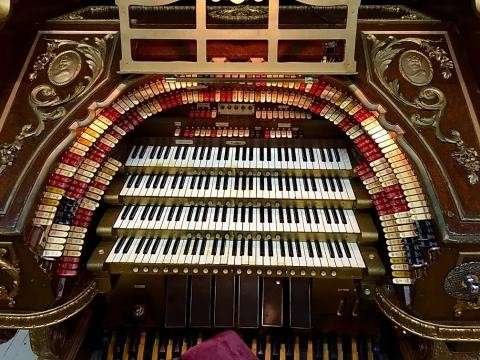
In 1910, the company bought an insolvent enterprise owned by the eccentric Cheshire-born Robert Hope-Jones. A pioneer in applying electrical technology, he sold his patent for what would become the company’s greatest triumph, an organ that went down in the history of cinema as the “One Man Orchestra.”
Otherwise known as the “Mighty Wurlitzer,” the organ was equipped with trumpets, tubas, clarinets, oboes, chimes, xylophones, drums, and other sound effects.
With the advent of silent movies in the 1920s, it became an international success. The introduction of sound (“talkies”) spelled the end for silent film. Organs were replaced by speaker systems. The “Mighty Wurlitzer” went out of fashion.
 The company (and the music industry in general) survived the Great Depression thanks to the jukebox. Its rise coincided with the end of Prohibition and then reopening of countless bars and clubs. “Put a nickel in it” was the slogan – and dance away.
Early jukeboxes used heavy and fragile shellac 78-rpm records. Rival companies competed to improve the mechanism, leading to the so-called “Battle of the Speeds.”
Introduced by RCA in March 1949, the invention of the 45-rpm vinyl record accelerated the spread of the jukebox. It improved sound quality, increased capacity (100 selections), and lowered production costs. The 45s became synonymous with the “single,” featuring a hit on the A-side and an added song on the B-side.
The root of the word “jukebox” goes back to the coastal plain and Sea Islands of South Carolina, Georgia, and northern Florida where “Gullah,” a creole of West African languages and English, was spoken by enslaved people brought to the region in the eighteenth century.
The word “jook” meant disorderly or rowdy. A “jook joint” was a dance hall, gaming room, and brothel, all rolled into one. Early boxes were known as “nickel-in-the-slot machines,” until around 1937 when Time magazine popularized the nickname jukebox.
A novelty in the 1920s, the jukebox transformed into a post-war cultural icon. Omnipresent, the vogue was associated with an emerging youth culture. Located in diners, coffee bars, roadside cafés, soda fountains, and amusement arcades, these boxes provided a hub where teenagers could spend time together, dance, and socialize.
 They allowed them to control their choice of music at their own chosen venues. Wurlitzer was the market leader, its name almost synonymous with the machine. Stylish and colorful designs added to their popularity both in America and Europe.
Wurlitzer’s vanguard role was enhanced by the participation of Paul Max Fuller (born in Corisca in 1897; and died in Buffalo in 1951), the most talented box designer of the era.
The company stopped producing jukeboxes in 1974; by that time, the firm had sold more than 750,000 of them. New electronic music devices caused the company’s decline. Japan took the lead instead.
C. F. Martin and Rudolph Wurlitzer were young immigrants who made a career in music, showing a commitment to traditional quality and artistry that was emblematic for their enterprises. The former provided uniquely American acoustics for over a century of contemporary music, while the latter supplied the soundscape of entertainment that shaped popular culture.
One stood for the creation of music, the other served its dissemination and consumption. Within their own realms, both men represented a Saxon creative versatility they brought to the United States, securing a niche of professional esteem for themselves in the nation’s diverse musical history.
Read more about music history in New York State.
Illustrations, from above: A modern European instrument shop; “A Typical Family of Violin-Makers Outside Their Cottage” in Markneukirchen, ca. 1900; C.F. Martin Sr and his wife Otilia from a scrapbook page (courtesy Martin Guitar Museum); C.F. Martin bronze plaque at the intersection of 196 Hudson Street and Vestry Street; Making Drums for the Spanish American War in the Wurlitzer Cincinnati Factory, 1898; Wurlitzer 4/26 orchestral organ, 1928 (LIU Paramount Theater, Brooklyn); Wurlitzer Stores and Factory 1916; Paul Max Fuller designed Wurlitzer jukebox model 850 “Peacock” design, 1941.
Source link