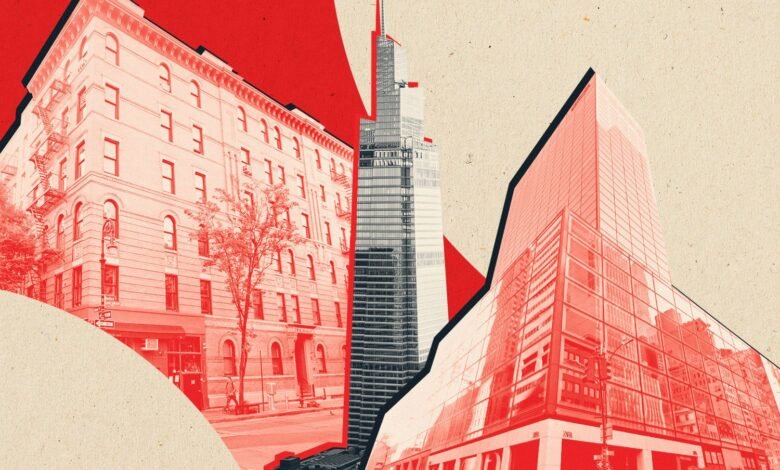

Japanese investors are emerging as the go-to buyers for trophy assets and a new lifeline for New York City multifamily dealmakers.
Japanese-based companies have acquired at least $2.1 billion worth of real estate in New York City since January 2024, according to an analysis compiled by Okada & Company and TRD Data.
Buyers from Japan have historically favored shiny office buildings, but are now targeting New York City’s not-so-glamorous walk-ups. Japanese-linked companies acquired 326 multifamily units, totaling $233 million of multifamily properties, in New York City since January 2024, according to The Real Deal’s data analysis.
JP Real Estate is among the largest Japanese acquirers of NYC multifamily. The little-known firm made a splash when it purchased the Friends building in the West Village at 90 Bedford Street for $32.7 million in late 2025.
“We have seen a flurry of middle-market and smaller acquisitions by family offices and Japanese corporations,” said Christopher Okada, CEO of Okada & Company, whose family has been involved in outbound Japanese investment since 1969.
Avison Young’s Brandon Polakoff said Japanese buyers used to be a smaller segment of the foreign capital pool. But he’s noticed a sizable uptick in recent years.
“They weren’t the only foreign buyers. I would sell to buyers from Japan, China, various European countries, Israel, Canada and South America,” said Polakoff. “And now I would say it’s probably 90-plus percent from Japan.”
Back in the 1980s, Japanese companies flocked to buy U.S. real estate. Mitsubishi Estate Co.’s acquisition of Rockefeller Center marked the peak of the buying frenzy, only for the Japanese asset bubble to collapse in 1990 and Mitsubishi’s $2 billion investment in Rockefeller Center to be wiped out in the mid 90s.
About 30 years later, Japanese investors jumped back into the NYC office market post-Covid. In 2023, Mori Trust, the Tokyo-based firm founded by Akira Mori, snagged a 50 percent stake in 245 Park Avenue. The deal valued the 1.8 million-square-foot tower at $2 billion.
The acquisition was crucial for NYC’s office market as one of the first big-ticket office deals since the pandemic began, offering price discovery for investors trying to value office properties.
In 2024, Uniqlo bought its retail property at 666 Fifth Avenue for $350 million. That same year, Mori Building Corp. acquired an 11 percent stake in SL Green’s One Vanderbilt. A year later, it acquired another 5 percent at the ultra-Class A building.
U.S. real estate is attractive to Japanese investors for a few reasons. Yields on U.S. real estate are higher than in Japan because of the country’s low interest rates. Japan’s ten-year treasury is hovering around 2.4 percent, up from just 1.2 percent a year ago. These numbers make NYC’s free-market multifamily capitalization rates of 5 percent look much more enticing.
Another perk: Japanese investors can borrow at lower rates in their home country, allowing them to outbid their American peers.
But Japanese buyers have also sought to buy real estate with wood-frame structures because of a quirk in the country’s tax code. In Japan, the useful life of a wood-frame building is 22 years. After that, they are considered to have zero value for tax purposes. Buildings over 20 years old could depreciate on a rapidly accelerated basis in as little as four years. Japanese investors used their wood-framed U.S. real estate as a tax shelter against other income.
In 2020, Japan attempted to close the loophole for individual investors who purchased U.S. real estate. But companies have still been buying U.S. real estate, and industry sources and The Promote reported that Japanese companies are still able to take advantage of depreciation benefits in the U.S. The current tax benefit favors properties where the building is worth more than the land.
Japanese investors are looking beyond NYC. Japanese companies have purchased or have announced plans to close on 23 single-family home builders since 2020, according to the Wall Street Journal. In total, Japanese buyers have purchased about 6 percent of the U.S. home construction market, the Journal reported last month.
In NYC, Polakoff said Japanese investors are selective, looking for buildings without code violations. In his estimation, the Japanese are targeting multifamily properties in NYC around the $5 million to $15 million range.
Polakoff added that these investors also have offices and advisors based in the U.S., making them more comfortable with investing in the U.S.
“It’s not like I’m going over to Japan or sending these deals directly to Japan,” said Polakoff.
Okada projects that, unlike in the 1980s, the basis and pricing of the Japanese acquisitions make more sense.
“Long term, these trades should hold up,” said Okada.