 When Josiah Stratton was laid to rest in the Village Cemetery in Galway, NY, in 1904, he left behind a life of service to hi county, survival in war, and dedication to family spanning his 94 years on earth.
His story is also one of tragedy and survival that could have ended his life 30 years too soon.
For Stratton, life in Saratoga County began when he moved to Saratoga Springs from Gratton, in Windham County, Vermont, in the summer of 1846.
Short in stature and weighing only one hundred pounds, Josiah was well known as a peaceful and inoffensive man, but one with a will that refused surrender.
When the call went out for volunteers to defend the country in the Civil War, Josiah stepped-up and in December of 1861 volunteered for three years’ service in New York’s 77th Infantry, the “Bemis Heights” Regiment.
When he enlisted at 51 he left behind his wife Laurencia and his three daughters: 15-year-old Sarah, 11-year-old Collista, and their youngest, Ella, age 8.
After spending that first winter serving in the defenses around Washington, the 77th was assigned to the 6th Corps, where, by May of 1862, they had fought at Yorktown and Williamsburg, followed by heavy fighting at Antietam, where thirty-two of their comrades were lost or wounded.
In May 1863, the now battle-hardened troops of the 77th Infantry sustained heavy losses during the assault on Mary’s Heights, part of the Chancellorsville campaign.
At the end of 1863, Josiah was discharged due to disability, suffering from rheumatism so severely that he lost use of his left hand. Only weeks after his medical discharge, Josiah Stratton re-enlisted in the 77th Infantry and then went on to serve until the end of the war.
During his second enlistment, the 77th fought in the Battle of the Wilderness and played a key role as part of the Union’s 6th Corps in the Siege of Petersburg and afterward in the pursuit of the Confederate army.
As the 77th Infantry was present in Appomattox during the surrender of Lee at Appomattox Court House on April 9, 1865, it is possible that Josiah Stratton witnessed this historic event. The 77th New York Infantry was mustered out of service on June 27, 1865, and Josiah returned home.
Life After War; And Near Death
Soon after returning from the war, Josiah moved his family to West Galway in Saratoga County, where he took up farming, supplementing his income as a tin peddler and gatekeeper at the Amsterdam Reservoir, what we now know as Galway Lake.
By the early 1870s, with their daughters all grown and gone, the couple continued life in Galway, with Josiah often staying in a small cabin at the dam on the reservoir where he rented boats and sold food and cider to those who visited the area.
On Wednesday, May 20, 1874, sixteen-year-old William Betts and his twenty-one-year-old brother Charles Franklin arrived at the reservoir looking to spend the day fishing.
When they approached Josiah Stratton to rent a boat, he reminded them of money they owed him from past visits. Franklin responded with a profane tirade of verbal abuse that ended the discussion, and the two took a boat and rowed out onto the lake.
When the Betts brothers returned from fishing, they demanded food from Josiah. Having nothing but cider available, Stratton opened a cask with a small hammer, which he set on the counter to pour their drinks.
In an act of senseless brutality, Franklin grabbed the hammer and attacked Josiah, fracturing his skull in seven places. Having survived the attack and still conscious, their victim lay helpless as they rifled through his pockets, robbing him of five dollars and an old pistol.
When they were satisfied that they had gotten everything of value, they fled, leaving Josiah in a state of near death behind the counter.
With what was later called “commendable pluck,” Josiah somehow found the strength to crawl from his store to the house of his son-in-law George Webster, a distance of nearly half a mile away. Though physicians were quickly summoned, they could do little for the wounded man, and gave him no chance of recovery.
Though in critical condition, Josiah swore out a warrant for the arrest of both Franklin and William, and it was given to Constable Robert Shaw to be carried out.
When Shaw spoke to their father Carmi Betts he learned that while William was somewhere nearby, Franklin had not returned after going fishing at the reservoir.
After getting assurances that Cami would bring William in for questioning, the constable left. The following week William stood before Galway Justice Crouch, who sent him to be held at the County Jail in Ballston Spa.
After William Betts was examined and locked up, and Josiah Stratton still hovering between life and death, a search was started for Franklin Betts. It took until June 6th, seventeen days after his assault on Josiah Stratton, for Franklin Betts to be captured.
While the authorities had assumed that he had fled to either Hamilton or Warren Counties, in reality, he had headed further east to Whitehall at the south end of Lake Champlain. Once there, he stole a wagon and team, which he drove along the Champlain Canal to Troy.
From there, he exchanged the wagon for a horse and turned west, ending up in Hagadorn Mills in the town of Providence, just north of his family’s farm. He was soon seen in the vicinity of a barn, and during a careful search, he was found hidden in a large barrel he had pulled down over himself.
On July 20th, Betts had a short taste of freedom when he and two others escaped from the Ballston Spa Jail. After one of the prisoners overpowered a guard and took his gun, the three slipped out through an unlocked door. With officers and bystanders in close pursuit, the three headed towards the nearby fairground and the woods beyond.
What the pursuers did not realize was that one of the escapees had separated himself from his companions and, pretending to be part of the crowd, directed the posse toward the other two and then snuck away in the opposite direction. Betts and his companion were quickly caught, but the third man was never apprehended.
Franklin Betts was sentenced to five years and four days in prison in October of 1874 and during his imprisonment was found to be insane and transferred to Auburn Prison. Only a short time after he was released, Betts allegedly committed suicide by drowning himself in the Sacandaga River near Batchellerville.
After Franklin was found guilty in the attack on Josiah Stratton, his brother William was exonerated of all blame in his brother’s actions and discharged. William later married and moved to Gloversville, where he took up work in a sawmill.
Over the days and weeks after the assault, Josiah Stratton, whose death was considered inevitable, made a miraculous recovery.
For the next 30 years, Josiah and his wife continued to live in Galway for the rest of their lives, and on his passing in 1904 at the age of ninety-four, he was the oldest member of Galway’s E. B. Carpenter Grand Army of the Republic Post.
Read more stories about crime and justice.
This essay is presented by the Saratoga County History Center.
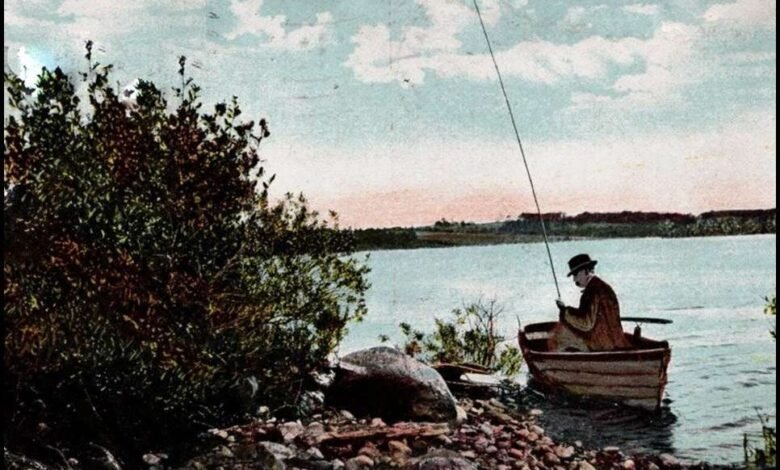
Illustration: “Fishing on the Galway Reservoir” (Galway Lake, aka Amsterdam Reservoir).
Source link