
A basic fact not well understood by the public and politicians is that developers must raise money for their projects — and cannot if the expected return doesn’t compensate for investors’ risk.
In other words: No profit, no project.
One elected official who gets it is Brooklyn Borough President Antonio Reynoso, a congressional candidate and unofficial member of the city’s YIMBY movement.
I was impressed to see this sentence in his conditional recommendation of Monitor Point, a 1,150-unit project on the Greenpoint waterfront planned by the Picket family’s Gotham Organization:
“Initial lending of capital is contingent on the developers demonstrating a 6.25 percent to 6.5 percent yield on their initial investment; otherwise, financiers will not lend the developer money to build the project.”
Those returns are lower than I would expect. But the point is, I didn’t expect him to include numbers at all, even if they were tucked away on page 13.
Below that sentence, Reynoso delivered a primer on the finances of housing development.
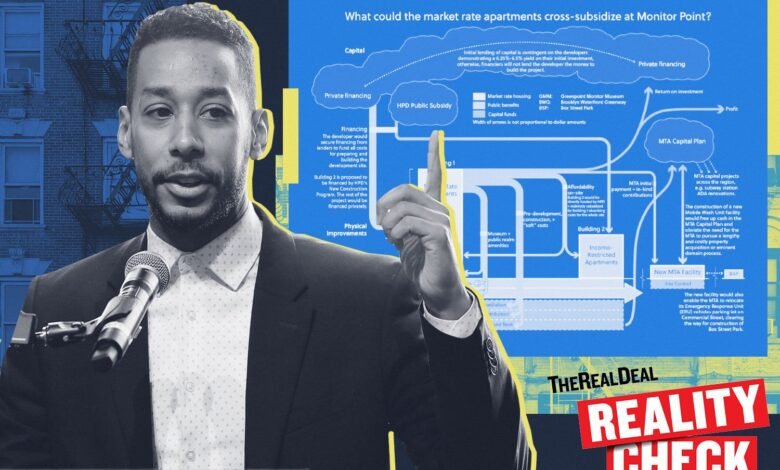
A flow chart showed how funding would come in, what it would build, how the market-rate units would generate revenue and all the places that revenue would go.
Most of the revenue destinations are beneficial: subsidized apartments, a Greenpoint Monitor Museum, public realm amenities, park maintenance, a new MTA bus-washing facility and ground rent for transit funding.
More arrows show returns going to investors and profit going, well, into the ether (but presumably to Gotham, run by David Picket).
Reynoso’s diagram also depicts “Building 2” getting financing from the Department of Housing Preservation and Development and money from the market-rate tenants’ rent payments.
Money flows into Building 2, but not out. It’s a graphic representation that low-income housing costs rather than produces money, even though tenants pay rent.
Reynoso also lays out a dynamic that the local Council member, Lincoln Restler, omitted from his argument that half of the units must be affordable because the project uses public land.
“The MTA site is fundamentally different from other publicly owned sites in that the ground has not been transferred to the developer at a zero or nominal cost,” Reynoso notes. “Rather, the applicant is required to expend upfront and ongoing costs that need to be offset by the market-rate units.”
After all that, however, Reynoso makes the same demand as Restler: that half of the units be affordable — a standard rarely, if ever, reached in such projects. However, the borough president wants some of those income-restricted units to be for moderate-income households (earning 90 percent to 120 percent of the area median income).
That might be how Restler plans to get Gotham to agree to 50 percent affordability, because middle-class tenants pay much more rent than those at 60 percent of AMI.
Gotham may be thinking about higher-AMI units as well, because its initial proposal was for 40 percent affordability — unusually high, because of that low-interest HPD financing. Now Gotham will have to do better so Restler can take credit for something.
Rezonings typically require a deal that allows the local Council member to highlight a negotiated public benefit. Having some higher AMI levels also works better socially. It creates more diversity among tenants.
The City Council is scheduled to vote on the project’s rezoning late next month. Should it reject the application, Gotham could appeal to a new three-member panel that includes Reynoso.
If all that fails, Gotham could build a smaller project as-of-right. Its agreement with the Metropolitan Transportation Authority doesn’t let the developer off the hook if the rezoning is blocked. Gotham would still have to build the MTA a bus-washing facility and pay $29 million (instead of $61 million) in ground rent, among other things.
The other firms that responded to the RFP also submitted as-of-right alternatives, but in 2021 the MTA found Gotham’s Plan B to be the most generous. I saw it as a bet by Gotham that Plan B won’t be needed because Plan A will be approved. We’ll find out soon enough.
Read more

Gotham Org’s Bushwick project pits liberal pol against Mamdani

Day in the Life of: David Picket

Lincoln Restler’s vacancy proposal is a red flag for real estate