
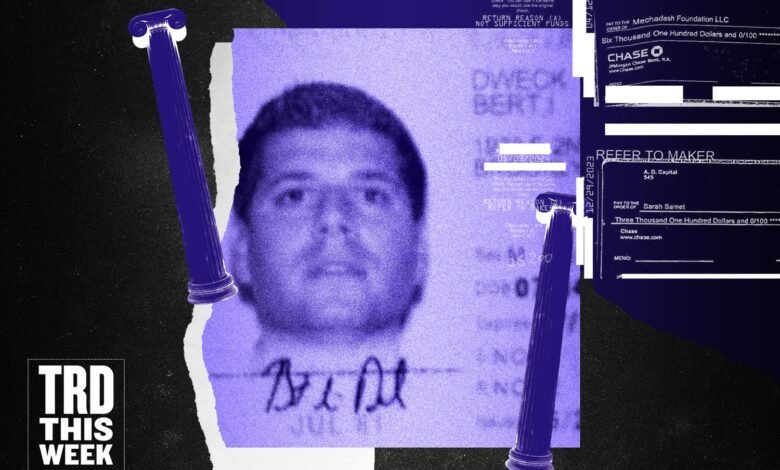
Brooklyn dealmaker Bert I. Dweck is staring down a legal avalanche that reads less like a routine business dispute and more like a slow-motion collapse.
Dweck, of Dweck Group, faces seven lawsuits in New York state court seeking at least $14.4 million over allegations that include unpaid loans, diverted escrow funds and checks tied to frozen or nonexistent accounts. The complaints sketch out a network of investors and lenders who claim they kept wiring money into deals.
According to multiple lawsuits, Dweck allegedly pitched acquisitions, collected deposits or partnership capital and then failed to close deals or return funds. In one December complaint, five companies tied to Patriarch President Capital accused Dweck of stealing $2.8 million connected to properties at 1526 Grand Concourse in the Bronx and 4188 and 4910 Broadway in Manhattan.
Investors alleged that Dweck supplied fraudulent documents and that escrow money was improperly released by attorney Jacques Erdos.
Dweck denied the allegations, while Erdos, through counsel, denied wrongdoing and said the claims against him lack merit.
But the lawsuits kept coming. Bronx supermarket owners Luis Manuel Diaz and Senelda Diaz alleged Dweck and associate Mark Benun convinced them to pour more than $2.8 million into two Bronx transactions that never materialized.
One involved a neighboring property whose owner allegedly had no record of receiving payment. Another centered on a former Apple Bank site, where an LLC created for the acquisition was later dissolved without buying the asset.
Then there are the lenders. Brooklyn investor Gary Porat alleged Dweck defaulted on nearly $6 million in loans and attempted repayment with 130 bounced checks and failed ACH transfers totaling roughly $5.5 million. Another lender, Mordechai Samet, claimed Dweck and affiliates issued $1.9 million in bad checks tied to insufficient, frozen or nonexistent accounts.
The sheer volume of allegations is what makes the saga notable. Real estate has always run on leverage and relationships, particularly in Brooklyn’s insular investment circles.
It’s the middle of May, so it may behoove you to check out the top stories of the week out of New York City real estate.
Eli Karp wins reprieve in $15M guarantee fight tied to East Flatbush foreclosure
Developer Eli Karp scored a temporary reprieve after a judge vacated a $15 million personal guarantee tied to his lost East Flatbush property, 271 Lenox Road.
Karp argued that his former attorney, Leo Jacobs, failed to contest the judgment without his knowledge.
Karp’s opposition centers on disputing a $29.6 million appraisal by BBG Real Estate Services, which he claims contradicts the firm’s higher 2019 valuation of $46.2 million.
EB-5 investor accuses Gary Barnett of $100M bait-and-switch
A South Korean citizen named Jung Shin, who invested $560,000 in Extell’s 555 Tenth Avenue project via the EB-5 program, is suing Gary Barnett for $100 million, claiming Barnett diverted her and 198 other investors’ money to prop up his distressed Times Square hotel projects.
The lawsuit alleges that Barnett manufactured a crisis in 2022 to pressure investors to keep their money in the project and slashed the interest rate while subordinating the EB-5 investors’ position so that later equity investors would be paid out first.
Shin accuses Barnett and the migration agency, Bether Capital, of intimidating Korean and Vietnamese investors by leveraging fears about their pending visa applications to coerce them into accepting the offer.
Sam Sprei, former Brooklyn judge arrested
Sam Sprei, a Brooklyn real estate operator, and former Kings County Supreme Court Justice Edward Harold King were charged with criminal wire fraud conspiracy for allegedly diverting investor escrow funds.
The fraud scheme involved Sprei and King soliciting $6.5 million from investors, allegedly for a Freehold, New Jersey, real estate bankruptcy sale, by requiring them to deposit funds in King’s escrow account as proof of liquidity.
They face up to 20 years in prison if convicted.
Is good cause eviction causing tenants to stay put?
The good cause eviction law was initially expected to have little impact on New York City, primarily because the governor diluted the original bill and nearly half of all rentals already had even stronger tenant protections.
Real estate executive Mitch Perle argues that the law is causing tenants in the 1 million free-market units to stay longer, which in turn reduces apartment turnover and drives up market-rate rents.
There’s reason to be skeptical about the law’s impact on tenant behavior, as any savings from staying put would be modest, luxury rentals are excluded and a new broker-fee law encourages turnover.
Read more

Brooklyn dealmaker Bert I. Dweck faces barrage of lawsuits over missing money, bad checks

Eli Karp wins reprieve in $15M guarantee fight tied to East Flatbush foreclosure

EB-5 investor accuses Gary Barnett of $100M bait-and-switch