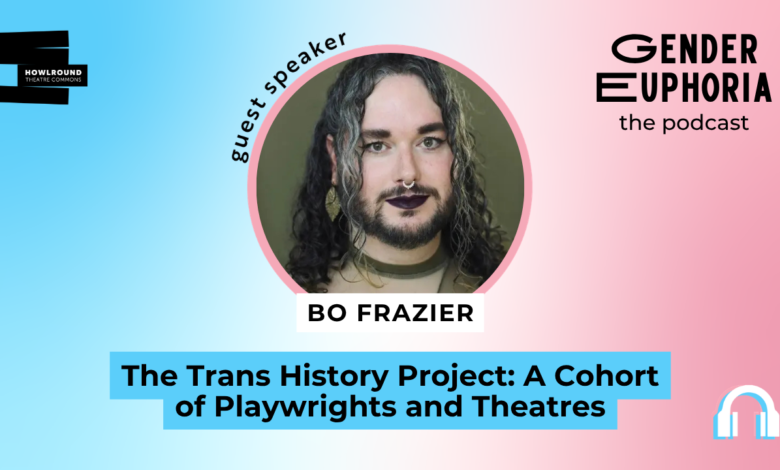
Nicolas Shannon Savard: Hello, and welcome to Gender Euphoria: The Podcast, a series produced for HowlRound Theatre Commons, a free and open platform for theatremakers worldwide.
I’m your host, Nicolas Shannon Savard. My pronouns are they, them, and theirs.
In today’s episode, I’ll continue last week’s conversation with Bo Frazier about The Trans History Project. Quick refresher: The Trans History Project is an initiative Bo is spearheading as artist-in-residence at Baltimore Center Stage. It’s a two-year residency and play development program with the goal to commission and produce ten new plays by trans and gender nonconforming artists about the real history of gender nonconformity across cultures and across time.
The first cohort, convened in the fall of 2025, includes Dane Figueroa Edidi,Bree Lowdermilk, Roger Q. Mason, Yona Moises Olivares and trans-devising ensemble Mirage Auto Depot.
Last episode, we talked about the plays in development, the histories the artists are exploring, and the questions they’re grappling with in their work.
For this episode, Bo and I take a step back to take a look structurally at how the Trans History Project is building community-based support into the program for playwrights and for partner theatres. We’ll pick the conversation back up with our exploration of why and how the initiative is working to create a cohort of trans and nonbinary playwrights and a cohort of theatres prepared to produce trans stories.
Chorus of voices: Gender euphoria is bliss. Freedom to experience masculinity, femininity, and everything in between. Getting to show up as your own self. Gender euphoria is opening the door to your body and being home. Unabashed bliss. You can feel it. You can feel the relief. Feel safe. And the sense of validation and actualization. Or sometimes it means being confident in who you are. But also to see yourself reflected back. Or maybe not, but being excited to find out.
Nicolas: From what I’ve read, it seems like you’re not just commissioning totally separate and independent projects. You’ve specifically gathered a cohort of playwrights. Could you talk a little bit about why you’ve chosen kind of a cohort-based approach for the project?
Bo Frazier: I think it is very hard to find community right now. And unless you are in a major city, a community of TGNC folks who make theatre is even smaller. So I specifically wanted to connect artists as much as we can when they’re all living across the country to not only have community and make friends, but also to support each other as artists in ways that you can find it difficult if you are not within a community.
So one of the things that I am hoping to do is to have a summer convening next summer, once we have cohort one and cohort two, to bring all ten plus artists together here in Baltimore to maybe kiki a little bit but also share ideas and community and discussion. It’s just so rare that we can be in space together. And we need to. We need to support each other. We need to show up for each other.
Being a playwright can be quite lonely. Especially people that write solo. Because you can write plays from anywhere, and a lot of places you can develop a play or get commissioned, you’re just talking via email for so long. And I wanted to try to get away from that. Obviously things happen. I wanted to help alleviate that loneliness that can happen as a writer. And even me as a director, it can feel very lonely. So yeah.
Nicolas: What does building that community of playwrights look like?
Bo: You know, it is a work in progress. We’ve all been in contact with each other. And we had a really wonderful Zoom happy hour with Stevie Walker-Webb, the artistic director of BCS and me and the playwrights.
Like, sure, we talked about “how are the plays going?” But then we just started, you know, just chatting about the world. And Roger started talking about something really crude –that’s just how Roger is. And so it’s small little moments like that. It is… I mean, I won’t say it’s difficult. We’re all busy working theatre artists, so trying to schedule that was hard. But yeah, I really hope to bring us all together like quarterly to, you know, just hold space, even if it is virtual space.
The reading that is happening tomorrow, the other artists that live in New York are going to join us and support Dane and her reading. And yeah, just be there if we can.
Nicolas: Nice. So in addition to your cohort of playwrights, you’ve also got a cohort of theatres all over the US, developing and producing this work. Could you just tell me a little bit about–why did you choose to work with multiple theatres across multiple cities, as opposed to just hosting everything in one spot?
Bo: Yeah, I really wanted to rethink how plays are developed in the country, specifically in regional theatre. It can feel, or not even feel, it is very siloed. And like a lot of regional theatres don’t talk to each other about what they’re commissioning and what they’re developing.
I knew, just like logistically, I knew that Baltimore Center Stage could not fully develop ten plays over the next two, three years. Every regional theatre is, you know, struggling financially right now. But we have this funding to pay for the commission. And I also knew that like the pipeline from burgeoning playwright to regional theatre is so mysterious. And I really wanted to connect artists to theatres where they have not been connected previously. Between me and Stevie and George, who runs Breaking the Binary, we had connections, obviously, at regional theatres, that we wanted to bridge that gap between artist and theatre. Particularly in this moment, it is so important to get into different regions of this country, and not just stay in the bubble of New York.
I don’t think the typical New York theatre audience needs their minds opened as much as someone else in other regions. While everyone needs their minds opened to new stories, you know, some regions have farther to go. And so it was very important to me to get into different regions.
Nicolas: There’s already opportunity in New York to hear a wider range of stories.
Bo: Yeah. I also wanted to work with different size theatres. We have very mid-sized theatres in cohort one. We have small theatres in cohort one. And in fact, in cohort two, I can’t say who they are, but we have even smaller-sized theatres in cohort two, and then even larger theatres. And so I really wanted to have a range of geographic location, and size of theatre, and type of work, and mission.
Obviously, we have Diversionary, who is very LGBTQ-focused in their programming and mission, and then Rattlestick, which is off-Broadway, which does specifically new work. And then we have like more traditional regional theatres.
And in this second cohort, I will say, we are working with more culturally-specific theatres, which is really exciting to me. And we are also working with theatres in the South, so in different regions than we have in cohort one, just to not only help regional theatres connect to the communities—because trans folks are everywhere—but also to get our artists into theatres where they had not previously been in.
Nicolas: How did you end up deciding which theatres to partner with? What did that process look like?
Bo: Obviously, this is a podcast for industry folks, so I can be a little more candid. I’m not gonna lie, it was harder than I thought.
Nicolas: Okay, how so?
Bo: Every theatre is so strapped right now, where in my mind… So how it logistically works is we, BCS, pay the commission fee, like we are the commissioning theatre. We pay for the dramaturg and or research assistant for each playwright. And then it is up to the theatres to produce one reading this current season, and then one sort of larger workshop, whatever that means for what the play needs. And that would be in the second year.
And while, I mean, every theatre is so grateful to be part of this project, it is still a lot to ask to produce a reading and a workshop at this particular moment when every theatre has a deficit. And new work is, unfortunately, not a safe bet right now. So it was finding theatres that not only have the capacity to add that to their workload but also already had infrastructure of development where they could slot this into a festival or include this in their reading series.
Because we wanted to make it as easy as possible for the regional theatres, or all the theatre partners, obviously. But yeah, everyone is so… I mean, you know, theatre is struggling right now. I mean, everything in this country is struggling.
I had a lot of conversations. There were some theatres that unfortunately had to say “no.” There was a theatre that was going to be in cohort one, but they were sent the press release last year. And it was during the moment where Trump was pulling funding from Harvard and NEA and all these things. And it was really unfortunate. Their board was scared of losing corporate funding. So they had to pull from the project a week before we were going to announce—and it was specifically in a region that I think really needs the work—even though their staff and artists were so excited about the project. So it’s just like, there are all kinds of things that go into this. And that was a really hard moment.
But yeah, it’s not as easy as I thought.
Nicolas: Thank you for being candid about it. I think that’s important for theatre professionals to hear, because I like getting real about like, what is challenging about this? What are we doing?
Bo: As a theatre artist, it has taken a lot of experience to like, even somewhat understand how this industry works. And so I’m always about demystifying what goes into things and what the struggles are. In my mind, I was like, we’re giving theatres a pre-commission. Why would you say no? And then it’s like, well, what actually goes into producing the new work is actually a lot. And specifically around budgets and everything, a workshop can cost upwards of 25,000 dollars, which is like, a lot.
Nicolas: There’s financial costs. There’s… trans stories are suddenly—I guess, not suddenly. They’re in the spotlight; it’s inherently political for us to be on stage. More so in certain parts of the country than others.
Bo: Oh, completely. I had a conversation with one of the artistic directors of one of the new theatres in cohort two about like, they’ve done some trans stories on stage before, but then issues of like, once they leave the building, how do they keep those artists safe where they are? And how can you, how do you support that? And I mean, we’re all learning and growing, but, you know, that’s the thing that we have to think about. Like, if we’re going to do the work in the places where we are not welcome, we have to keep our community safe.
Nicolas: Absolutely.
Okay. I’m going to interject here. In the spirit of demystification, in addition to frank conversation about the very real challenges of producing new work by trans writers and the barriers our community faces getting our stories on stage, I think we need models of success.
I want to talk a bit more here about the five theatres that said “yes“ to residencies and workshops and productions for the Trans History Project’s first cohort. They reflect some of the broader patterns I’ve found in my research of the kinds of organizations that have historically supported the development of trans and queer theatre. To hear more about that research specifically, go back to season two of Gender Euphoria. It’s in the episode on the Queer Trans Family Tree Project.
So the first two theatres fit largely into the camp of places that are already prioritizing or centered around LGBTQ work. We’ve got Diversionary Theatre in San Diego, California. It’s one of the oldest and longest running LGBTQ theatres in the US. It was founded in 1986 in the midst of the AIDS crisis, and it filled a need for raising awareness, provided a forum, and a physical space for members of the gay and lesbian community to gather for entertainment, for activism, for support in grappling with the devastating impact of the epidemic on the community. Their current mission, and I quote, is “we aim to foster and amplify the next generation of lesbian, gay, bisexual, transgender, queer, and other marginalized voices by providing the local community with live entertainment in a dynamic, inclusive, and welcoming environment that celebrates and preserves our unique culture.”
So it’s not especially surprising to me that they’d be willing to take a chance on premiering a trans play for the Trans History Project because they’ve done just that before with writers like Sylvan Oswald and Kit Yan. Prior to the Trans History Project, they’d already been in collaboration with fellow cohort member theatre, Rattlestick Theater, on an LGBTQ teen writing program. Fun fact, one of the instructors was season one Gender Euphoria guest Azure D. Osborne-Lee.
That brings us to the Rattlestick Theater in New York’s West Village. It’s an off-Broadway theatre with artistic director Will Davis at the helm, and Will Davis is the first out trans person to run an off-Broadway theatre. Rattlestick is largely focused on producing and developing new work. That is a major part of its mission. It’s doing so through the Terrence McNally New Works Incubator, fellowships for emerging playwrights and directors, and a multi-year playwright-in-residence program.
And Basil Kremendahl, one of the handful of trans writers to have their plays published prior to the Methuen Drama Book of Trans Plays, has been Rattlestick’s playwright-in-residence since 2019. So between the focus on incubating new work and multiple trans folks really shaping the theatre’s work, the connection is already there. So of course this is a place that would want to support play development with trans artists.
I think where things get interesting, and where there’s a less obvious immediate connection, is when we look at the three regional theatres that are part of cohort one, none of which are specifically focused on queer work. So I want to talk a little bit more about why would these theatres be places where The Trans History Project fits? What are they doing in terms of new play development for underrepresented voices?
We’ve got the Baltimore Center Stage, we’ve got the Round House Theatre in Bethesda, Maryland, and we’ve got the Long Wharf Theatre in New Haven, Connecticut. And the trends and connecting threads that I’m seeing among these theatres and how they’re also reflective of other theatres that have historically been especially supportive of trans artists’ work include the following:
One: all of them have organizational missions that prioritize voices that have been historically underrepresented in the theatre, a mission that is explicitly focused on engaging with contemporary social issues, new or experimental performances, and the programming backs it up. In other words, they don’t just pay lip service to diversity and token representation in their season. They really walk the walk across all of their programming on the main stage, in the community, in their educational programming.
Two: these theatres have really robust community-based and educational programming. They are actively engaged with a diverse local community. We see a lot of active outreach happening so that the voices presented on stage are reflected in the audience.
And three: they have strong new work development programs built into or alongside their main stage seasons.
An additional connecting thread among Baltimore Center Stage, Round House, and the Long Wharf Theatre also seems to be Dane Figueroa Edidi. She has been working all over Baltimore for years and years. That is her hometown. She was part of the group of writers who produced Round House’s Homebound Series back in the 2019-2020 season. And she has been in collaboration with the Long Wharf Theatre heading the Black Trans Women at the Center Festival, which has been running annually since 2020. The festival has reached its fifth year producing this virtual play reading festival featuring all Black trans women writers.
Looking a bit more closely at the Round House Theatre’s support of new works, they have their Equal Play Initiative. It’s aimed at producing gender and racial parity on stage in their main stage seasons, in addition to a new play commissioning program. So over the next decade, the Equal Play Initiative will commission and develop thirty new plays written exclusively by women playwrights and playwrights of color, including ten of those plays will be produced specifically for their Teen Performance Company, which is a pre-professional youth theatre company largely focused on producing original work.
Additionally, they have a resident artist program that is two years long, in which the artist is fully integrated into the company in a year-round role. They work on multiple productions and are part of the season planning involved with audience outreach, involved with the education arms of the company.
And I think the three of those together shows both a commitment to really supporting traditionally marginalized voices in the theatre and also an investment in really developing local talent. There are really strong relationships built between their various education programs, the main stage, and their artist residencies. That seems to be really important in establishing that sense of community and really growing and developing both the work and the artists.
I want to talk a little bit more about Baltimore Center Stage and the Long Wharf Theatre as regional theatres, and I want to take a historical lens to looking at them. And I think it’s especially useful to take the long view of this history of these two companies founded in the 1960s. Both of them have been real leaders in the regional theatre movement in the US because of their ongoing support of new work and real commitment to artistic innovation and very socially engaged playwriting.
And I think I want to use that lens to kind of challenge the idea that theatres ought to want a “safe bet” and that new work development doesn’t fit the bill for that. I concede it might not be a “safe bet” today. The first reading of an experimental play is not going to be what drives your ticket sales for the entire season. It’s not what new work development is for. Rather, it’s an investment, not just in a particular story, but in an artist.
New work development is really playing the long game in terms of cultural development and sustaining artists’ careers in the long term. And I think the Baltimore Center Stage offers a really great example of that long-term investment in playwrights. So I went down a bit of an archival rabbit hole and looked at the entire production history of the Baltimore Center Stage, dating back to the sixties and seventies, and a couple of patterns that I noticed in doing that…
So there were many different iterations of new works and play development programs over the years, but it’s clearly been a very consistent priority. And very frequently, the names that would pop up in their new play programs, in first reading, and development programs would reappear one or two or three seasons later with other work on the main stage, whether it was that play specifically or a different work of theirs. It wasn’t just a one-time reading or a one-time workshop. These programs seem to lead to ongoing relationships between the artist and the theatre, sometimes across changes in artistic directors, sometimes over the course of decades.
So particularly notable examples include Tony Kushner, Paula Vogel, Lisa Kron, Lynn Nottage. They all had either first readings, workshops, or regional theatre premieres of works of theirs relatively early on in their careers and relatively early on in development of those specific plays. BCS was doing The Baltimore Waltz and How I Learned to Drive years before either was published. They supported Lisa Kron’s early readings and workshops of Well and 2.5 Minute Ride. Twenty years later, those same artists’ work with Indecent and Fun Home are back on the main stage, fresh off of Broadway runs and Tony Awards.
Lynn Nottage is another great example of this long-term connection to BCS. Nottage developed Intimate Apparel during the 2001-2002 First Look program. The following year, BCS presented the world premiere of the play, and then Intimate Apparel was the most produced play in America in the 2005-2006 season. Nottage came back to Baltimore’s First Look program the next year with By the Way, Meet Vera Stark, and she’s back again a couple more times in the following few years.
In more recent history, we see the same cycle with playwrights like Lauren Yee and Larissa Fasthorse, who had works in development at the BCS Play Lab, King of the Yees in 2014, and Thanksgiving Play in 2017. Both of them were among American Theatre’s most produced playwrights for the first time for the 2019-2020 season.
This pattern isn’t just about a handful of playwrights who have become stars of the theatre industry. It’s kind of a reframing of what the regional theatre and what these new play development programs are really for. It’s not about the immediate commercial success.
So I guess all of this to say is it’s not that theatres like the Baltimore Center Stage are not interested in plays that are going to be “safe bets” because they are instead prioritizing new work development. I think what we see from this history and this really strong pattern is that their approach to developing work and creating a space for artists to do so is kind of building that “safe bet” play. It’s not the “safe bet” for tomorrow. It’s an investment for three or five or ten or fifteen years from now.
We don’t get the next Paula Vogel, the next Lynn Nottage, the next Larissa Fasthorse without these kinds of spaces and without these programs where playwrights can go and develop their work and get it in front of audiences while they’re still in draft mode.
And to tie this back to theatres that are especially supportive of producing trans work, I think Baltimore Center Stage, Long Wharf Theatre, and Round House Theatre are really useful examples to look to because it’s clear from their track record they know how to get stories that usually exist outside of our mainstream straight white theatre in front of audiences. They know how to set them up for success.
Looking at these theatres as places that really commit to supporting a diverse group of artists who are willing to meet the people and the stories where they are and adapt–I feel like that’s something that we really ought to highlight. These are the places where trans stories can thrive.
Okay, let’s get back to the conversation with Bo.
What do you hope the artists, the theatres, their audiences take away from being part of the Trans History Project? This might be concrete plans you’ve got, this might be wildly ambitious dreams, anything in between.
A moment of hope to bring up the terrible downer I just created for us.
Bo: I mean, that’s the nature of being in, you know, this world right now.
I personally hope to be able to publish all these plays. I used to not be a “literary” person. You know, I’m such a visual person, as a human, that like the written word did not seem as important to me in my youth, but now I understand it to be quite important, especially when it comes to like writing our history and leaving a legacy. So I really, really want to publish all these plays either like as an anthology or separate plays. So that is a goal of mine.
While it is very hard to get to agree to fully produce a play before it has been written, we have asked each theatre to choose a piece that they could see in their season and then like heavily consider it for the following season once it has been workshopped. So I hope that we can get all ten plays produced, whether that’s at those theatres or other theatres within our network.
I also have this dream to do a third cohort of musicals. As a musical theatre girlie, I want a musical, but obviously musicals are a lot more expensive and we don’t have that funding yet to do that. But that is, that is a dream.
And I just, I hope that the industry can see… I hope that they see that trans work is not scary. And that just because a play is about a trans or nonbinary person doesn’t mean that only trans and nonbinary people will enjoy it. And I hope that we can rethink how we collaborate with other theatres across the country to develop this important work.
Nicolas: That’s a lovely note to end on, I think. I’ve got a couple questions that I ask of all guests of Gender Euphoria, the Podcast. First, I’d like to invite you to give a shout out to a member of your own queer, trans, artistic family tree. Who is someone who has supported you, inspired you, showed you a path to follow to become the fabulous queer artist that you are?
Bo: I will definitely say my playwright and teacher friend, C. Meaker. We went to grad school together and they were the person I mentioned earlier where I like pitched this piece. But they were very instrumental in my coming out process, even though at that time, they also did not identify as nonbinary, but they were so supportive in the like, rethinking of self and gender and possibilities. They changed a lot of things for me and were so supportive and just showed up. And I think that is what we can do for each other, just show up and support. Yeah, that’s who I’ll say.
Nicolas: And finally, would you leave us with a snapshot of a moment of joyous queer community?
Bo: So last night, I saw Sasha Velour’s Travesty at the Woolly Mammoth. So first off, I’m a Drag Race fan and Sasha Velour is my all-time favorite. My two favorite are Bob the Drag Queen and Sasha Velour, who are very different queens.
But Sasha specifically, not only her like electric presence, but also outside of Drag Race, she’s a performance artist. And like, all of her multimedia performance art is like, so my aesthetic, and I really hope to work with her someday. But she did this piece that was multimedia, it was drag, it was theatre, it was dance, it was fashion. But it was specifically looking at history and the history of like—she told a very personal story about a queer space. And she was from Champaign-Urbana. It was a gay bar called C Street that was very instrumental in her journey as a queer person, but also a drag performer, and how it was torn down ten years ago.
But the thesis of it all at the end was sort of the same thing that we’re doing with this project that “we have always existed.” And it’s saying that in such a very different way. But it was so, it was so powerful, and just visually stunning. The things that she does with projections is insane. So yeah, that was my very recent moment of queer joy last night at Woolly Mammoth.
Nicolas: I love that so much for you. Sounds like a great night.
Bo: It was great. You know, just a random Wednesday night, seeing some drag in DC.
Nicolas: Fantastic.
That is all for this week’s episode. Join us again next week. Until then.
This has been Gender Euphoria: The Podcast. Hosted and edited by me, Nicolas Shannon Savard. The voices you heard in the intro poem were Rebecca Kling, Dillon Yruegas, Siri Gurudev, Azure D. Osborne-Lee, and Joshua Bastian Cole. The show art was designed by Yaşam Gülseven. This podcast is produced as a contribution to HowlRound Theatre Commons. You can find more episodes of this show and other HowlRound shows wherever you find podcasts, including on noncommercial open source apps like Anytime Podcast Player for iPhone and AntennaPod for Android. If you loved this podcast, please share it with your friends, your colleagues, your students. You can find a transcript for this episode along with lots of other progressive and disruptive content on howlround.com. Have an idea for a meaningful podcast, essay, or TV event that the theatre community needs to hear? Visit howlround.com and submit your ideas to the knowledge commons.