 On a warm, sunny day amid the winding hills of Herkimer County, the world descended on Van Hornesville, a small Mohawk Valley community, without a train station but home to a global, widely respected statesman of commerce and international finance.
Ninety-five years ago this June, Owen D. Young (1874-1962), architect of the Young Plan on Germany’s fiscal rehabilitation after World War I, and longtime chairman of General Electric Company, presided over graduation ceremonies for the town’s newly built seven-room schoolhouse replete with a swimming pool, a playground, and an auditorium “wired for talkies.”
The lead story in The New York Times that day concerned distant matters in which Young had played a significant role: German President von Hindenburg’s telegram of appreciation to U.S. President Herbert Hoover regarding a moratorium on debt payments.
 But the tall, angular 57-year-old Young remained anchored to the narrow valley his forebears had farmed since Colonial times.
By his side that day was New York Gov. Franklin D. Roosevelt, there to pay tribute to “my old friend” Owen Young and help hand out high school degrees to the graduating class of seven girls and one boy, with the entire town of 200 joining in a daylong celebration featuring a parade, a picnic, and swimming and outdoor play.
A solid, deeply rooted place less than 15 miles from Little Falls, NY. “Rocking chair advisor” Young helped make the new school happen; it replaced the one-room affair, heated by a wood stove, he himself had attended more than 40 years earlier, which had burned to the ground in 1927.
Young’s aim: to build something he never had as a boy – in the words of noted journalist Mildred Adams (1894-1980), “part of an attempt to make change in one phase of the present course of economic progress, to stop, in this one spot, the abandoning of farms, the decay of a village, the drift of people to cities… to show that country life, properly organized, can supply every advantage the city offers and some things that the city, by reason of being a city, cannot possibly give.”
Gov. Roosevelt, less than 18 months away from being elected President and having to deal with the Great Plains Dust Bowl and the Great Depression, struck a similarly aspirational tone in his remarks that day:
“The splendid achievements of recent years which have brought us higher standards of living, greater physical comforts, vastly better education and more abundant prosperity must be maintained and even increased. Nevertheless, the machine that we call civilization is today out of balance and the principal effort of the next few years will be to restore that balance.”
In a film taken of the event, Roosevelt, smiling, shoulders erect and chin upturned in a confident pose Americans would come to know well in the trying years to come, sung Young’s praises to the hometown assemblage.
“He is now and (has) for many years past been a very necessary factor in almost every forward step of the nation,” intoned the governor.
 “And I need not remind you that his modest leadership has greatly influenced the course and progress of other nations besides our own. But today I like to think of him more as Owen Young my old friend. Not the Owen Young of world conferences, not the Owen Young of great industries, not even the Owen Young of unselfish social betterment. But as your own Owen Young up in Van Hornesville. He is your unassuming simple neighbor and friend, who in spite of a world acquaintance, still has his heart right here in this community.”
Young, who in the precious dozen years had helped form GE’s Radio Corporation of America (RCA) and the National Broadcasting Company (NBC), illuminated a fast-changing and modernizing world.
Four years earlier, not 50 miles distant in Schenectady, GE engineers had achieved the first demonstration of television broadcast reception. The vast company Young ran was among the five largest in the U.S. by assets.
At the graduation ceremony in a town founded by Abram Van Horne – who in 1777, Mildred Adams noted, “went off across the hills to help General Herkimer hold the British back at Oriskany” – Young mapped out an emerging, connected globe.
“These remote hills are remote no longer,” he said, “because now we live near and are part of the rest of the world. News and music, prizefights and politics, stock markets and stage favorites come to us every day. We are not unknown the world, or the world to us.”
Therefore, said Young said, as “citizens no longer of an isolated community, satisfied with its distinctions” the approach to education required modernization, elevating Van Hornesville’s youth as “aspirants and competitors for places in the whole world outside.”
The little red schoolhouse is now known as the Owen D. Young Central School. Young’s long and consistently consequential life included service as director and vice chairman of the New York Federal Reserve Bank and chair of Hoover’s Committee on Business Cycles and Unemployment.
 He remained GE chairman from 1922 to 1939, retiring at 65 to his farm in Van Hornesville, briefly returning as GE chairman during World War II from 1942 to 1945.
One sign of the widespread veneration Young enjoyed came in the form of a laudatory 1932 biography written by muckraker and investigative journalist Ida Tarbell (1857-1944), entitled Owen D. Young: A New Type of Industrial Leader.
Young died at 88 in 1962. In appropriate juxtaposition, his front-page New York Times obituary appeared adjacent to an article touting the first satellite broadcast from Europe to the United States via the Telstar satellite.
“He had strong views on the subject of retirement,” The Times wrote in his obituary. “It was his often expressed view that older people should get out of the way and let younger people run the affairs of the world.”
Indeed, he had over the years been approached about running for Mayor off New York, Governor, and even President, but demurred and remained on his farm or tending to his orange grove in St. Augustine, Florida.
His time overseeing farm tracts near Van Hornesville did not prioritize making money, Adams wrote in 1931. “It is the constant sorrow of his manager, whose job it is to make the farms pay for themselves, that his employer keeps giving away promising young calves to promising young farmers.”
Honored by the New York City business community at a 1924 testimonial dinner, following his return from Europe as “Ad Interim Agent General of Reparation Payments,” Young used his Van Hornesville vocation to illustrate a point about his globally significant war debt negotiation efforts.
“When I am in the country, my chief occupation is to trade cows with my neighbors,” he told the Waldorf Astoria audience.
“Just before I left for Europe, having spent the whole of an arduous morning in a most difficult negotiation, I said to my neighbor as he seemed about to leave, ‘Abe, will you buy that cow?”
His answer was, ‘Well, she’s most too dear to take and she’s most too dear to leave.’” His debt plan, he said, had to be just that.
Owen D. Young was ever as grounded as they come.
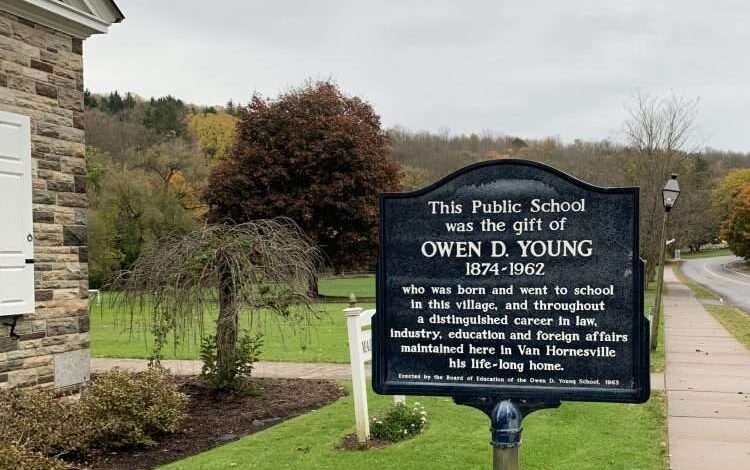
Illustrations, from above: Historic sign for the Owen D. Young-donated school in Herkimer County; Participants in a rally against the Young Plan at the Hermann Monument on September 1, 1929 (the monument was constructed between 1838 and 1875 to commemorate a victory over the Roman Empire at the Battle of the Teutoburg Forest in September of 9 AD; and Owen Young at the Expert Commission in Berlin after World War One; and a portrait of Young.
Source link