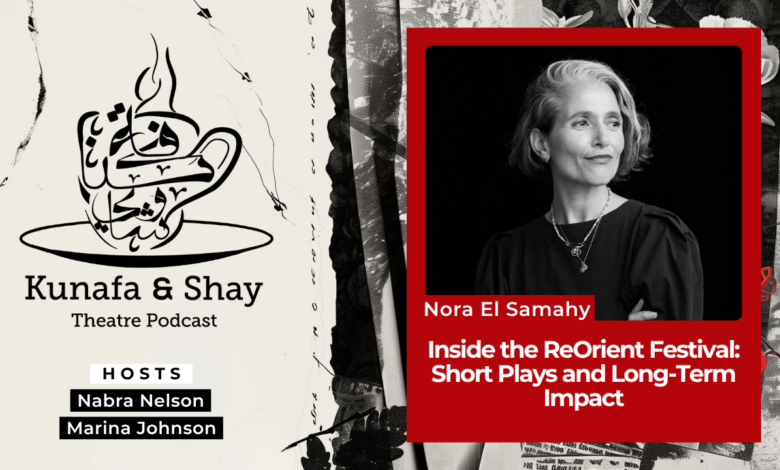
Nabra Nelson: Salam Alaikum! Welcome to Kunafa and Shay, a podcast produced for HowlRound Theatre Commons, a free and open platform for theatremakers worldwide. Kunafa and Shay discusses and analyzes contemporary and historical Middle Eastern and North African, or MENA, and Southwest Asian and North African, or SWANA, theatre from across the region.
Marina Johnson: I’m Marina.
Nabra: And I’m Nabra. And we’re your hosts. Our name, Kunafa and Shay, invites you into the discussion in the best way we know how, with complex and delicious sweets like kunafa and perfectly warm tea, or in Arabic, shay.
Marina: In each country in the Arab world, you’ll find kunafa made differently. In that way, we also lean into the diversity, complexity, and robust flavors of MENA and SWANA theatre.
Nabra: Season six of this podcast marks a double milestone, the thirtieth anniversary of Golden Thread Productions, the oldest MENA theatre company in the US, and my first year as the theatre’s new artistic director. Across ten episodes, we use Golden Thread as a case study to revisit landmark productions from 1996 to 2026, and trace shifting tropes, political urgencies, and aesthetic strategies that shaped the company’s early decades.
Marina: This season also expands to reflect on the past three decades for MENA theatres across the US, not as a closed chapter, but as a living archive, one that illuminates where we’ve been and where we’re headed.
Nabra: In this episode, we take a closer look at Golden Thread Productions’ ReOrient Festival and the National Convening of Middle Eastern North African Theater Makers Alliance, or MENATMA. ReOrient has long served as a vital platform for new and innovative works by MENA and SWANA playwrights, showcasing bold storytelling that challenges aesthetic and political expectations. We explore how MENATMA’s biannual convening builds on that momentum, bringing artists, producers, and cultural workers together to strategize, resource share, and imagine collective futures. Together, the festival and the convening reveal how presentation and infrastructure must move hand in hand, shaping not just what appears on stage, but how the field sustains itself.
Marina: I’m so excited to talk about ReOrient Festival as it is one of the ways that I first began working with Golden Thread myself. And I would like to talk about the first ReOrient Festival, which in 1999, when it was first premiering, was called Six Plays and Short. So I’m going to read specifically from the website here because I think it’s a really lovely description:
“Golden Thread Productions Festival of One Act will present six short works by authors from or on themes concerning the Middle East. Most of the productions will be premieres of original plays developed by the company. However, Bay Area theatre lovers will recognize Emily Shihadeh’s Grapes and Figs Are in Season, which has previously toured the Bay Area to remarkable reviews. This unusual festival, perhaps the first of its kind in the US, will run in repertory for four weeks in August at the Exit Theatre in San Francisco. Golden Thread Productions, which defines its connection to the Middle East expansively and inclusively, is made up of artists from all around the globe. In organizing Six Plays and Short, we wanted to explore the political, the sensual, and the absurd. We reached out to local writers and performers and were delighted to find so many wanting to join us on this adventure. Out of the six works presented in the two series, five are premieres. This is at once challenging and rewarding. At Golden Thread, we have come to understand our role as facilitators. This festival is our first attempt at bringing together a collection of contemporary works that explore what it means to be, quote, from the Middle East, end quote. The baggage we carry is ever present in our work, no matter how subtly.”
Nabra: So since its very beginning, ReOrient Festival of Short Plays has been central to the company’s artistic mission. It’s a recurring event that brings together playwrights, directors, and performers from the Middle East, its global diaspora, and folks in solidarity with our region. And since its inception in 1999, the festival has functioned as both a platform for new theatrical writing and a cultural intervention into dominant representations of the region in American public discourse.
Marina: And this is something I love about ReOrient is that it’s a chance to have short works by different artists on stage. When you are a, you know, great and scrappy theatre company like Golden Thread, you’re presenting two to three main stages a year. You’re not presenting, you know, six to eight, which maybe a larger regional theatre would be doing. And so you have to be really specific in choosing the plays that you want to do.
Golden Thread doing ReOrient Festival gives a chance to have more artists participate in this mission and also more chances with these different short plays to talk about different places, themes, ideas, conflicts, etc. So I love that this is something that they were doing and i think that 1999 was the first and only time the plays ran in rep.
We heard from Torange and I think Evren, that it was just tricky to do this because people didn’t necessarily know that there was like an A night and a B night where you had different plays on different days. And so now ReOrient is one night of all of the plays at once, keeping it to a shorter time span, you know, less than two hours. Really interesting to see how this started and then really to see where we are now with this development.
ReOrient Festival intervenes in our larger cultural landscape, but also in our larger geopolitical landscape by giving a space to artists who are from the region, but also in the diaspora, and able to use the space to talk about complex, contradictory perspectives on identity, politics, belonging. People are allowed to have very different opinions here and to express them artistically. So the curatorial emphasis on short plays and emerging voices—this space becomes a laboratory of sorts. And I love using the term lab here because we can experiment, dramaturgically, we can experiment with form and content in a way that you can’t necessarily when you’re doing a main stage, you know, neat ninety minutes play.
Nabra: I mean, that’s what I’ve loved about the ReOrient Short Play Festival is that since I’ve been like privy to it, I went to the past two ones as an audience member. And, you know, it’s clear that there’s just so much experimentation happening and support for that experimentation. There is a forum or camp in advance of ReOrient where all of the folks involved get together months before. Usually it was apparently the Fourth of July weekend because there was a local university that would host. And it was a time to kind of, before the pressure of rehearsal, to get together and to workshop some of this work to support the playwrights and to support the designers who are designing for a whole bunch of different plays.
There’s one designer, one sound designer, one lighting designer, one set designer, etcetera. So this idea of a lab is very potent in that element of the ReOrient Short Play Festival. And I believe Marina, you were involved in the lab last year right? Or the camp? How did that go?
Marina: It was great, yeah. So for the last ReOrient festival I was one of the dramaturgs. You know there are usually two or three dramaturgs who are working across the six-ish plays and then there is a production dramaturg and a overarching dramaturg also. But what’s great about being a dramaturg in this setting is that the camp gives a chance for dramaturgical feedback to come into play. It might be the first time that the artists are hearing the play out loud. And so if there are edits they want to make now that they have actors reading these parts, and when you hear it in a human voice verse when you hear it in your own head as a playwright, that’s a very different circumstance and situation. And so having this time and space is really a luxury that I don’t get to see happen frequently in processes that aren’t specifically like new play development processes before staged readings, they know they’re having a production soon. And so there is a different urgency in the camp to build community and also to make the changes that kind of come up and they have the time and space to do that, which is really exciting.
Nabra: And I also love that there are, seem to be recurring plays that are by folks that maybe aren’t conventionally in theatre or starting to write in theatre, maybe write in different media or artists in different media.
Like a couple of years ago, at the last one, I believe, Hamed Sinno from Mashrou’ Leila, who’s a incredible and famous Lebanese musician, had a short play that was this very interesting experimental short play. I believe it was their first short play. And it was really exciting to be able to see Hamed step into this new realm because of course their art is so incredible and powerful in their own medium. And so to have the support to experiment in other media is I think really exciting for me thinking about the future of MENA theatre and the evolution of MENA theatre, especially as we become more and more multidisciplinary in the theatre world, I think in general.
And this year, Sepehr Jafari has a play. She is a playwright, but more primarily does illustration and filmmaking and performance art. And so checking out some of her work. in conversation with this play really illuminates how she’s approaching the genre, which again is very experimental. It’s very different from what I’ve seen on stage, especially in short play formats. So I love that there’s that space for folks from other disciplines to come in and form the theatre world and what we consider theatre and transform what theatre can be through their perspectives in these other media and it really does come through and is very exciting for me as an audience member.
Marina: What I love that there’s this mentality in theatre… And I don’t understand where this comes from, honestly. I think it comes from playwriting classes, where often, if you’re taking a playwriting class for the first time, you’re encouraged to write a short play. But there’s this idea that short plays are somehow like a starter play. And actually, the short play form is quite difficult, because you have less time. And if you have a full-length play, there’s a little bit more time for certain things to unfold.
Short plays are really specific, and they don’t have much time, and they have particular constraints. And so getting to see how ReOrient embraces this structure of these plays that are actually quite complex, often an idea and what they’re doing and having a place to explore and experiment with them is really, it’s very fruitful to see.
Do you want to talk about the name ReOrient?
Nabra: Yeah, I mean, I can’t tell you how it was chosen, obviously, but this idea ReOrient suggests this deliberate reorientation of perspective. So rather than reproducing Western gazes toward the Orient, the festival aims to redirect attention towards the voices of those who are often excluded from mainstream cultural production to orient us back to the Orient, perhaps.
And actually, I’ve been thinking about the term oriental recently because I learned about its etymology and it really fascinates me because the etymology is about orienting towards the sun.
So how folks used to orient ourselves before like modern compasses and such was towards the sun. That was considered kind of like North almost, which is why the terms for west and north, or sorry, from left and north are similar in Arabic.
So wait, let me take you back. If we are oriented towards the sun, we’re oriented towards the east, right? And so then on our left hand is the north. And so then you get words like shemal, which is left and shamel, which is north in there, almost the exact same sounding unless you know Arabic. And so, and I probably didn’t articulate very well this time, but they’re almost the same word. And I’ve always wondered why that is. And I came across information about that. And then this term, oriental came from orienting ourselves to the sun, which I kind of love.
And it’s really tragic how then oriental became a term that’s considered a race, you know, a racist or racially charged term because of just European and Western racism that would have been placed upon people of you know, the East, I guess, or what they called the Orient. And then, of course, that racism translates to all of these racist descriptions, racist scholarship using the term oriental.
And now it’s so far removed from its etymology. But I kind of love this word, this word ReOrient, this title. To me, I’m also reflecting on how it’s a reclamation. It could be a reclamation of oriental in the way that many terms that have been appropriated by Western folks or, you know, denigrated by Western folks are kind of taken thereby by people that aren’t our people and made bad or made evil when the etymology isn’t rooted in that.
It’s kind of exciting to think about the idea of taking that our words back and twisting them and adding a little bit of zaniness or a new meaning and creating this platform that is empowering for our people using like a version of this word.
Marina: For sure and I mean I think we could talk about this for hours and you and I have talked about this for hours actually. But I think Edward Said’s foundational scholarship on Orientalism was the first time that someone was calling people out on this racism in a scholarly way, and looking at what the Institute was doing. But when I’m in Palestine, people frequently will say the word oriental when they’re translating something to English. I was going to a dance class with a friend, and they had asked me if I wanted to go raqs sharqi, right? Eastern dance. But the way they translated it to me was oriental dance. So like belly dancing, specifically in this context. But it was really interesting because in Arabic, it doesn’t have the same baggage necessarily when people are just using these terms in everyday life.
So anyway, we haven’t talked with Torange about the name ReOrient, but I think that we were just doing a close reading of the name and also some of the things that we’re interested in amongst ourselves politically here.
I would love to talk about the play selection process because I’ve twice been on the reading committee. Once, taking the large plays down. So let’s say that if Golden Thread gets a hundred plays, then that’s narrowed down to a smaller pool. And then once, I was on the smaller pool into the selection process, and this is always a group of artists who have not submitted plays themselves, to this process and looking at what it means to put particular plays on stage. So are you interested in this play? Is this play, a feasible play that could happen for ReOrient? So one of the things that often happens, it seems, is that people will submit plays that are like forty-five minutes long. And it doesn’t mean that that play can’t be produced. But because the goal is to include several plays, I think usually it’s between four and six plays, depending on length. A forty-five minute play is just a much harder play to include in the evening, unless the playwright is willing to have that be cut down.
If you have a play that’s a one-person play you probably don’t want to have too many of those, so if you’ve selected one or two you probably won’t select the third even if that play is really great. So this is just a curation question. At the end of the day is, well and if all the plays are by people from Iran or Iraq or Egypt like how are there ways that we can tell different stories? Is there a theme that’s emerging from the plays and can that theme be emphasized?
So really these things that we know from curatorial discussions that are important all go into this conversation and I’m always really fascinated to see how these things are handled. Because there are so many plays that have been submitted to ReOrient and it’s really exciting and I never envy the task of the artistic director or the final folks who are there to say, okay, this is our final lineup because there are just so many great pieces.
Nabra: Absolutely. And this year, I’m glad I was not part of the selection this year because I know how much pressure that is. Sahar did select, I mean, was the ultimate, I guess, selector of these plays. So I need to give her kudos for the amazing curation.
You know, maybe we should read some excerpts from this year’s festival. The 2026 festival, which is again the thirtieth anniversary edition, features Dare Not to Speak by Hassan Abdulrazzak, Camouflage by Ahmed Masoud, Regarding Antigone by Banafsheh Hassani, Homing Pigeons and Co. by Sepehr Jafari, and Blood Fruit by Hannah Khalil. And this will be playing October 9th through November 1st at Potrero Stage 2026.
These represent Iraqi, Palestinian, Iranian playwrights, but all of them have to do with Palestine or Iran. So it’s really exciting to have that as the focus of this year’s ReOrient Short Play Festival. So we’re going to start with an excerpt from Dare Not Speak by Hassan Abdulrazzak, which is a London-based Iraqi playwright. And I will play Hind, and Marina will play Natalie. And you’ll see what this is about. We’re going to do play readings. I love play readings. You’ll get it.
Marina is playing a director, an artistic director in a theatre, a predominantly white theatre, having a kind of pitch session with a woman named Hind:
Marina: I don’t mean to rush you, it’s just that I have a meeting with the board after this. Are you comfortable? Do you need water?
Nabra: I’m fine.
Marina: Shoot.
Nabra: A little girl gets in a car with her uncle, aunts, and cousins, and they drive south. They are fleeing the occupying army, which is shelling the north where they live. Their conversation is about fighting, yes, but also about more mundane things. What they forgot to pack, the merits of practicing trigonometry, even though the schools have shut. Should they listen to the news or to a song to calm their nerves? That sort of thing. Suddenly, the car is shot by an army tank, killing the uncle, aunt, and four cousins. One of the older cousins, who survives, calls the Red Crescent. They’re shooting at us. We’re in the car. The tank is right next to us. Later, while the cousin is on the phone, she’s shot dead by a soldier raking the car with his machine gun. When the dispatchers call back, only the little girl is left alive. She stays on the line with the Red Crescent for three hours, telling the dispatcher, I’m so scared. Please come. Come take me. Please, will you come? When the Red Crescent ambulance crew finally arrives, they find the little girl dead. The play is basically the last day of the little girl’s life, condensed into an hour and a half.
Marina: Wow, okay, I read that story in the news. Remind me of the little girl’s name?
Nabra: Hind.
Marina: Like your name?
Nabra: That’s the excerpt, and you’ll see where there’s a bit of a twist, but you might be able to guess what happens.
Marina: Yes, and I’m sure you can guess the Hind that this is based on. It’s also the Hind that there’s a new movie about, etc.
Nabra: We’ll next read a play by a London-based Palestinian writer, Ahmed Masoud, which is someone that Marina has collaborated with. And this excerpt is from Camouflage.
Maybe I’ll be the dad and you’ll be Nibal.
Nibal, what do you think of this one?
Marina: Well Baba, he lives in Area C. Do you really want me to marry someone who lives there? I will never be able to come back to visit you in Ramallah easily. The fact is, I don’t really want to get married at all. I’ve never felt attracted to anyone.
Nabra: Daughter, you will need someone to look after you when I’m gone.
Marina: Here we go again, waiting for Mr. Protector to come, riding a white horse and charging through Israeli checkpoints, shouting, step aside, everyone. I am here to save Nibal from the awful situation she lives in. I am here to take her away from her loneliness and to put an end to all her needs for a strong, masculine man. I can’t do anything about the occupation, but sure enough, she will not be on her own when they invade.
Nabra: And that’s the end of the excerpt. This is done as a monologue. Camouflage is four monologues of four different Palestinians, read by four different people. So it’ll be a really interesting, again, different format, kind of, than most, I think, short plays that you see.
And our final excerpt is from Regarding Antigone by Montreal-based Iranian artist Banafsheh Hassani. This is when I will be directing and is a monologue as well in a very interesting format, in my opinion, a kind of a different genre than, again, one would expect. So this is the actor who plays the whole thing.
But how much can you care before you collapse? You learn to live with it, to walk with the blood rather than on it. The show just couldn’t stop. It had turned and transformed into something bigger than us. It was the one thing that was going to stay to see the life we had missed out on. I reluctantly took Antigone’s role. I didn’t think it was right. And I knew I wouldn’t be as good of an Antigone as the one we lost. She was just radiant. Our Creon stopped showing up then. Occasionally sending word that he’s okay, just not safe to show up. He said they’re watching his street. And I wanted to tell him he can crash at mine, but I guess I was, I don’t know why I didn’t. It’s been eight days since he last texted me back. And he always texted me back, even when it wasn’t safe to have an uncleared phone on you. Then it was just me and our director. It was really difficult to get here today. All the main streets are closed. It’s way past our call time. I’ve waited for so long and no one’s coming. I cry. And I know that this is the end. And even though I made it, I don’t know if it was worth it.
As you can see, this year’s ReOrient is going to be very powerful. There is a lot of comedy as well as a lot of really deep, intense pieces. So I’m really looking forward to being able to support it as a producer and we already have an amazing team starting to come together. Yeah, so that’s October at Potrero Stage.
Marina: Yes, I’m so excited. I love ReOrient and I love these plays. I think it’s going to be a really amazing festival. And with that festival comes the MENATMA convening. So this is the second year that the MENATMA convening will be held in conjunction with the ReOrient festival. MENATMA, again, that’s the MENA Theater Makers Alliance, holds a bi-annual convening, although the last one I think was three years ago, and it brings together the community theatre with an interest in MENA theatre. Being at ReOrient is a way for MENATMA to share its support of the huge team of artists that make ReOrient possible, hopefully drawing national attention to this festival and the artists involved.
Producing and seeing MENA art is what, you know, MENATMA is all about. And so this is a great way to live the MENATMA values.
Nabra: At the last convening in 2023, we held our first and only, so far, Kunafa and Shay live episode. So maybe that’ll be another one. If you want to meet us in person, come to the MENATMA convening. But check out our last one, that’s season three, episode seven, about affinity groups, MENA affinity groups.
2023, however, at the same time, was this time of great mourning as the genocide in Palestine had escalated to unfathomable heights of destruction and loss. Unfortunately, it looks like this year’s convening may have much the same need for collective grief.
The genocide continues in Palestine, as well as in Sudan and the Congo. Iranian protesters were murdered en masse just earlier this year, and a war with Iran has started, aggressed by the United States and Israel, and our communities and allies are being terrorized on our own doorstep here in the US by government agents.
I don’t know where we will be in fall, but I know it will take more than a few months to grieve for the loss that we’ve already felt in the first few months of this year. That question of the role of art is as present now as it’s ever been, and thankfully for many artists even more so as they’re forced to face the impact that each of us have on the course of our society. For those of us who have been asking that question urgently for a long time, the work just continues.
And I’m so grateful to be at a company where I know my every day has at least the intention of changing culture for the better. If we all have that intention, we may just be able to do it.
So we want to hear now from one of those artists that is and has been doing the work for so long and has been involved in the ReOrient Festival in many different ways for years to gain some more insight on this festival and her positionality as an artist and why this is important to her.
So I would love to welcome Nora El Samahy.
Marina: Nora, we’re so happy to have you with us today. You are quite a legend both in the Golden Thread world, but also just in the theatre world. I remember seeing you at a Charles Mee play several years ago and it really just made me so happy and excited to see you on stage in these ways. You’re very talented. So thank you for being with us today on the podcast.
Nora El Samahy: Oh, thank you very much. That’s very kind of you. I’m grateful to be here with the two of you, especially. Thank you.
Marina: We talked in our prologue to this episode about the founding of ReOrient, which was formerly, I think, just for one iteration called Six Plays and Short which premiered in 1999, three years after the founding of Golden Thread. But I’m curious, what was your first experience with ReOrient Festival?
Nora: I have to say my first experience was as an actor. I auditioned and then my first time performing was in 2009. So I had actually never seen it before, but I had known of its origin. And of course, because of my longstanding relationship with Torange, I really appreciated the lens of it. So I was very excited to be in that first one. And those two pieces especially were quite dynamic and different. And that’s something I always value as a performer, and also as a viewer.
Nabra: Do you remember what those first plays were?
Nora: Yes, I do. What was wonderful about you asking me to do this was, I will admit, I am pretty terrible at keeping track of what I do. I don’t know if it’s a Gen X situation. And I’ve just, I’m recently, I’m like, oh, maybe it would be a good idea for me to actually look at my resume and clean up what I do and record. So it’s been a really wonderful act to go back and review, especially because this is my thirtieth year living in the Bay, which is crazy. And I’ve been acting for twenty eight of those years, in the Bay.
Those first two pieces were Tamam by Betty Shamieh, and which was really a monologue, but we did it with two actors, which was really lovely. And then the second one was Naomi Wallace‘s play. And I wrote it down so I could remember the title. I mean, I remember I did it with Sara Razavi. It was called No Such Cold Thing. And it was, I really, really loved that piece because we were two young girls, Afghan girls, who were doing these songs about the Taliban and there was a soldier, a US soldier, but it’s just a beautifully written play. And she’s been featured so often, Naomi Wallace’s work in ReOrient. And I just find both her and Betty’s writing delights to do, and they’re very, they’re very different.
But yeah. I remember that season very clearly in that particular group of people.
Nabra: Yeah, that’s one of the things that I think has been very clear, even before, you know, I was in this position at Golden Thread, but even just seeing the ReOrient Festival, that ensemble feeling that they cultivate, they’re able, everyone is able to cultivate, seems to be clear and a core portion of ReOrient since the very beginning.
Nora: Completely Nabra. That’s, you know, it’s the joy of theatre for me. I was just talking to my son about this because he’s actually going to be in the next play I’m in, with me, which is very exciting. But we were talking about all the people it takes to make a piece come to life. And even if you are supposedly a solo performer, that is, you’re never a solo performer, you have all this backing behind you. So there’s just the sheer number of people that are in the room when you do a festival like ReOrient. Even if it’s a smaller cast, you have all these designers, all these playwrights, and it creates an incubator of space for not only creative development, but wonderful conversation and a variety of experience, usually, which I also really appreciate in the room and playwrights at different stages of their career and different voices and styles of working. And that is, that’s really a treasure to have. And especially I think for our community, very important always.
Marina: Just diverging from ReOrient quickly, because you mentioned that you and your son are in a play together. Can you please share any details with us?
Nora: Yes, we’re doing Macbeth at the Magic Theater. It’s part of the Play On! Company’s work, which is, so it’s billed as a modern translation or adaptation, not adaptation, excuse me, of Macbeth by Migdalia Cruz, who’s a wonderful Puerto Rican writer, and he will be playing one of the young soldiers at the end of the play. So he came to his first rehearsal the other day, but it was really wonderful for him to be in the room. And he was talking about what it is to have clear direction and a vision, an artistic vision. And we were talking about the amount of work it takes. And that’s something that I actually, as I get older, I think I was just having this conversation with the director, Liam Vincent yesterday. I was like, I realize as I get older, how much work this is. You know, it, it takes so many people to pull something up onto its feet and such dedication and time and focus. And with all the other things we have to do in our lives as theatre folk, which, you know, it’s quite often for many people having other jobs and, you know, of course, life, family life and all of that. But it’s really, I feel very lucky to do it. And I feel very lucky to do it in this area where, you know, there may not be a lot of fame or I don’t know how to put it, but maybe not too many monetary rewards, but there’s this rich quality of dedication in the Bay that has to do with the work and the desire to do it.
I’m not trying to make it sound more noble than anybody who moves anywhere else, but there’s just an aspect that I really appreciate. And perhaps it’s been because it’s my artistic home, it’s what I know, but I have really grown to appreciate the community in a way that is quite deep at this stage of my life.
Marina: For sure. I mean, I think theatre is kind of miraculous, and I love that you’re pointing to these things because it can be easy to take for granted. We do this all the time. But the Bay ethos is also very particular, which I didn’t understand until I moved here. So getting to hear you talk about that is really special. And I’m excited to see you and your son in a show together. That’s really amazing.
Yeah, well, I think just so, and ReOrient as you’re talking about these kinds of collaborations is really such a particular collaboration, too, because we often have actors who are cast and we’re working across multiple plays and who are getting to collaborate with different directors to put on different parts of this festival. You mentioned being an actor and a spectator for ReOrient. That has been your relationship to the shows, right? I just want to check that I’m not missing a different valence.
Nora: Exactly. And Marina, you and I were involved in the place selection process this year. And I’ve done that, I believe one other, definitely one other time, perhaps two, but I believe it’s just one other time. And that has been really fun, especially to see the progression since I began in 2009, just the amount of submissions that we have at this point. And, you know, I’m sure you two have heard this, but I always joke that Torange said at the beginning of her foundation of Golden Thread, she would literally just sit in cafes and look at people, and if they looked Middle Eastern would ask if they would like to act in something. And now we have in our community, so many artists, you know, across all disciplines. So we have all these submissions.
And for me, at this point in my early fifties at this stage to see all these young artists come up who are very talented, whose voices are really important, who have many, different relationships with immigration or not, and distance from coming or not, you know, all of that. It just creates a wider breadth of material, which I think is really healthy for our work. And I think you’re absolutely right. It is pretty miraculous to do this work. And I think what is so beautiful about it is that it can only be done live. And because of that, you need the bodies in the room, the minds of the room, the hearts and the passion behind it. And, you know, no matter how many times in my life I have thought I’m going to walk away, I keep coming back because to me there is nothing richer than that connection.
I feel best when I’m in a rehearsal space or in a collaborative space with people who know more than me, who are learning along with me. And it’s just, you know, it is magical. It is absolutely magical. So I am very appreciative to have had these many forays or entrances, I suppose, into ReOrient.
Nabra: And you mentioned a little bit about how you’ve seen the ecosystem for MENA artists shift and change through ReOrient, and especially being able to read plays. I’ve done that before for a festival, and it gives such an idea of the ecosystem of theatre across the nation. I feel like a little sampling.
Can you talk about how you think ReOrient has changed that ecosystem for MENA theatre artists or affected it and how it’s shifted over the years that you’ve seen it?
Nora: I would say one of the biggest things I hear through ReOrient and honestly through many of the shows that we do at Golden Thread is that people who are of Middle Eastern background feel at home. They just feel like they don’t have to censor themselves like they might have to do in other spaces. There’s a baseline of understanding that is often felt.
And that I believe and hope always creates different access points for creation. And I’m very grateful to that. And I would say to answer the second part, you know, over the years, I think Torange has always been highly ambitious, you know, so, but to begin with, you can tell it was, you know, groups of people that she knew, friends and writers, because she comes from such a rich artistic background, she’s always had access to writers, poets, visual artists, dancers, everything, which I think is very imperative to our theatrical world as well. It’s one of the things I actually really appreciate about Torange’s lens and something we’d be able to continue, I believe, as a company.
And through that, you know, from that, then it’s become more systemized, you know, and there was, I think you both know that at the beginning, not at the beginning, sort of midpoint, there were these programs A and B. So there was a lot that was trying to be produced. So we would have two different nights of shows because she wanted to incorporate so many. And while that was amazing, it became slightly confusing for people. So then we reduced down to having one night of theatre that had this big array and variety of performances and just lenses and styles actually.
But I would say that what it has allowed is, is just, aside from very established playwrights, other writers who are trying to write in a way that may be, you know, less narrative based, maybe slightly, on the slightly absurdist angle or allegorical, it’s allowed them to have voices as well. And I, I really think that’s exciting. I’ll stop there.
Marina: The A and B nights. I didn’t know about this. I don’t know if you did, but that’s incredible.
Marina: I can see why it would be confusing.
Nabra: It’s a clever way to include so many people.
Nora: Yeah.
Nabra: Seems to be a core of the ReOrient ethos is introducing just a breadth of MENA voices.
Nora: Completely. A breadth of MENA voices. And again, that the whole concept of stylistic differences is really important to me. And, you know, there’ve been times where there’ll be pieces in a night that I really love and others that are not my style. But I appreciate that as a viewer.
And I think that, you know, from an audience perspective, it just gives, it gives, you know, it does what we’re aiming to do, which is show that, there is not a monolithic experience to being from a particular geographical region of the world. And that, I believe is imperative, you know, so that it’s, the work doesn’t present as didactic or issue driven or message sending, but they’re in the specificity of style or voice. And then, you know, the embodiment through lots of different kinds of actors, you are pulled into a space in a world that you may not have otherwise expected.
And that, that for me, I think is the most satisfying aspect of doing work like that is that, you know, people come and, and they see these different works and if maybe they didn’t really understand something, well, it was ten minutes. And then they move on to something else, and there’s something else. And so you just never know what’s going to pull you in. And that’s what I always feel so interesting. And what makes it art is that one person’s system sees something in a different way than another’s, and it hits them in a different way. And I find that very exciting.
Marina: Definitely. And that there’s not, right, as you mentioned, there’s not a monolithic identity in the Middle East, and there’s also not particular type of content or particular type of aesthetic, right? ReOrient gives us a taste of everything.
And as we noticed when we were reading scripts, there are certain themes that seem to come up depending on where we are sort of in geopolitical time. So we noticed particular things when we were reading this year, like, oh, several playwrights are touching on these issues from different vantage points, of course. But I’m assuming that’s been happening throughout the course of ReOrient. People are responding to the world, they’re writing plays and submitting them. I’m curious, we know that there are lots of misconceptions around MENA and SWANA identities worldwide, especially in the West where we have sort of vicious media cycles as we’re seeing right now.
Are there misconceptions that you feel audiences have come into the theatre with that ReOrient has addressed or disrupted in some way? And also, I think the second part of that question, which we can do either at the same time or after is ReOrient responding to moments of crisis. Whether it’s directly responding by having the festival literally a month after 9/11, as Torange let Nabra and I know was what in fact happened, it was scheduled and continued, and how that sort of has felt as either an actor or a viewer.
Nora: Yeah, the second portion of your question, Marina, about the response is, I think it’s done, you know, there’s been a wave, right? And I think one of the things I’m always interested in as an actor from this region is the concept of aesthetic distance, which we have literally for those of us who don’t live in the region anymore.
And at the same time, there’s work that’s coming from the region where that isn’t, not available in the same way. But because the selection of work happens almost a year prior, it, there’s, it’s, I think what’s interesting is to see what always, what still sticks.
So maybe this is not completely a direct answer, but I think what I’m trying to say is that there’s, there’s something that at least in several of the pieces is always responding or, or maybe responding isn’t all, isn’t correct word. It’s working with, you know, trying to, not only humanize, but again, take things out of sort of a larger global journalistic lens into specific story, and that I think is very, very effective.
I remember my mother and father came to, I think it was 2019, they came to the ReOrient, which was delightful to have them be there watching, especially because one of my dearest friends in the world Atosa Babaoff was in those. And I remember my father thinking, saying how amazing she was. It was very sweet. But aside from that, my, both of them walked away and they, you know, they both live in Egypt and, or lived in Egypt. My father’s now deceased, but anyway, they talked about how, especially my mother talked about how effective it was to see those stories on stage in that way without it being news flashes or just, frankly, something that’s just supposed to raise your adrenals and have you react, but a felt experience.
My mother said, I feel like narrative is always way more effective in these instances than anything people read. And I will say that while I won’t speak to the global audience, I’ll talk about audiences that I’ve brought, who may not have much of an experience of the Middle East at all. Specifically, my in-laws who come to every show and have become major supporters of the company. My father-in-law just said again the other day how grateful he was for the work that we do and how important he believes it is because he said you know, we’re ignorant in ways that we don’t even know and that to me is that’s, that’s important and I’m grateful for that, and I’ll stop there.
Nabra: Can you tell us about any particular ReOrient productions that really stand out in your mind, whether ones you’ve been in or you’ve seen, and what makes them so resonant?
Nora: I remember, in terms of one that I’ve been in, the year I got to do one of Yussef El-Guindi’s pieces, The Birds Flew In, it was a monologue. And it was the first time I actually did a monologue like that in performance. And I will credit my dear friend, Evren Odcikin, for his belief in me, especially at the time I was a really new mother, I think. My Ziad was a year plus, really little. So he said, you should do this piece. And I thought, uh, okay. I’d never done a monologue like this. It was several minutes on my own on stage. And it was, um, a woman talking about her deceased son, who was an American soldier, but they were Arab-Americans.
And so just doing it at that point where I had this little baby boy and I got to sink into a piece that was expertly written in Yussef’s fashion and very beautiful, very chilling, very vulnerable and rich but to be able to play with that material at that stage of my life and in particular was very resonant and has shaped a lot of my work since, I believe, in my ability or perhaps the trust that I can do that kind of thing, thanks to Evren.
And then also in that same night, we did a piece by Jen Silverman, which was about a Lebanese poet and an Israeli woman, two women, it was a queer story. And that, just to do that in the same night was very impactful for me as an actor.
And then as a viewer, I would say that same ReOrient that my parents came to, right? Atosa was in, she did two different monologues and another piece that was really quirking absurd, that was futuristic. And just, I remember the costumes stood out. So in this night you had Atosa dressed as a fancy, rich sort of businesswoman at one point. And then she did Yussef’s Brass Knuckles piece, which was a young hijabi who was talking just about being out in the world and being a brave Muslim in this American world. And then this piece where there are these three office workers who are from the future. I mean, it was just a wild ride of a night. And there were a couple of other pieces that I can’t recall right now, but it was fun. It just felt like you were taken to like twenty-five different places in the span of less than two hours.
Nabra: I remember that ReOrient and it was wild. And I felt like that, I’ve been to two ReOrients and both of them have felt like twenty-five different places in one night.
Nora: Yeah. We met, Nabra, we met at the last ReOrient where they had the MENATMA convening, which was also really rich, I think. To have that convening, especially at that time, we had a space, a gathering space as artists after a very hard time in our worlds and to have the panel discussions and that the conference in general, but then also just to be able to go and see work in the evening. I thought that was a really, really well orchestrated ReOrient and just time for all of us.
Marina: Yeah, I was one of the dramaturgs in that ReOrient and I have to say the genocide started while we were in tech and or it’s not in tech, maybe in a rehearsal process at some point. And in addition to the artistic community, I was never so grateful to be with a community of people who we could just be as it felt like everything was collapsing and watching destruction in real-time and just being together there. So really, I mean, ReOrient is such an amazing gathering place. And as you’re mentioning, MENATMA has formed through ReOrient and then also sort of has continued to meet. And so this year after ReOrient, there’ll be another MENATMA convening, I guess not after, coinciding with, which is really exciting.
Nora: It is exciting. And I am so grateful for the group of people that started MENATMA and I’ve had the privilege of working on MENATMA for a little bit and I know now Nabra’s on there and it’s just, it’s just, there’s so much care and drive and an impulse to connect and to really deeply discuss in the community that I value because we cover a large swath of territory in terms of, you know, identity and space and time and how we move within the field. And I think that that’s imperative for longevity and future thinking as well and envisioning. Because I believe that what we can do with art is actually through it all, aside from try to understand what it is we’re experiencing or you know have, try to have distance from or is that we can also have the boldness to have a kind of imagination for another future and another way of being and and I think, um, without knowing what it is of course, but but it’s It’s why I keep doing the thing. It’s why we can dig into plays like Macbeth and still see like, oh, there’s still so much resonance. Or very new work, like any of the amazing playwrights we’ve gotten to work with during ReOrient and see what could be or what will be.
Nabra: And thinking of what could be and what will be, we want to end with a question about the future. Looking ahead, you know, what does the future of ReOrient look like, in your opinion? What would you love to see it become in the next decade?
Nora: I would love to see the artistic risks be really supported and rich, you know, maintain this rich quality. I love the concept of it being having a wide array of playwrights at various points in their career, but supporting young, young writers as well, and younger actors and everything. But just the sort of multi-generational aspect of it is something that I hope continues to build. And I would love to see it in larger spaces, that we have bigger audiences and more cross-collaboration. And I’m always a big proponent of other disciplines coming in. So music, live music, a little bit of visual artistry and movement, but in a way that sort of weaves in. That’s a pretty large vision, but I think it’s possible. Why not? Why not?
Nabra: Yeah, I love that vision. I love multi-disciplinary work. And it’s part of also the ethos of, I mean, Golden Thread from the beginning, we’re really learning that it’s Golden Thread productions, because there’s always the lens of the connection between artists of different disciplines. And of course, What Do the Women Say, has always been multi-disciplinary. So I agree, why can’t ReOrient?
And even, I’ve been seeing it in the ones I’ve seen, you know, even with some more experimental pieces, pieces that integrate music, pieces that are very movement heavy. So I could absolutely see that world and I love that big vision of it. Make it a real, a big festival. I love that. I mean, it already is a big festival. It can get even bigger and there’s so many possibilities. So thank you for sharing that vision of it.
Nora: Thank you both so much. I am very grateful to everything you do for our community and I’m excited to continue working with you in all kinds of capacities.
Marina: No, us too. Thank you so much, Nora. It’s always great to hear you talk and to hear you speak about sort of this history with ReOrient is really beautiful. I’m looking forward to seeing all of the work that you’re going to be doing next, including with your son very soon. Thank you.
Nora: Thank you so much. Thank you both. Take care.
Nabra: Thank you.
This podcast is produced as a contribution to HowlRound Theatre Commons. You can find more episodes of this show—and other HowlRound shows—wherever you find podcasts, including on noncommercial open source apps like Anytime Podcast Player for iPhone and AntennaPod for Android. If you loved this podcast, please share it with your friends. You can find a transcript for this episode, along with lots of other progressive and disruptive content, on howlround.com.
Marina: Have an idea for a meaningful podcast, essay, or TV event that the theatre community needs to hear? Visit howlround.com and submit your ideas to this knowledge commons.
Marina and Nabra: Yalla! Bye!