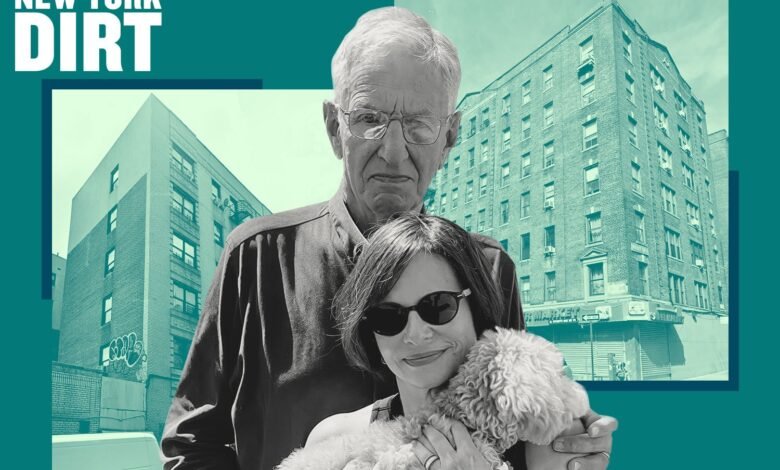
“They did everything a landlord was supposed to do.”
What led me to that quote, from investment sales broker Marco Lala, was something the Mamdani administration and industry people alike have been asking: Who’s still buying rent-stabilized buildings?
A headline posing that very question has been among The Real Deal’s most-clicked this year. The answer is evolving, and each sale gets us a little closer to the answer.
That’s why I looked into the $3.965 million trade of a 67-unit building in the Bronx, although it was well below The Real Deal’s threshold for coverage. The 72,000-square-foot property at 1181 Sheridan Avenue fetched just $59,000 per unit.

Yet I found myself thinking about the seller, Howard Alkoff. It turns out that he had died on April 18 at the age of 93.
Alkoff’s H&H Equities hadn’t bought 1181 Sheridan in 1984 looking to make a quick buck. In those days, rent-stabilized housing was about earning modest, steady returns. Alkoff’s company kept the building for 42 years — the rest of his life. (He transferred it to an LLC under Aida Spitzer in 2018.)
Lala brokered the sale to Walter Wilfinger, pairing it with a building around the corner at 185 McClellan Street. Lala is selling all 20 of Alkoff’s buildings to a handful of buyers. The deals have all closed or are in contract.
These are not the crumbling buildings that Mayor Zohran Mamdani chose to highlight on his first day in office. Quite the opposite. Alkoff’s portfolio had, by Lala’s count, just 32 open HPD violations across 984 units.
Distressed buildings tend to have 10 or more violations per unit. Alkoff’s buildings went to market with one violation for every 30 units.
Records show 185 McClellan Street, with 111 units, has just seven HPD violations. The 67-unit 1181 Sheridan Avenue had zero until an inspector showed up two days after Alkoff died and flagged seven. One was for “lint blowing out into the south yard emitting lint and blowing into the apartment at laundry room.”
The price for 1181 Sheridan Ave was low — just 3.8 times the rent roll — yielding a cap rate of 10.4 percent, despite being in fine shape for a Concourse Village building constructed in 1936. Lala described it as “well-maintained.”
“The property is distinguished by its impressive steel-and-glass entrance doors opening to a tiled entryway and a massive, well-lit lobby accented by steel and marble staircases,” the listing reported. “Common areas are clean and inviting, complemented by dual elevators serving all six floors.”
The silver-coated roof is in good condition, and recent improvements include parapet wall, stucco and flashing repairs and repointing, he added. One elevator is occasionally out of service, according to tenant complaints.
But the financial picture for 1181 Sheridan, and all such buildings, has deteriorated since the Housing Stability and Tenant Protection Act of 2019 trapped rent-stabilized properties in a vortex of low revenue and rising expenses.
The distress showed up in the building’s property tax bills. Alkoff paid taxes of $105,000 in 2021, $137,000 in 2022, $156,000 in 2023, and $161,000 in 2024. But H&H started falling behind in early 2023 and in August 2024 owed $314,000. It reached a payment plan with the city and whittled the balance down to $92,000.
Lala said Alkoff’s second wife’s sister managed the properties starting in 1995, and they employed unionized superintendents and had a pension plan for staff. Alkoff wasn’t overleveraged; his buildings were debt-free.
Which brings us back to Lala’s quote, now rendered in full: “They did everything a landlord was supposed to do,” he said, “only to get kicked in the nuts with the 2019 rent law.”
What we’re thinking about: Any New York City landlord or property manager would know how unfair it was for the Daily Mail to slam Howard Alkoff after 12 people were killed by a fire in one of his Bronx buildings, 2363 Prospect Avenue, in 2017.
A three-year-old boy started the blaze by playing with a gas stove, after which his apparently inattentive mother fled with him and a sibling but failed to close their first-floor apartment door. The fire raced up the stairwell. (The next year, the city passed a law requiring self-closing doors and stove-knob covers.)
The Daily Mail reported that Alkoff’s buildings had “hundreds of complaints and violations.” But that was a cumulative total across 20 buildings and many years, and included violations that had been cleared.
One sentence read, “Another property, 1181 Sheridan Avenue, had 16 complaints between 2005 and 2016.” That’s one complaint for every four units in 12 years — a remarkably low total for any building, but especially for a rent-stabilized one in the Bronx.
Ever been victimized by tabloid journalism? Send your thoughts to eengquist@therealdeal.com.
A thing we’ve learned: Commercial diving in New York is done by members of Dockbuilders and Timbermen Local 1556, which is within the New York City District Council of Carpenters.
Elsewhere…
Linda Rosenthal, chair of the Assembly Housing Committee, seems to go out of her way to maintain her status as the real estate industry’s most hated legislator.
To justify her bill to make it easier for localities across the state to adopt rent stabilization, she told City & State, “No one’s forcing you to be a landlord.”
Why not cap food prices at 10 cents per item? As Rosenthal might say, “No one’s forcing you to be a farmer. No one’s forcing you to own a supermarket.”
What about limiting the price of a pair of shoes to $10? No one’s forcing you to sell footwear.
You might recall that Rosenthal voted during the lame-duck session of 2022 to give herself a $32,000 raise to $142,000. By her logic, this was unnecessary. No one is forcing her to be a legislator.
Closing time
Residential: The most expensive residential sale recorded Thursday was $12.75 million for a 2,793-square-foot condominium unit at 1049 Fifth Avenue on the Upper East Side. Donna Olshan of Olshan Properties represented the seller and Elizabeth Goss with Compass brought the buyer.
Commercial: The most expensive commercial transaction was $30 million for a 175,000-square-foot educational facility at 300 Howard Avenue in the Grymes Hill section of Staten Island. St. John’s University sold the property to Wagner College.
New to the Market: The highest price for a residential property hitting the market was $15 million for PH1 at Cassa Hotel And Residences, 70 West 45th Street in Midtown. Sebastian Lopera at Corcoran has the listing.
Breaking Ground: The largest new building permit filed was for a proposed 105,697-square-foot, 165-unit project at 129 Osborn Street in Brownsville. Alen Moghaddam with Urban Architectural Initiatives filed the permit on behalf of Osborn Street Housing Development Fund Corporation.
— Matthew Elo
TRD‘s new platform Policy Pro helps you stay ahead. Each week, Policy Pro subscribers get access to timely analysis and news at the intersection of real estate and policy. Learn more here.