The end of the war does not produce liberation, but merely transforms one unstable political condition into another. The final film in Wajda’s trilogy, Ashes and Diamonds, would move to the post-war years and the ongoing difficulties of Polish resistance amid an overwhelmingly bleak 1940s Poland. In 1945, Poland was taken over by the communists, who enacted new forms of repression, leaving little room for hopes of independence. The film follows a former Home Army soldier, Maciek Chełmicki (Zbigniew Cybulski) who joins the anti-communist underground and is ordered to assassinate the local secretary of the Polish Workers’ Party. The action occurs on a single day, Victory in Europe Day. This should mean resolution, yet for Wajda, and for Chełmicki (whose first assassination is an abject failure involving the deaths of a couple of innocent civilians), it produces uncertainty. The film not only charters his instability about his act, but the broader collapse of the Polish anti-communist resistance.
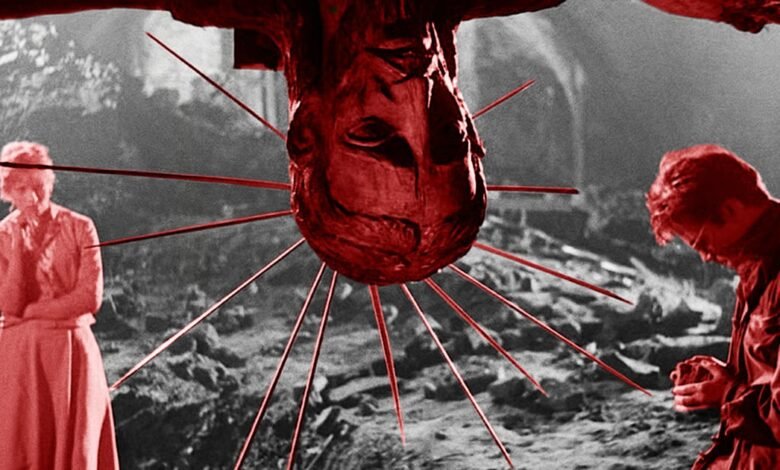
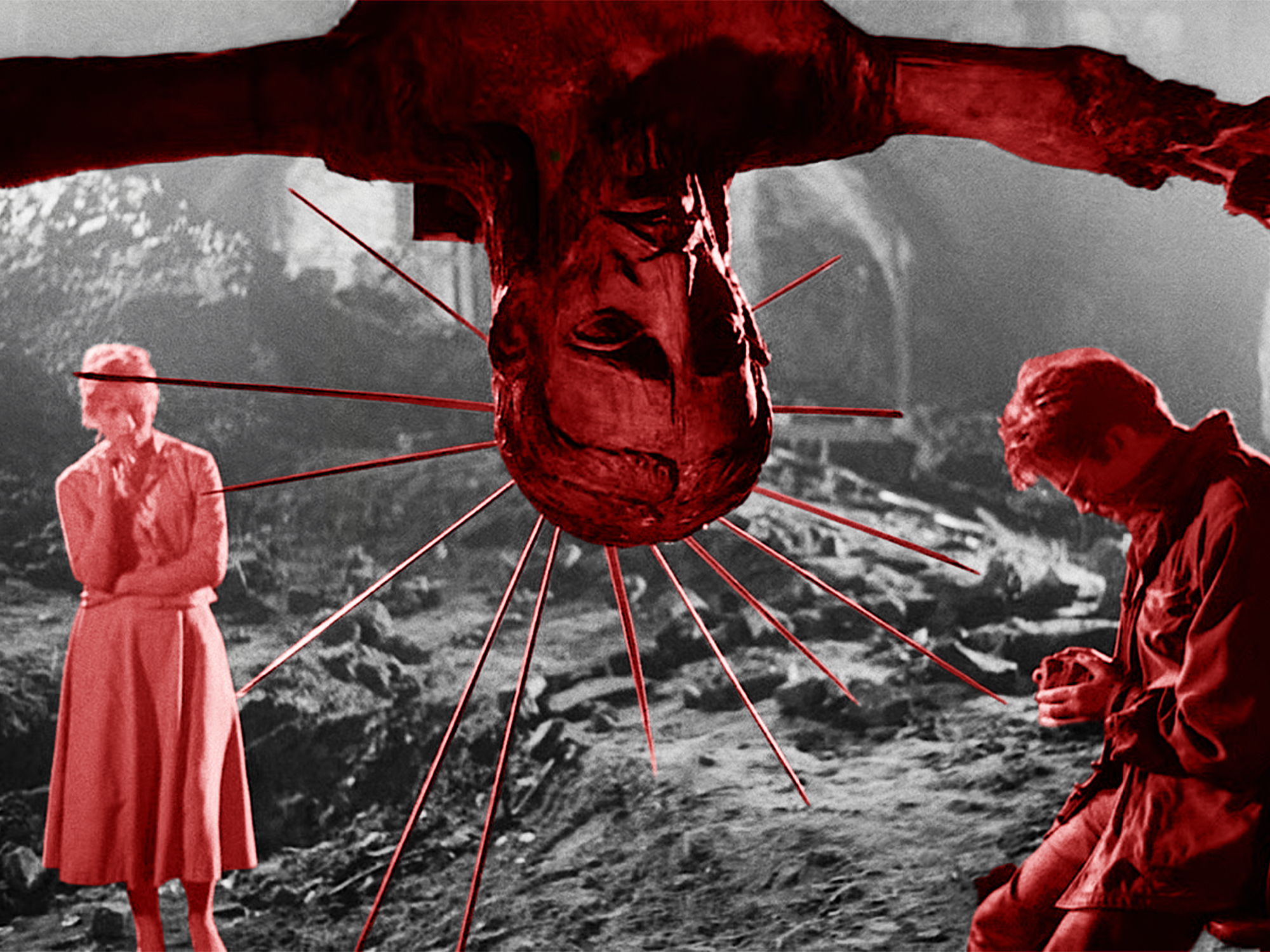
Chełmicki’s role is complicated after a love affair with a barmaid, which culminates in a tragic scene in a ruined church, behind the silhouette of an upside-down Christ, in which he explains to her that he wishes for a normal life, where they would be able to be together. The stereotypical images of a Christian Poland – upended, and broken by occupation – not only overtly symbolise Chełmicki’s collapse of mission for a free country, but the ethical tumult in the aftermath of war, where Poles’ hopes were unable to be manifested in a landscape of devastation. The depiction of resistance in the film is, instead, limited, heartbreaking, and set in contrast to the desire for peace.
Wajda would return to the images of wartime and post-war uncertainty of his War Trilogy. One of his later films, Katyń (2007), would mark the first cinematic portrayal of the 1940 massacre of tens of thousands of Poles by the Soviet Union – an appalling atrocity which would cast a shadow over Polish historical memory. It was a particularly poignant film for Wadja, whose father was among the Poles killed.Wajda focuses on one family: Andrzej (Artur Żmijewski), a young Polish captain, his wife Anna (Maja Ostraszewska) and daughter, Weronika (Wiktoria Gasiewiska). The film opens on a bridge, where crowds coming from both directions argue about which route is safer, directly pointing towards the chaotic effect of German and Soviet occupation. Andrzej is taken prisoner, and his refusal to take his wife’s advice and pretend to be a civilian creates the conditions that the film goes on to explore: the suffering experienced by the officers, and the desperation of the family back home, left in the dark about Andrej’s fate. It was only with the fall of communism that those Poles who had family members imprisoned by the Soviets finally became aware that their loved ones had perished at Katyń.
Wajda never shied away from showing the stark brutality of war and its aftermath of uncertainty in a nation whose sovereignty suffered against the worst of the Nazis and the Soviets alike. Told with a strong humanist spirit and juxtaposed against a wider canvas of wartime tragedy, these individual narratives of turmoil are the acts of remembrance that keep a complex historical memory alive. As we now face the active threats of historical revisionism and nationalist resurgence, these films’ emotional resonance continues to linger and feel urgently significant today.