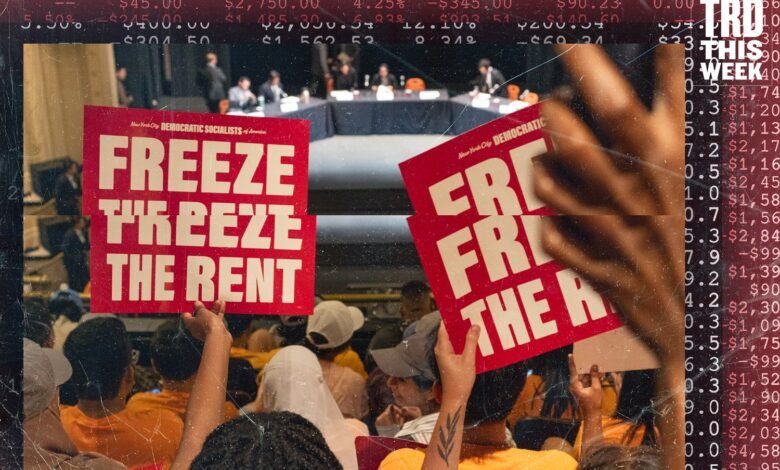
New York City’s rent-stabilized landlords got the policy outcome they feared for months: no rent increase at all.
The Rent Guidelines Board voted 7-1 Thursday night to freeze rents on both one- and two-year rent-stabilized leases, handing Mayor Zohran Mamdani a political victory and cementing one of the most aggressive tenant-friendly moves in the board’s history. While annual RGB votes often spark fierce debate, a freeze on two-year leases is unprecedented, raising the stakes for owners already grappling with rising operating costs and tighter financing conditions.
The decision fulfills one of Mamdani’s signature campaign promises and marks a sharp departure from recent years, when the board approved at least modest increases. Tenant advocates celebrated the vote as overdue relief for working New Yorkers, while owners left the hearing preparing for what could become a lengthy legal fight.
The vote was overshadowed by the resignation of landlord representative Christina Smyth, who accused the board of abandoning its statutory role as an independent fact-finding body in favor of “political theater.” Her departure hours before the final vote only strengthened expectations that industry groups will challenge the freeze in court. Real estate attorney Massimo D’Angelo of Blank Rome said litigation could come within weeks.
Whether a lawsuit succeeds or not, the practical implications for landlords are immediate.
The RGB’s own staff data showed operating costs climbing 5.3 percent over the past year, meaning owners of stabilized buildings will have to absorb another year of inflation without corresponding revenue growth.
For many institutional owners, that compresses already-thin margins. For smaller landlords, particularly those with aging buildings and significant debt, the pressure could be substantially greater.
That reality is likely to reshape investment decisions across the city’s stabilized housing stock. Owners may defer nonessential capital projects, delay apartment upgrades and scrutinize maintenance spending more closely. Lenders, meanwhile, could become even more conservative underwriting rent-stabilized assets, particularly properties with heavy capital needs or floating-rate debt.
Industry groups also argue the freeze could accelerate a broader trend already reshaping New York’s multifamily market. Owners unable to generate sufficient cash flow may increasingly pursue sales, recapitalizations or restructuring, while distressed assets become more common.
For landlords, Thursday’s vote wasn’t simply another annual RGB adjustment. It signaled a new political landscape in which City Hall appears willing to prioritize tenant affordability over owner economics.
Heatwaves are everywhere and we’re only a few days into summer. We brought the heat with our top stories this week:
The primary winners poised to shake up real estate
It’s easy to forget after Thursday’s drama that there were critical primary elections in New York two days earlier.
Left-leaning and Democratic Socialists of America-backed candidates saw significant success in New York state legislative primaries, defeating multiple incumbents by running on platforms that prioritize tenant rights, aggressive regulation of landlords and an expansion of social housing models.
The election results could significantly shift real estate policy in New York, as incoming legislators aim to curb developer influence and implement greater tenant protections, creating a distinct policy contrast from more moderate outgoing incumbents.
Only a few incumbents or establishment-aligned candidates were able to hold onto their seats.
REBNY legislative lead resigns after tearing down political signs
Earlier that day, Dev Awasthi — a REBNY vice president — lost his job with the real estate industry group after being filmed removing and discarding campaign signs for NY-12 congressional candidate Jack Schlossberg.
REBNY’s Senior Vice President and General Counsel Carl Hum condemned the actions as “completely inappropriate” and stated that such behavior does not meet company standards.
Awasthi, who served as the group’s vice president of New York City legislative affairs since October 2024, resigned on Tuesday following the incident in the 12th Congressional District.
Soloviev eyes record $400 rent at nearly full 9 West 57th Street
Stefan Soloviev is marketing office space at 9 West 57th Street for a record $400 per square foot, a move that would surpass the $327 per square foot record set at the same building earlier this year.
The Soloviev Group is aiming to lease an 11,155-square-foot space on the 50th floor, which is one of only two remaining units in the 1.5 million-square-foot tower.
Soloviev has been modernizing the property — developed by his father, Sheldon Solow, in 1974 — by adding a new 20,000-square-foot amenity floor to attract high-end tenants.
Adam Driver drops $12M on three units in Brooklyn Heights condo
“Let the past die. Kill it, if you have to.”
Kylo Ren, aka Adam Driver, is moving on from his past, purchasing three sixth-floor units at The Standish condo conversion in Brooklyn Heights for $11.5 million.
The deal for the units, which span a combined 3,500 square feet, pencils out to over $3,200 per square foot, marking one of the most expensive home sales in the borough on a per-square-foot basis.
Driver has listed his nearby three-bedroom condo at 20 Henry Street for $5 million, shortly after making the new acquisition.
Read more

It’s official: New York City is getting a rent freeze

Member of New York’s rental board resigns, decrying political “theater”

The primary winners poised to shake up real estate