
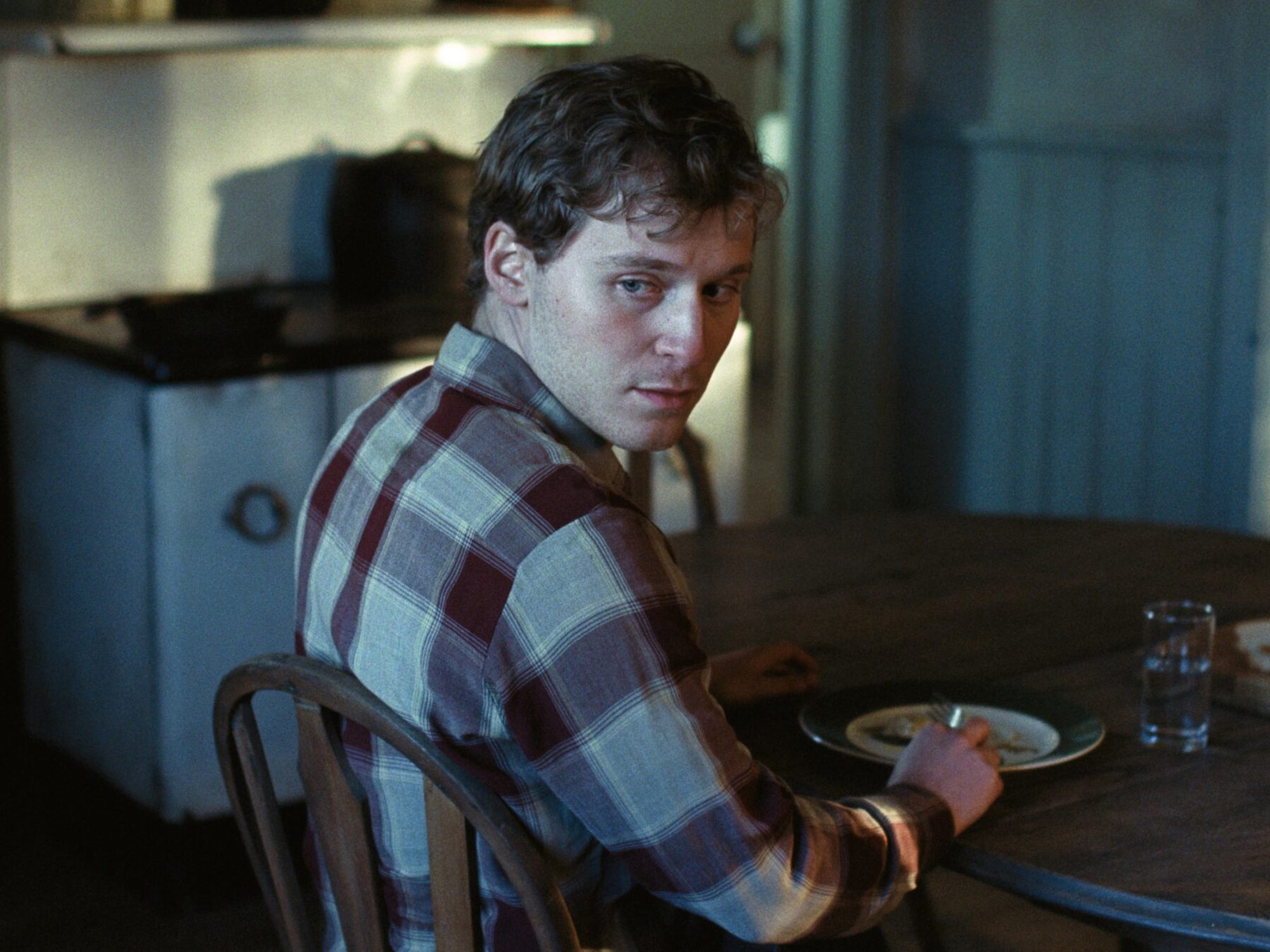
They’ll find the body when the vultures come. That’s what Lester (Ebon Moss-Bachrach) tells his son Mikey (Fred Hechinger) after his mother Louise (Caitríona Balfe) goes missing in a vicious storm near their mountain farm. The night before she’d fought with her husband over her alcoholism; he’d thrown out all the booze, leaving Louise to her fury despite Mikey’s timid suggestion they just go and buy more to make her happy. Her sudden disappearance haunts the rural landscape the family call home; all winter Mikey trudges through the snow searching for her, never quite able to give up hope she’s found a way to survive. With his younger, more worldly brother Tommy (Kit Connor) gone to fight in Korea, Mikey doesn’t have much else to occupy his days. He tends to the chickens and rabbits, but he’s not as good at it as Tommy was. He writes letters, but no one answers. He sneaks longing looks at a handsome sheriff’s deputy. Those go unanswered too.
Andrew Haigh’s sixth film, adapted from Colm Tóbin’s novella of the same name, moves with the slowness of the low season yet never suffers for it. Steady on the delicate figure of mousy, well-meaning Mikey, too pure for the brutal world that seeks to devour him, Haigh finds gentleness where it seems improbable. The velveteen ear of a lop snuggling in the hay; steam evaporating off a hot bath; a hearty stew received with gusto; these are the markers of warmth in the bleak midwinter. It comes mostly to Mikey’s world with the arrival of Jimmy (D’Pharaoh Woon-A-Tai), a sullen, near-silent orphan whom Lester brings to live with them in Louise’s place. In exchange for a place to stay, Jimmy will cook, clean and take care of the housework while Lester makes furniture with an old friend and Mikey looks after the animals. They form an unlikely family unit. Mikey becomes quietly enchanted with the boy now sleeping in his brother’s bed.
Get more Little White Lies
A Long Winter rests on the shoulders of Hechinger – hitherto a promising supporting player in The White Lotus and Thelma – and he’s remarkable in a performance that demands a whisper rather than a shout, capturing the softness and optimism that make the character so easy to fall in love with. Mikey’s sweet nature seems miraculous amid the postwar machismo that surrounds him, like a flower peeking through a snowdrift, blooming stubbornly despite the cold. André Turpin’s wintery cinematography is equally arresting; Calgary doubles for Colorado, but the vast, unforgiving spectacle of the mountains creates the sensation of standing at the edge of the world. Somewhere that can keep secrets, but also keep people trapped.
That yearning for freedom was recognisable in Louise and Tommy, who made it off the mountain one way or another, but Mikey himself is yet to find his way. What he is left with in their absence is not quite grief, but some grey cousin of the feeling that keeps him trudging through the snowdrifts each day, an icy purgatory. The emotional landscape of A Long Winter is painted with the same precision and care as its images; somber shadows glance off the impenetrable ice while simmering tensions never quite boil over into dramatic confrontations. But matters of the heart lack the security of the natural world. While the thaw is inevitable, closure is not, and Haigh threads his tender but melancholy narrative with uncertainties that linger past A Long Winter’s arresting final scene. So much that is beautiful and fragile in our world is destined to be destroyed, after all.