“Why do we need a guide to utopias today?” Slavoj Žižek opens by answering his own question inimitably from afar, over the snowy image of a northern Norwegian military base. Just from there, director Sophie Fiennes takes us on a voyage through his vertiginous thinking, as intellectually nimble as it is gleefully unruly.
The Pervert’s Guide to Utopias is the finale of an exhilarating trilogy in which the Slovenian superstar academic reads cinema through philosophy and philosophy through cinema, where every film shares, and slyly exploits, the same dialectical bone: there is no neutral vantage from which to see reality plainly, so the cinematic frame does us the rare favour of making visible how our perception is organised. The Pervert’s Guide to Cinema (2006) ran this in a televisual key, overdosing on psychoanalysis to show how it instructs desire rather than satisfies it; The Pervert’s Guide to Ideology (2012) took it into politics, where ideology proved the very form of our spontaneous relation to reality, exemplified in alien invasions and Coca-Cola commercials. Yet Utopias might be the best way in, as under the pressure of the present, it recasts utopia from a sweet dream into an invention of last resort.
Get more Little White Lies
There is no better place to begin these utopian deconstructions than Apocalypse Now (1979), which takes up the failure of the Enlightenment and finds evil not as ignorance but as evil fully aware of itself. But how does one survive all this, asks Natalie Portman’s character in V for Vendetta (2005)? Žižek’s reply is that the rebellion, with all due respect, cannot get very far when its goals are never even named. His scene analyses of nearly two dozen films thrill on their own, but they also serve a smooth passage into the pressing real-world examples his logic keeps veering toward. Across its two hours, the film covers Gaza, AI, Putin, Kylie Jenner’s Handmaid’s Tale themed party, class divisions of vampires, and Trump, who earns the most elated pillorying. There comes a video of the US president mid-rant about ending every war and the Nobel he feels he’s owed, intercut with Žižek’s appalled face, before he aptly diagnoses the obscenity of an “authoritarian without an authority” who refuses “symbolic castration”.
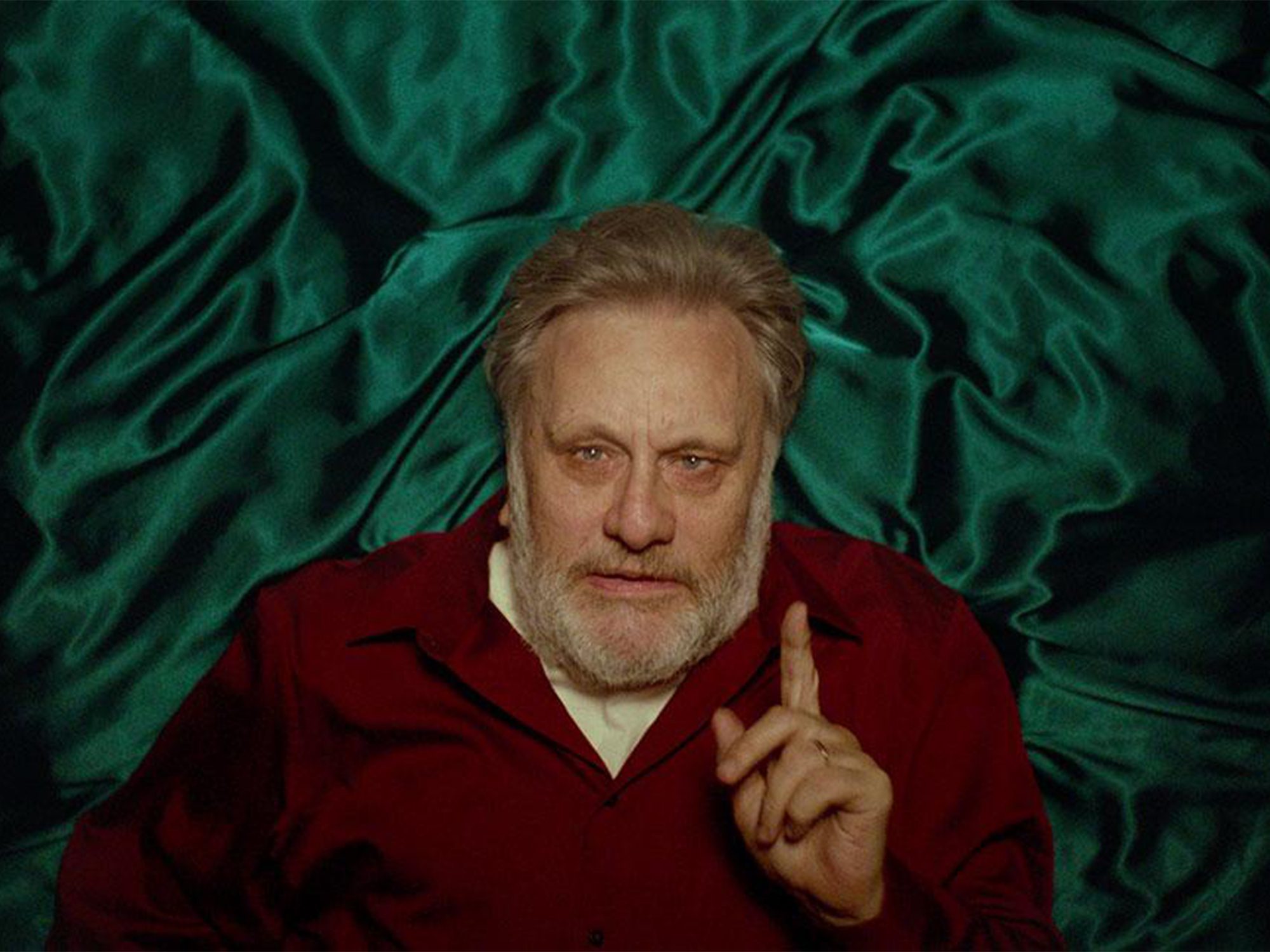
And if his terms and turns threaten to lose us, Fiennes has mastered a cinematic syntax that carries Žižek’s dizzying detours through incisive cutting, seductive light and a rich chromatic palette, casting the whole viewing experience in a sleek, hypnotic glow. A further treat is the widening of Žižek’s presence within his own screen universe, planted on the reconstructed sets of the films he unpacks, settling at last into Jeanne Dielman, 23 quai du Commerce, 1080 Bruxelles’s (1975) kitchen table, or lying topless in an empty bath over a bridal veil, slipping into the pose of Kirsten Dunst in Lars von Trier’s Melancholia (2011).
There is a plethora of aphorisms, wisdom and absurd takes worth pocketing, but the most trenchant sequence belongs exactly to von Trier’s gem, through which Žižek gives our contemporary consciousness its eponymous diagnosis. And yet, with the rogue planet bearing down on Earth in Melancholia, now ever more legible as nuclear dread, he turns the thought of accepting the end into a way of imagining how to withstand it. Dialectician to the last, Žižek offers no consolation, only the parting thought that the sole way to win is to begin with a strong dose of pessimism, which is somehow the most bracing note he strikes.