
It’s staggering how a ninety-minute conversation between two people in one location can be quite so captivating; it’s even more mindblowing given that the conversation centres largely on paedophilia. And yet, Blue Film, the second feature by filmmaker Elliot Tuttle, manages to be one of the most thought-provoking, gripping and important films to come out this year.
It takes place mainly over the course of one night, when camboy Aaron Eagle, played by searing newcomer Kieron Moore, arrives at a supposed fan’s house to spend the evening with him, only to find that he is, in fact, a remnant from his past. Not just any remnant, but an old teacher from his high school who was charged with attempted sexual assault on a fellow student. What Aaron, whose real name is Alex, believed would be a night of sex work, instead unravels as a complex, gritty and soul-searching encounter between two men both trying to come to terms with who they truly are.
Get more Little White Lies
The teacher, Hank Grant (Reed Birney), is almost offensively charming given what we know of his past, his soft smile and good nature seemingly at odds with the truths he reveals about himself as the film unfolds. But this is in many ways the whole point. What does it mean to be a “pervert,” as Hank refers to himself? Is one born that way, or are paedophiles created? Does he, a convicted child molester, deserve redemption? Love? Desire? A lifetime of punishment? Or, worst of all, as he posits halfway through the film, does this thing that defines and consumes him so entirely, actually mean nothing at all?
It is the presentation of these questions, the almost spiritual investigation of child sexual attraction, that steers the film, but Tuttle treads the line so carefully and judiciously that there’s no room for misinterpretation. This is not a film that attempts to justify, glorify or pardon paedophilia; instead it asks us to confront what we think we understand about it in a way that deepens, complicates and disentangles it.
Through Aaron’s often cavalier reactions to Hank’s revelations, and his own falsified stories of childhood trauma, Blue Film is an exploration of how we justify ourselves, to ourselves. Aaron chastises his lack of traumatic origin story to provide the rationale behind his sex work. Was he always destined for this life? If so, is that necessarily a bad thing? His and Hank’s frustration intermingle throughout the night, each man trying to resolve their own convoluted soul-searching. Both men are confused about the definitiveness of their respective problems, and simultaneously unshaken in the knowledge that they can’t change.
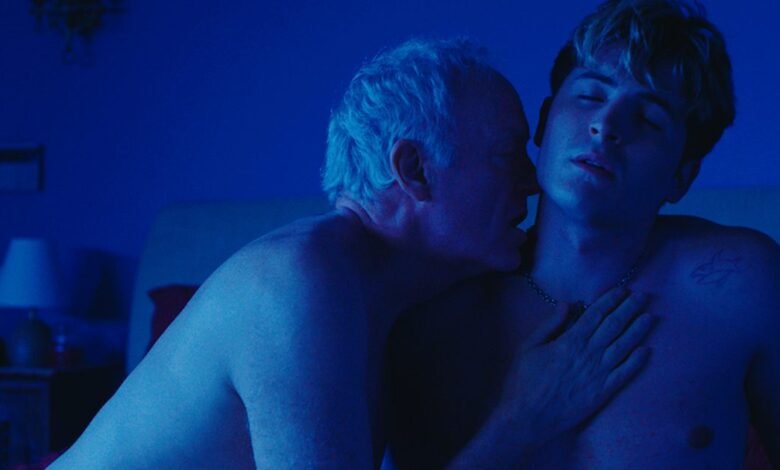
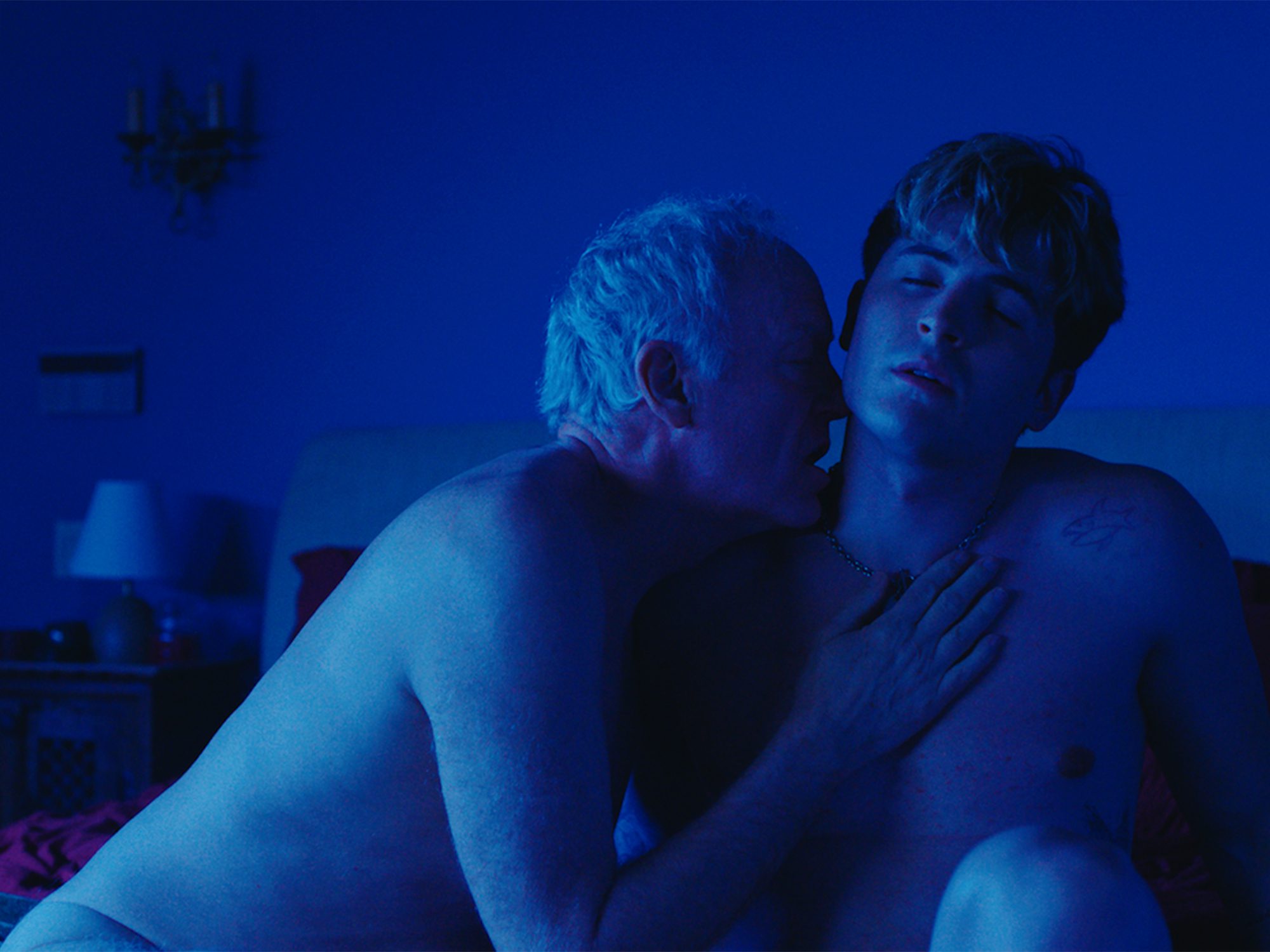
As suggested by the title, blue runs throughout Tuttle’s colour palette: a reference to the Hays Code term used to denote pornographic or sexually explicit movies. In its more poetic application in the film, it also symbolises and captures the internalised loneliness both these men have experienced in their lives. The lurid red sheets of the bedroom and a few outdoor shots provide the only brightness in what is otherwise a perpetually moody and sultry atmosphere, drawing us further into the tension and oppressive closeness of the space that our protagonists inhabit, ensuring we don’t miss a beat.
It’s hard to overstate the intricacies, vulnerability and nuance that both Moore and Birney bring to their roles. Moore, known for ITV’s Boots and Code of Silence, conveys the cockiness of Aaron Eagle, the confident and shameless cam boy, with the same intensity as the meek, gentle Alex underneath, a young man going through heartbreak and struggling to work out his identity and place in the world. Birney’s ability to make us both hate and warm to Hank without ever feeling guilty for either of those responses is borne through his unwavering softness and a discomforting, heartwarming twinkle in his eye.
That the words ‘controversial’ and ‘provocative’ have come up so frequently in discussions about the film is boringly predictable. The genius of Blue Film is that its provocation is cerebral. Tuttle doesn’t offer a redemption arc; if anything, he doubles down on the horror of Hank’s actions towards the end of the film. In the same breath, he also refuses to simplify or flatten reality. Hank’s revelation about his own childhood trauma allows us to understand but never excuse his actions, while Aaron’s desire for sexual dominance that sometimes borders on violence has no specific or attributable source. Hank’s frank honesty about his attraction to children doesn’t undermine the harm he’s caused, but it is nonetheless disarming. It’s unexpected to hear a paedophile admit their attraction so easily, to acknowledge and deeply engage with the horror of what that means.