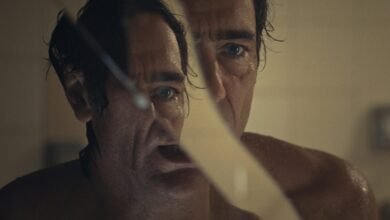


The best audition scene in the history of movies about movies is, of course, the one in Mulholland Drive, in which Naomi Watts’ Betty finds an intense, intimate erotic charge in the most turgid of scenes, playing whispering and subtle, against the grain of the script, shocking and transporting the room and totally altering our understanding of the character. Things didn’t work out for Betty, but the scene made Watts’ career.
Chris Rock doesn’t scale the same heights as David Lynch with the audition scene in Misty Green, but he does the most important thing: He convinces us that Misty (Rosalind Eleazar) is a good actress. Misty, a once hot property who has developed a reputation as “difficult,” is reduced to reading for a minor character in a middling project. She didn’t get the updated sides, because she was out late and on drugs; the producer and director keep talking over her and the star of her coveted role in a Dreamgirls adaptation just pops in to say hi. The role is a cliched junkie character, but Misty underplays it, giving her caricatured confessional an awful clarity, revealing the truth underneath the hackneyed dialogue and its parallels to her own dependencies and self-loathing.
Get more Little White Lies
Eleazar exhibits similar restraint throughout her whole performance, never making the obvious choice. Misty is a mess, but she’s also suave, arrogant and sad; she dispenses her one-liners with a dry crackle, and carries herself like she has a secret even at her most desperate and compliant. There is never any doubt that Misty is talented, nor that casting Eleazar was a coup for Rock. The movie works because of her. Rock’s last film as writer-director, the misogynistic and self-aggrandising autofiction Top Five, was an entertainment-industry passion play, and so is this one. This time, the overelaborate plot machinations and career neuroses are transferred onto a figure with significant distance from Rock himself, allowing Misty Green to emerge as a largely successful sketch of the dark side of the dream factory, rather than a whiny rich guy’s airing of grievances.
Misty Green played a flight attendant on a popular TV show in the late 2000s; every civilian she meets used to watch it with their parents. She’s still picky about her roles these days – she maintains what her friend Naomi (Anna Kendrick) calls a “one-sided beef” with Shonda Rhimes – but her industry heat has cooled off after a series of on-set incidents, unreliability, and substance-abuse issues. As the film opens she’s still living large, in a luxury pad near the Santa Monica Pier – until her late boyfriend’s widow barges in to reclaim the property, ready to kick her out until she sees Misty’s Emmy and her sides for that audition. She makes Misty read, and is impressed enough with her acting that she gives her a week to find another place.
Misty had been something of a kept woman, trading on her name recognition in a sugar-daddy relationship that wasn’t explicitly quid pro quo. Her sometime hookup, Zack (Adam Driver, looking sleazy), wants her to fly with him on a private jet to Dubai, alongside his stable of “influencers,” for a party with emirs featuring a private concert from an aging Busta Rhymes. (If the implications are orientalist and censorious, Rock doesn’t exclude his own icons from the degrading hustle economy.) Zack is a producer, sort of, but more like a pimp, or just one of those Los Angeles types who’s useful because he has drugs; that’s certainly his utility to Misty.
Even more so than Top Five, in which Rock and Rosario Dawson compare their sobriety chips, Misty Green is strongly influenced by the tenets of Alcoholics Anonymous. The line in Misty’s audition that hits closest to home, about being unworthy of the love of anyone but a saint, is the one that rhymes most clearly with Misty’s life, as well as with multiple conversations that she has about the capacity for forgiveness. The film earnestly believes, as a person in recovery must, in humbling oneself before a higher power, and making amends.
Grace is in short supply in a town of transactional relationships with despair lurking on the margins. The clock ticking down the time until Misty is homeless is mirrored in the tent cities sprung up alongside Hollywood Boulevard, and in the running joke in which Misty’s agent (Topher Grace) keeps interrupting to tell panhandlers, and delivery guys, that he’s got no cash to give.
Rock makes it abundantly clear that Misty is brilliant, stopping the movie dead to showcase Eleazar even in her gig singing at a hotel cocktail bar (a slowed-down version of the most on-the-nose lyrics from “Creep”). He pities her almost as much as he did himself in Top Five; her circumstances are beneath her and the world is not fair, a point the script pushes by engineering several deus ex machina twists that range from the convenient to the outrageous, particularly involving Misty’s troubled bipolar brother Jordan (Daniel Kaluuya). He keeps getting pulled over by the LAPD because he resembles the suspect (a young Black male) in a high-profile carjacking, a grasp toward political relevance introduced early in the movie practically wearing a sign reading “Pay Attention! This Plot Point Will Be Important Later.”
Racialised panic over carjacking is a bit of a throwback to the 1990s, when Rock was a hot young standup comic on the cutting edge of social commentary – energy he tries to tap back into in his supporting role as a director with a history with Misty. Their riffs about fidelity, institutional racism and gender relations, many with a riff of Rock’s old standup routines, are a breath of stale air in a movie that otherwise logs fairly up-to-the-minute observations about today’s Los Angeles of self-tapes, celebrity exercise instructors and protein powder. Misty is the moment – to the extent that her director can get out of her way.