Sophie Thatcher hasn’t slept properly in weeks. Between wrapping the final season of cult horror series Yellowjackets and being a part of Nicolas Winding Refn’s first feature in a decade, she’s barely had a chance to come up for air. Her Private Hell is the latest in a run that’s established Thatcher as one of horror’s most compelling new faces – from squaring off against Hugh Grant in Heretic to playing a vengeful robot girlfriend in Companion. And yet her performance as Elle – a tortured movie star chasing her missing father through a misty metropolis – is unlike anything she’s done before.
LWLies: How are things with you?
Get more Little White Lies
Thatcher: I bought a house in upstate New York, so I’ve been trying to finalise furnishing it. Honestly, I’ve just been sleeping for three days straight. That final stretch of Yellowjackets was so exhausting. But the movie, yeah… super strange.
In the best way.
Yeah, I feel like I’ve done movies that have been pretty well received. So to have something so polarising, I’m like, ‘Whoa! I should just not look at my phone.’
What was your first encounter with Nicolas Winding Refn – did the reality match your expectation?
I think all of us agree he was really intimidating at first. I went to his place in Silver Lake. We’re just sitting at the kitchen counter in this beautifully modern house, and he’s asking me the most personal questions. I learnt that his process was just getting to know me. It felt vulnerable. It felt like we had to be completely open.
What kinds of questions?
I remember him asking a lot about my relationship with the internet. It wasn’t like any other meeting I’ve ever had. We started talking about this German film called Der Todesking. We bonded over that and other films by the director [Jörg Buttgereit]. So after that first meeting, I was like, ‘Nailed it!’, because our taste was so aligned. As soon as we started talking music, I knew we were on the same page, and it’s rare to find that. He’s a music-head. He’s a huge cinephile. Then in the second meeting, I tried to win him over. I spent a lot of money on a Cannibal Holocaust vinyl.
Oh wow!
The movie is problematic, but the soundtrack… Our first bonding was over Italian composers and Pino Donaggio, who ended up doing the score. We were just talking about our love for these luscious scores set against a sometimes abrasive, harsh movie.
What went through your head the moment you finished reading the script for the first time?
Confusion, but excitement. In that second meeting, [Refn] was like, ‘These are the bare bones. Anything can happen.’ So there was a sense of freedom. When you read a script, a lot of the time you think that’s it. But to read this script knowing that things would change felt much more abstract. We had so many calls trying to piece things together, because a lot of the movie is [Elle’s] interpretation. But after getting the insight into [Refn] dying for, like, 20 minutes – which is an insane story – and then hearing about his relationship with his daughter, it all clicked. It felt like I had a heavy task, but I was ready for it.
Can you tell me more about Refn dying for 20 minutes?
[Laughs.] He said it was like 20 or 25 minutes. He had a bleeding heart. It sounds like something out of a book. When he was telling me about it, I thought he was messing with me. He told me that Tom Cruise brought him back to life. I was like, ‘No way, really?’ But no – he does that a lot.
It’s such an important insight into the movie because that’s the heart of it. It’s about his relationship with his daughter, and that’s so complicated. While we were shooting, I was brought into the family. [Refn] felt like my dad. I was alone in Copenhagen. I became best friends with his daughter. They’re one of the most beautiful families, and surprisingly very normal, considering how weird Nic is.
Have you ever experienced anything like that on a film before?
Not at all. He made a point of having dinner with us at least three times a week. We would always go to the same restaurant in Copenhagen, this Italian spot, and most of the time he would just ask us about what we think of celebrity rumours. It was really light, and we needed that when we were working on this.
What did that teach you about Refn as a director?
There was always sensitivity – he’s very in tune with how people are feeling. You could see that with his daughters, with me on set. He could see if I was off in a second. That felt scary because usually I’m like, ‘Oh, I can just get over it in a second.’ But no, he would sit with me. It felt like a very personal, sensitive and vulnerable relationship that I hadn’t had before. Just the effort of him bringing me into his family was really beautiful. It gave me the trust to do this very strange project.
You’ve said there came a point where you stopped trying to understand the film and just surrendered to it. When did that shift happen?
I think midway – around us going to the party, because that’s when the film starts to turn into something else. I think that’s the switch within [Elle’s] character, and I think that was already naturally happening within me too. I was gaining more confidence as shooting went on. I was always thinking about the Elle and Dominique fight scene at the end. I had no idea if it was going to change. The ending was always changing – it went through like three different versions, and it was around the party scene when [Refn] changed it, to where I get the gloves and turn into… but I don’t even want to say that because that’s so up for interpretation, and even my views of the ending change.
You’ve mentioned Kenneth Anger as an influence on the film. What other films or artworks were you drawing on while shooting?
There’s a lot of older Japanese films – I might actually have to get back to you on the one film I’m thinking about. A lot of it was music. I keep talking about the band with Martin Rev and Alan Vega, Suicide, as a connecting force for the last part of the movie. I was listening to Suicide all the time. It’s this schizophrenic synth music. I love listening to that chaos because it’s a fun world to live in. That really inspired Elle’s arc towards the end. From those first meetings it was clear, music is number one. [Refn] saw that in me and I saw that in him. Pretty much every day after set, we would send each other songs to be like, ‘This is where I’m at. This is where you’re at.’ It could be totally unrelated, he would send me Abba and I’d be like, ‘Hell, yeah!’
Music is a huge part of your life as well – do you have aspirations to write and direct in the future?
Absolutely. I live with my twin, and we’ve been making short films basically every night – they’re so silly. We made a goofy re-enactment of Her Private Hell and it’s just me with glasses, and then me against the wall screaming.
I would love to see that.
My twin and I do a lot of work together. It’s been really inspiring, being in a weird cabin house with artists working every day. I’m very excited for this new chapter.
There are some amazing looks in this film – how much input did you have in the creative process behind costume and make-up?
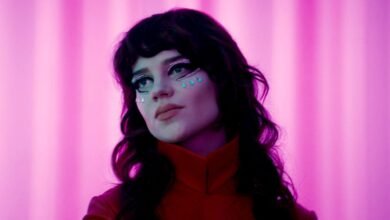
I had a lot. No matter what, I always want a say, especially with costume, because if the costume is off then it’s a very vulnerable thing. I’m just so drawn to certain decades of styling. Nic’s very much a rock’n’roll guy, and Elle felt like a blank slate as a character. I was trying to make her less modern so she’d blend into this unreality of worlds – Charles is in a kind of Sixtes timeline. It was mostly based on the music we were sending each other. So it was a lot of seventies glam rock – even the Candyfloss make-up felt almost like David Bowie. It all just felt larger than life.
I think that element of camp, mixed with glamour, was perfectly found within that genre. I was very drawn to that red leather jacket. It was really fun. Our costume designer, Jane, was amazing. She’d lay out all these beautiful options. It was kind of a dream. Her whole approach was, ‘What would make you feel the best?’ And for me, it was that leather. Throughout this press cycle, I’ve been wearing leather. I wore the leather Louis Vuitton corset look to Cannes. And I wore leather to the LA screening première. It’s fun to do that for press. Why not be camp and lean into Kenneth Anger?
So much of the film hinges on a single expression or pose – what was it like projecting emotion that way?
That’s my favourite kind of acting, honestly. I’ve never had a director where I wouldn’t know when he’d call cut. He would just keep going, especially for the establishment of my character in the bedroom. I unleashed whatever mask I had on, and it was just me. Because of the style of filmmaking, it felt like the most I’d ever been seen. I wanted to be seen by him, and I wanted to be seen by the camera, and that’s exactly how Elle feels. The dialogue is there, but it’s all within expression.
Filming largely in order, day to day, did you find that you and Elle started blurring together, the same way the film blurs reality into this dreamy state?
Absolutely. Towards the end, I was building myself into a manic state by listening to that chaotic music. My sleep was really off. It felt so amazing to unleash because so much of the movie was so incredibly still and stylised. At that point, it wasn’t about the dialogue or anything, just that feeling of wanting…
… catharsis?
Yeah, that. There was a lot of repression. I feel like I’m always playing characters that are playing against something. That’s what’s most interesting to me. It’s those character arcs. In the beginning, I felt that sense of loneliness. I was in Copenhagen, it took me about a month or so to feel like family and to get to the truth of everything. Every job is like that, especially when you’re going to a different country, and it was a really long shoot. It was three and a half months, so there was a daunting feeling and I think Elle was naturally feeling it.