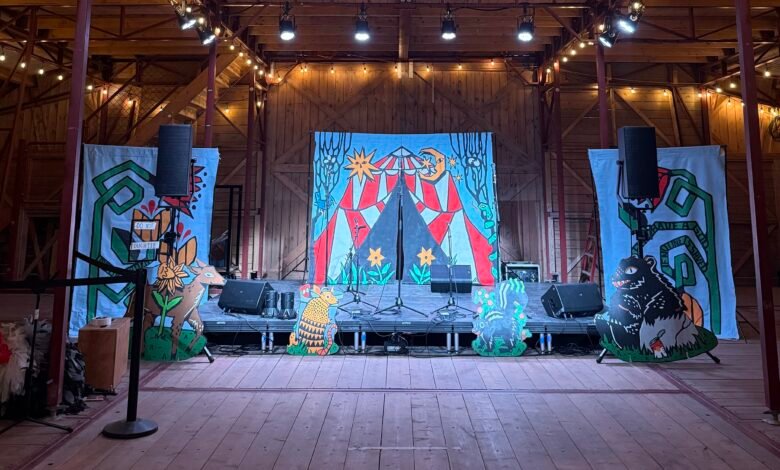
Carlisle promptly pulls us out of the somber mood into the next song, “Queer Liberation Means Destroying Corporations,” an upbeat tune that celebrates queer joy as a form of resistance. In one of my favorite moments in the entire performance, the animal puppets throw miniature pride flags from the ceiling of the venue as the audience erupts into a cheer.
The high spirits are interrupted by a sludgy, doom-metal-esque song and a shift to red lighting. From the back of the space, a twelve-foot-tall king puppet appears—a white man with gray hair, dressed in red and blue, a crown atop his head and a demonic grin stretched across his face.
“You cannot make dissent on a stage built by a king,” Carlisle sings. Several children stab at the king with their pride flags as the giant puppet pushes through the audience. The king can be many things, explains Carlisle—sometimes your boss, your landlord, a billionaire, or even the voice inside you that inhibits self-love. By allowing the king to represent more than just Wal-Mart billionaires, Carlisle adds complexity to his performance and broadens his critique to include the larger oppressive forces at play within society and ourselves.
Here, Carlisle directly names the irony of his whole performance: “you can’t make dissent on a stage built by a king,” he repeats over and over in a rageful yell as the music crescendos, telling us he is aware of the limitations of his own protest. This leads me to wonder: If Carlisle is aware of the limitations of this project, what is the point of it?
When Mama Opossum returns from the grave, Carlisle suggests an answer.
With a halo shining over her head, Mama Opossum battles the king. As she swings at him with a cast iron pan, Carlisle sings another rock-inspired song with the chorus, “Make me a king killer! Make me a king killer!” The chorus swells as Mama Opossum knocks the king to the ground.
Despite the limitations that Carlilse identifies, it’s a bold move to kill the king on his own stage, and this seems to be the point of the project. The lesson being: You can take the king’s money and still protest him. You can criticize your funders. You can bite the hand that feeds. Perhaps, in a way, that is the best way to have the king’s ear—protesting in his home. If Carlilse had independently produced this project and performed it elsewhere, what Wal-Mart affiliates would have even seen it? I am eager to speak with Carlilse afterwards and to find out what reaction his protest might have provoked from FreshGrass, the Walton Family Foundation, or their producing partners.
Mama Opossum fighting from the grave brings additional nuance to Carlilse’s message. With a halo above her head, she does battle—it’s unclear if she’s resurrected or if it’s her ghost fighting, but the details don’t matter. We understand that Mama Opossum has given her life, and still she fights. This image is a clear reminder that the fight for change comes at a cost. Progress can be brutal. That Carlisle does not give us a comfortable or tidy conclusion is a success of his project. There may be animal puppets, but this isn’t Disney. It’s true even when it’s uncomfortable.
And what’s more, the conclusion reminds me that win or lose, the fight itself builds “SOLIDARITY!” In united efforts toward change, we learn to be less like the king and more like Mama Opossum. In the fight, we learn ways to be better to each other.
I look around the audience, wishing my mom could have been there. Everything about the show moved me. That feeling was chased by the bitter reality that, with the price of FreshGrass tickets at $98, it’s unlikely a single Wal-Mart cashier was in the audience.
After the performance, I ask Carlilse if he had burned any bridges. “Absolutely not,” he says. I was surprised; I thought certainly there would be some reaction to his protest from FreshGrass, the Waltons, or their producing partners. A reaction is, of course, the desired effect of dissent. Carlisle points out that this isn’t his first time playing FreshGrass and that his opinions of Wal-Mart aren’t secret.
“They knew what they were getting into,” he says.
Why would FreshGrass knowingly commission a performer with negative opinions of Wal-Mart to perform at their festival?
It hit me. You invite the critic to the stage only if the critic serves you.
Outspoken artists like Carlisle serve Wal-Mart’s interests.
Hating on Wal-Mart is a favorite pastime of locals, and by participating, Wal-Mart ups their cool factor. Rather than doing damage, Carlisle’s criticism is absorbed positively into the cultural identity of the corporation. They further curate their image as a “hip” corporation and Bentonville as a cool town. Wal-Mart attacks itself as a self-promotional smoke and mirrors act.
Or, if that’s too Machiavellian, you could say that Wal-Mart and its branching cultural institutions are simply too powerful for any of this to matter much. They, as a friend of mine pointed out, “are too rich to care.”
What then is the utility of using Wal-Mart’s money to speak against them, when their power is so enormous it feels like nothing can make a dent?