
When I ask Bêda about how the city government is justifying their actions with the theatre and in the broader community, he speaks of the similarity of the city government’s discourse to that of the military dictatorship, which ruled the country from 1964 to 1985:
Everything is framed as progress, exactly the kind of discourse we saw during the military dictatorship: a supposedly progressive vision that is actually deeply backward and fascistic.
They are interested in eliminating diversity, proposing in Luz a territory, a zone, a perimeter where diverse thinking itself will be restricted, because the São Paulo State Government Palace will be there.
And we, because we come from popular culture and a worldview tied to another conception of life, are attacked. We were attacked recently with the destruction of the theatre—without warning, without communication. They simply arrived, dismantled our history, and took everything to a lot whose location we still do not know. According to them, it would be stored there.
So this is a material erasure and a silencing carried out through the justice system. Lawfare here has become the strongest mechanism of manipulation and oppression against popular movements in the state of São Paulo, and especially in the city of São Paulo, where I live.
The Luz neighborhood also hosts the Pinacoteca de São Paulo, a large art museum, the Memorial da Resistência (Memorial of Resistance), and the Museu da Língua Portuguesa (Museum of Portuguese Language) just minutes away from Teatro de Contêiner on foot. Bêda informs me that these organizations had all issued letters to the municipal government stating the importance of the theatre in the cultural ecosystem of the neighborhood, but to no avail. The city offered several other lots, but with unsuitable conditions to host their current facilities.
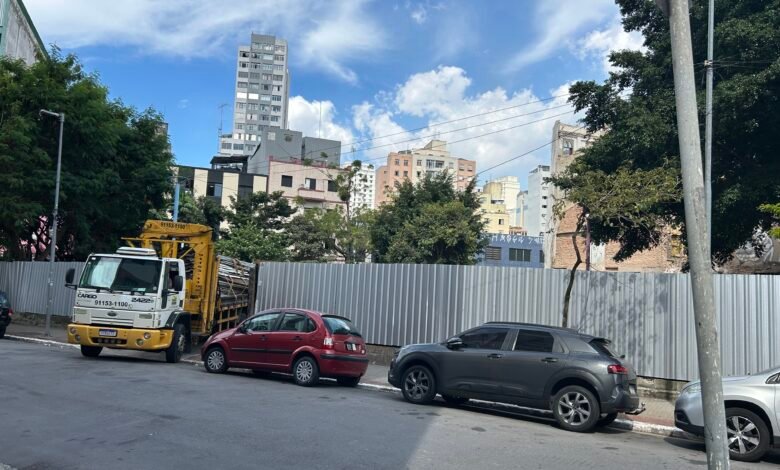
After winning an initial ninety-day extension to leave the lot, Teatro do Contêiner won an additional ninety-day extension to continue utilizing the premises as a theatrical space until December 2025, but this was understood to mean that the theatre company would wrap up their theatrical activity on the site while dialogue about the site might continue with the city. The municipal government offered less than 5 percent of what reconstruction would cost. The city eventually cajoled Cia. Mungunzá into an agreement about Teatro de Contêiner. In December 2025, both parties signed the agreement to relocate to a different lot in the city, but with the company lacking funds it reached further deadlock with the city about how they would move the facilities. After the contract was signed, the city stopped speaking with the company entirely. In January of this year the doors to the theatre were sealed by the city. In mid-March the city carried out the destruction of the theatre. As far as the theatre company’s members are aware, there was no project plan. They don’t know what contract was used to authorize the demolition, are unaware of a permit number, and do not know the technical engineer. (The office of the Secretário Municipal da Cultura did not respond to a request for comment.)
Bêda implored that the city and state provide them with space for the theatre again. The Ministério da Cultura (Ministry of Culture) of the federal government is currently housing the Cia. Mungunzá, and the company is even engaging them to assist in finding a site for the Teatro do Contêiner in order to rebuild it.
When asked what theatre artists locally and globally can do support the theatre in this time, Bêda listed a series of other theatres and popular cultural institutions in São Paulo being attacked by the municipal government: Teatro Vento Forte, Centro de Capoeira, Teatro União e Olho Vivo, and Samba do Cruz. He attributes this to an international lust for “higienização” (cleaning up cities), a word that falls flat in contrast to his preferred term of “esterilização” (sterilization), which implies zapping them entirely of the ability to produce life. He insists on the global need to resist the logic of markets:
We Brazilians know the direct connections of the President of the United States, Trump, to the real estate market.
This financialized and real-estate logic has global impact. And the ideological model of the United States president is advancing strongly in countries where colonial power structures are maintained.
The relationship between Tarcísio de Freitas [the right-wing governor of the state of São Paulo], Trump, former president Bolsonaro, and his sons—who are seeking the Brazilian presidency—is extremely important, because United States-style political campaigns are also being financed here in Brazil, while these atrocities are carried out and sold as political achievements to a segment of the far right.
After inquiring about the process of destruction less than two weeks when it occurred, I ask Bêda what hope he can summon for Teatro de Contêiner and theatre writ large:
So we know that wherever there is ground, there will be theatre. And where they take away the ground from us, we will have the sky.
Theatre, as a form of human existence, is indispensable. Theatre is eternal… We are, in fact, going to rebuild Teatro do Contêiner Mungunzá.