The musical theatre writers, playwrights, choreopoets, and librettists we serve stand exactly where all of these barriers cut deepest. You can draft a monologue, a scene, or a song at a kitchen table. You cannot learn to build a musical, opera, or choreopoem there. The form demands rooms, collaborators, a piano and the hours to sit at it, mentors who already know how—the whole costly apparatus a conservatory or an MFA controls. It is the most resource-heavy craft to learn inside the most expensive art form, which means the book writers, lyricists, and composers are shut out of that training before they begin. And in the country that exports the American musical to every stage on the planet, there was no program I could find where top industry professionals teach the form to Latine and Caribbean writers for free. The people with the least access are reaching for the hardest thing to learn, in the tradition that owes them the most.
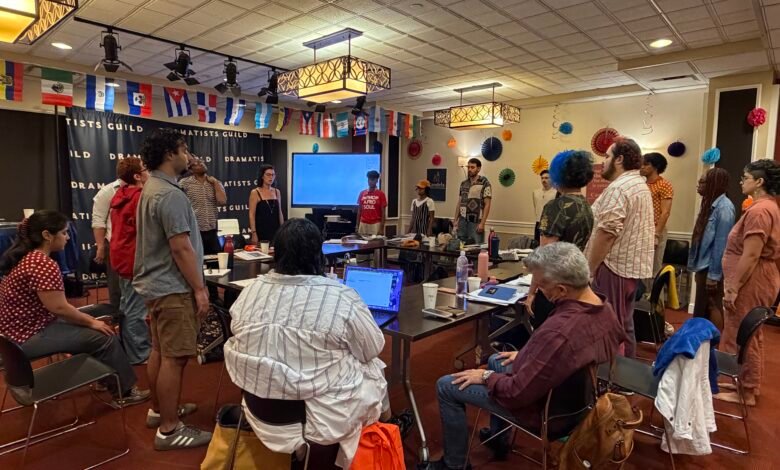
Candela is what I built instead of waiting for permission, and it is free to every fellow because training this necessary cannot only be sold to the people who can already afford it. It is an arts education program, not a development lab turning out finished musicals, and it works upstream, before the professional field’s gatekeeping decides who counts. In 2024, my program co-director, Dr. Daphnie Sicre, joined me, as did a major institutional partner, the Latinx Theatre Commons, and together with our long-term partner, the Dramatists Guild of America, we have welcomed sixty-two fellows from more than two dozen countries and territories. For a week they study, through workshops, masterclasses, craft talks, and panels with working professionals, taught in a way that treats their culture as material, not obstacle, inside a cohort built to outlast the week. The musical is not our only form; Candela trains playwrights, librettists, choreopoets, composers, and we treat the play, the opera, and the chorepoem as seriously as the book musical.
The mentors have included Pulitzer and Tony winners—artists who usually teach only inside the rooms that cost the most, and who here teach for free to writers who could never have bought their way in. The training is holistic on purpose. We teach craft alongside financial literacy and labor rights, because an artist who does not know the terms of their own work will be handed someone else’s, and because a career has to be survivable to be a career. The goal is not only to make the art but to keep making it, with dignity, on terms you had a hand in setting. We give fellows the network the most expensive programs sell and a seat at the table with no conditions attached. We ask for nothing back. Fellows have gone on to develop work with places like the Eugene O’Neill Theater Center, premiere plays and musicals in New York and around the country, tour productions overseas, win grants, and start collectives of their own.
That seat we offer is not as a colorblind welcome—colorblindness is the very thing that failed our artists. Candela does not stop seeing race. It holds the differences inside the diaspora without ranking them, and it treats the region’s full inheritance as legitimate artistic material. Our fellows are queer and straight, trans and cis, of many faiths and of none, and none of that is checked at the door. In our classrooms Portuguese sits beside Spanish, Kreyòl beside English, French beside Papiamento, Quechua beside languages older than the empires built on top of them. Jamaican Patois is not a dialect waiting to be translated but a living artistic language. Code-switching becomes a technique. Multilingual writing becomes dramaturgy. When a Brazilian writer, a Haitian writer, and a Jamaican writer study one another’s traditions in the same room, difference stops being a border and becomes a relation, and the field itself gets bigger. The makers who have been shoved to the margin by a Spanish-only Latinidad are not merely welcomed here. They are centered. That is what it actually looks like to serve the whole hemisphere that a word like Latino or Latine claims to hold. New York hands us the map for a room like this: The Endangered Language Alliance has documented more than seven hundred language varieties across over twelve hundred sites in the metro area. If Candela reflects even a sliver of that, we are doing something right.