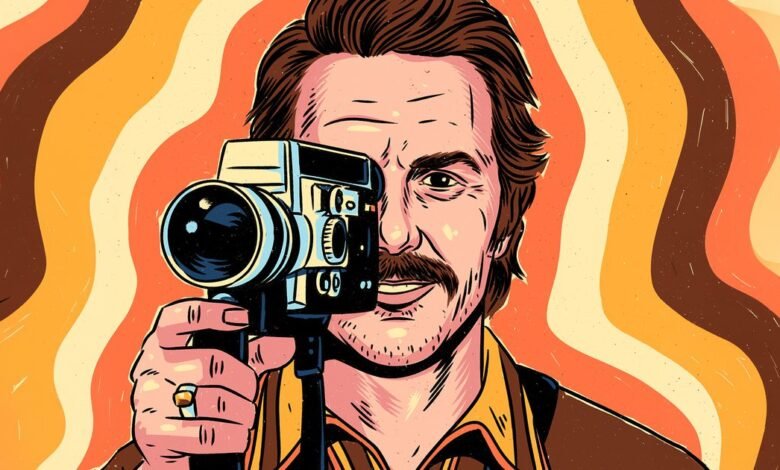

In his fourth collaboration with Martin McDonagh, Sam Rockwell has become one of the director’s most reliable vessels for moral chaos. Their latest, Wild Horse Nine, finds him in unusually restrained territory, playing an unhappily married CIA operative whose time in Rapa Nui becomes entangled with friendship, regret and redemption. He talks to LWLies about what draws him to complicated characters, and what happens when you put them in complicated times.
LWLies: How do you pick your roles? When you are going to be in a movie it could be anything.
Get more Little White Lies
Rockwell: Well, I’ve been very lucky.
You think it’s down to luck?
It’s luck and, I guess, taste. But it’s emotional taste, sort of what strikes you emotionally.
This film is very complex emotionally.
What came up for you emotionally?
I’m always one minute away from an existential crisis, but I guess it was questions of legacy, remorse and maybe fears of being too late to really atone.
You’re in the perfect demographic we were going for – people close to an existential crisis. Because that’s exactly the way to approach this particular movie, to come in and be open to something like that, just see what it brings up. And Martin is great at these buddy movies. The Banshees of Inisherin was really a love story about a break-up. But this one, I still don’t even know. I don’t know if this is more father-son or buddies or a love story too.
Your fourth time working with him, and might this be your first Martin McDonagh love story?
I think so. Although I’m sort of in love with Colin [Farrell] in Seven Psychopaths, I suppose. But it’s not requited. I watched Kathy Bates in Misery for that a little bit. That was unhealthy love, an unhealthy obsession with Colin’s character.
What did you watch for this? Such a good year for films, 1973.
There was some Nicholson stuff. Five Easy Pieces, that was a reference, and Midnight Run was an influence. The Passenger is an interesting film to think about. Historically, I was a bit ignorant about it, so I found out about Pinochet. I watched and rewatched documentaries. I remembered seeing a Costa-Gavras movie when I was a kid called Missing, with Jack Lemmon and Sissy Spacek.
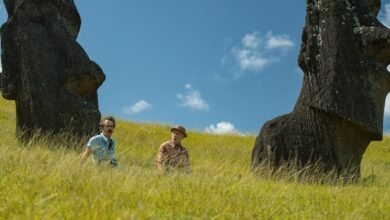
There was such a sense that these statues were there long before us and will be there long after us. Again, existential crisis. What is it like being in their presence?
Well, they’re amazing. They have these rangers there who watch over them. You can’t get too close or touch them, and there are tourists everywhere, who looked so small because they were enormous. Sometimes you’d sort of casually maybe try to lean on one and they said, ‘No, no, can’t do that.’ They’re just big heads, as they say, but the Moai are sacred.
I want to go see the big heads now.
I think a lot of people will watch this and want to see the big heads. It’s a great culture, the Rapa Nui culture. They have their own language. I was so busy learning Spanish, then I wanted to learn Rapa Nui, and then I gotta learn my lines. There were stray dogs everywhere that we’d feed leche. And horses. Wild horses. And the most beautiful sunsets I’ve ever seen in my life were at that hotel. And I also found some weird spider crab in my trash can.
Huh. Is he still doing okay?
I escorted him outside, but I don’t know what happened to him. I’m assuming a crab and not a giant spider or something bad.
I guess when you’re in an existential crisis, everything feels like a symbol.
Exactly. What did John say about the whole thing?
He was very complimentary about you.
Oh, that’s nice. He’s not so bad himself.
Do you think because you both have that traditional background and training on the stage you were able to work together better?
Absolutely. He told me Steppenwolf stories and we ran lines and rehearsed in the theatre. I mean, he’s one of my heroes. John has always had what my acting teacher called ‘emotional power’. There’s a kind of explosiveness. There’s, like, a volcano in certain actors. There’s an accessibility to their emotional life. Mike Nichols said that Phil Hoffman had the emotional equipment, some actors have that times ten, and John has that.
Do you feel being paired with him brought out anything in you?
I do. Whenever I’m matched with an actor like that, like Frances McDormand or Laurence Fishburne or Gene Hackman, you can’t dominate, you can’t try to overwhelm, you have to play tennis. You’re not gonna win the acting contest, you know what I mean? With an actor like John Malkovich, you have to leave space for that volatility, that force. There was a moment at the Public Theater [New York], we were rehearsing, Martin McDonagh, me and John. Martin politely said to John, ‘Could you turn up the heat a little on this one line?’ And he just turned it up the way he does, and it was incredible. Martin and I looked at each other like, ‘Wow, we just got front-row tickets to that.’
Something I get slightly annoyed with is you are so often described as ‘scene-stealing’. I know that’s a compliment, but it seems wrong.
Thank you! That’s very acute of you to say that. I’m glad you got annoyed because that’s a misnomer about actors. I think there are a lot of misnomers about actors. There’s one that they’re good liars. Actually, really good actors are terrible liars. They don’t have good poker faces. If they do, they’ve learnt that somewhere else. Because acting training is not about a poker face, acting training is meant to break you down so that you are as transparent as a child. And that’s really what you’re building from.
There is this specific worldview of the film, where all these huge events are secret plans that were perfectly executed by the CIA. Does that fit your worldview?
I’m not a big conspiracy person, but it’s great for drama and comedy. Originally these guys were actors. Martin’s first draft, he wrote them as actors, and then he changed it to CIA, but it might as well even been in the Mafia. A lot of Martin’s material comes from Harold Pinter’s ‘The Dumb Waiter’, all Mafia movies are basically notes on ‘The Dumb Waiter’.
With your character documenting so much on film, did you feel like you were in some ways playing Martin?
Sometimes they had Lee be the observer. And that was part of my job as sort of the straight man. At first I’m just an observer, and then I get more involved through John’s character. So much changes with Steve Buscemi’s arrival, ’cause I’m a company man until I’m not. Lee is really tortured and trying to figure out the right thing to do. I don’t know if Martin sees himself in it, but it’s definitely different from what Martin usually writes for me. He usually writes wackier characters for me.
How does that feel for you?
I think that he thinks I can pull it off. Martin has high regard for me and I have high regard for him. He thinks I can pull off the complexity of somebody who is not just one thing, that it’s possible to be a dummy and be smart at the same time. That’s something that’s not really around as much as it was in the Seventies. Taxi Driver, Badlands, Five Easy Pieces… Do we make enough movies about assholes where you sympathise with them? I don’t know if that exists as much now. But it’s coming back. I think that complexity is coming back.
Politically complex times can lead to very interesting art.
Yes, but I think Europe’s probably better at that than America. Think of that great German actress Sandra Hüller. She’s pretty great at that complexity. And as an actor I think you wanna play all the parts. You wanna be Hamlet, but you also wanna play Richard II.
Are you at all concerned that you’re now going to spend the rest of your life having people asking you to spell Czechoslovakia?
That would be hilarious, I would love it. But I still can’t spell Czechoslovakia. Can you spell it?
Yeah. I had to double-check but it’s just phonetic after you get past the first five.
Really?
The first five letters are C‑Z-E-C‑H, and then it’s ‘oslovakia’.
Oh, got it. Got it.