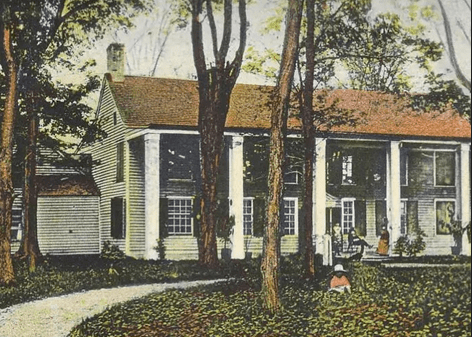
 As the 250th anniversary of the Battles of Saratoga approaches, the story of General Philip Schuyler’s house stands as a powerful testament to the resilience of early Americans during the Revolutionary War.
Located in Schuylerville, in Saratoga County, New York, this historic estate embodies the struggle, sacrifice, and determination that shaped a new nation.
A Strategic Estate Destroyed
The Schuyler House originally stood as a grand estate along the confluence of Fish Creek and the Hudson River. Built around 1763, it functioned as the fulcrum of Schuyler’s agricultural and milling empire, supporting local agriculture and the fledgling economy of the area.
The Schuyler family (with the labor of indentured and enslaved people) was instrumental in developing the Village of Saratoga — now known as Schuylerville — into an agricultural and industrial hub that relied on milling, farming, and fishing.
Fish Creek was central to this development, housing the milling and fishing operations that sustained the Schuyler estate and served the broader colonial community.
The Schuyler House endured its first destruction during King George’s War, demonstrating the vulnerability of such strategic sites during periods of conflict. However, it faced its most significant devastation during the American Revolutionary War.
On October 10, 1777, British Lieutenant General John Burgoyne made a fateful decision after retreating from the defeat at the Battles of Bemus Heights; he ordered his troops to burn the Schuyler House and 24 surrounding buildings.
This act was not random, but a calculated military strategy known as “scorched earth.” By destroying the estate, Burgoyne aimed to deprive American forces of valuable resources and damage their morale.
British Lieutenant William Digby noted that they burned the house “to prevent a lodgment being formed behind it.” The destruction was extensive, targeting the main house and the mills, barns, and storehouses crucial to the local community.
 Rebuilding with Determination
No sooner had the smoke cleared than Schuyler began to plot the rebuilding of his home. In a letter to Colonel Varick dated October 12, 1777, Schuyler expressed the urgency of his mission.
He wrote that he had sent enslaved individuals to the ruins of the burned house to salvage iron nails and other structural supplies essential for the construction of the new house, as iron was scarce during the war.
Schuyler emphasized his commitment to rebuilding, stating, “I intend immediately to have my mills rebuilt and some house erected.”
Construction commenced a mere two weeks after Burgoyne’s surrender on October 17, 1777. Schuyler mobilized a diverse labor force, which included carpenters and engineers from American General Gates’ army, local craftsmen, prisoners of war, and enslaved individuals from his estate.
The inclusion of enslaved individuals in this labor force highlights the complex and often painful legacy of slavery in American history. Their forced labor played a critical role in the reconstruction efforts, reminding us of the moral contradictions that characterized the pursuit of liberty during the Revolutionary era
.
The salvage and reuse of materials from the ruins were vital; timber from the estate’s upper sawmill — the only structure left intact — provided the backbone for the new construction. Iron nails, hinges, and stone salvaged from the ruins were utilized, illustrating an early example of resourcefulness and respect for the historical significance of the original structure.
The rebuilding efforts were impressively rapid. It is reputed that the house was reconstructed in only ten to sixty days after the fire. This collaboration between Schuyler’s mobilized workforce and the military personnel underscores the community’s collective determination to restore what had been lost.
According to Schuyler’s letters, the house was completed in a rough state by November 30, 1777. On November 4, he informed Congress of his progress, saying, “In less than twenty days, I shall nearly complete a comfortable house for the reception of my family.”
In a letter to a friend, Schuyler detailed the construction timeline: “On the first instant [November 1] I began a house, on the 19th I had two rooms and Cellar Kitchen finished, and on the 30th Instant I shall discharge my carpenters.”
Furthermore, in a letter to John Jay in November 1777, he reflected on his aspirations for a quieter life, expressing his enthusiasm for country living and his intent to distance himself from the “noise and bustle” of public life.
The new house was notably different from the original; smaller and more modest, it measured just sixty by twenty feet. Schuyler described it as “cheaply and speedily erected.”
In an incredible display of efficiency, he aimed to complete a “comfortable house for the reception of my family” within twenty days, demonstrating not only his determination but also his practical approach to rebuilding in the face of adversity.
A Complex Historical Landscape
The rebuilding process reveals the complex social fabric of revolutionary America. The workforce included local laborers, captured British soldiers skilled in masonry, and enslaved individuals whose forced labor was critical to the construction.
This nuanced history serves as a reminder that the pursuit of liberty coexisted with the brutal reality of slavery, and it compels us to recognize and honor the legacy of enslaved individuals whose contributions are often overlooked.
Perhaps most remarkable was Schuyler’s interaction with Burgoyne after the surrender. Despite the destruction of his estate, Schuyler hosted the defeated British general in his Albany mansion, demonstrating a remarkable sense of military honor and diplomacy typical of the era.
This act was more than mere courtesy; by treating his enemy respectfully, Schuyler showcased the emerging American leadership’s commitment to principles beyond vengeance—a subtle but important strategy in garnering international support for the revolutionary cause.
 A Living Memorial Today
A living memorial today, the Schuyler House is a museum within Saratoga National Historical Park. Visitors can walk through a structure that literally contains layers of history — from the original stones and timbers to the marks of patriot labor, British craftsmanship, and the often-overlooked contributions of enslaved workers.
The house is more than a building; it’s a microcosm of the Revolutionary era, embodying the complex interplay of military strategy, personal sacrifice, and the ongoing struggle for freedom.
As Saratoga approaches its 250th anniversary, the Schuyler House reminds us of the values that shaped our nation. It stands as a powerful symbol of resilience — of the ability to rebuild, adapt, and move forward in the face of tremendous challenges.
The story of this house is ultimately a story of hope. It speaks to the unbreakable spirit of those who fought for independence, who saw beyond immediate destruction to a future of possibility.
In its stones and timbers, we can still hear the echoes of a revolution that transformed a collection of colonies into a new nation.
As we commemorate this milestone, the Schuyler House invites us to remember not just the grand moments of history but also the daily acts of courage, adaptation, and resilience that truly define a people’s journey to freedom.
Schuyler House, rebuilt in 1777 (postcard ca. 1900); Emanuel Leutze’s (1816–1868) fanciful 1852 painting of Catherine Van Rensselaer Schuyler (1734-1803), wife of General Philip Schuyler, setting fire to her wheat fields to keep them from the enemy, whose arrival is announced by a messenger; and Schuyler House during a recent candlelight tour.
This essay is presented by the Saratoga County History Roundtable and the Saratoga County History Center. Follow them on Twitter and Facebook.