 In the summer of 1919, groundskeepers at old Fort George at the south end of Lake George discovered what was then called a “hand made spade” that dated to colonial times.
The artifact was uncovered during routine maintenance of the grounds around the fortification, whose construction was begun by British General Jeffery Amherst’s engineers in 1759. The find was made several feet below a large tree stump that was dug up by maintenance workers.
Based upon a 1919 newspaper description, it was not reported if the spade was fashioned entirely from iron or wood or if it was of composite assembly.
Furthermore, it is unclear if the blade head was rectangular in shape, which was normal for most spades, or if its blade end was slightly curved or somewhat pointed like a shovel.
A spade generally had a shorter wooden handle with a D-shaped grip. Moreover, a spade was primarily for cutting through grass and edging, whereas a shovel was generally for lifting dirt.
The Remains of Fort George
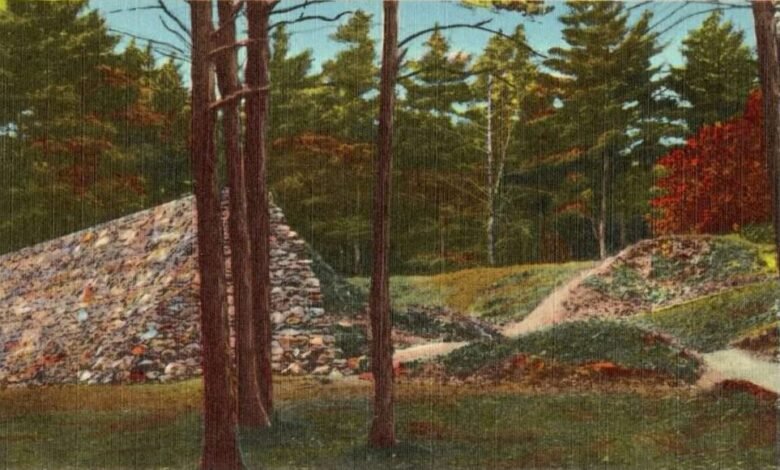
Today the remains of Fort George, named after British King George II (1683–1760), lie in Lake George Battlefield State Park administered by the Department of Environmental Conservation (DEC). The former fortified garrison was occupied during the latter half of the French & Indian War (1755–1763) and throughout the American Revolution (1775–1783).
After the revolution, one of the site’s buildings was used as a tavern. Moreover, parts of the fort’s stone walls were later salvaged for construction materials for area buildings.
 Over the years, Chestertown archaeologist Dr. David Starbuck (Plymouth State University), now deceased, directed excavations at Fort George and also at nearby Fort William Henry.
Starbuck’s fieldwork at Fort George was conducted under permit from the state. It is illegal to remove historic artifacts from state grounds without a state permit.
When the colonial-era spade was found in 1919, it was turned over to William Cheney, one of the state property’s caretakers.
The spade was found during a time when the New York Historical Association, then based at Lake George, was considering restoring Fort George as some of its walls had tumbled down.
At that time, the society, which later moved to Cooperstown and is now defunct, was waiting for local stonemasons to provide an estimate on “rebuilding the walls” of the 18th-century military installation.
Furthermore, in 1919, there was an expectation that stone pillars with “attractive signs” would be erected around Fort George and that electric lights would be added to illuminate a monument and the stone remnants of the fortification.
Moreover, fireplaces would be installed “for tourists.” It was also reported that cannons were to be “secured for the battle grounds” and a museum would be established near the 18th-century fort.
Over the years some of those suggestions were enacted, but no historic or replica cannons were installed on the property’s restored stone bastion or the property’s green space.
A version of this article first appeared on the Lake George Mirror, America’s oldest resort paper, covering Lake George and its surrounding environs. You can subscribe to the Mirror HERE.
Illustrations from above: A postcard from circa 1930–1945 showing the remains of Fort George at Lake George, including the restored corner bastion (Boston Public Library-The Tichnor Brothers Collection); and an early 20th century photograph of the Ephraim Williams Monument at the old Fort George grounds with Lake George in the background (Library of Congress).
.
Source link